
Buying in Bungalow Heaven
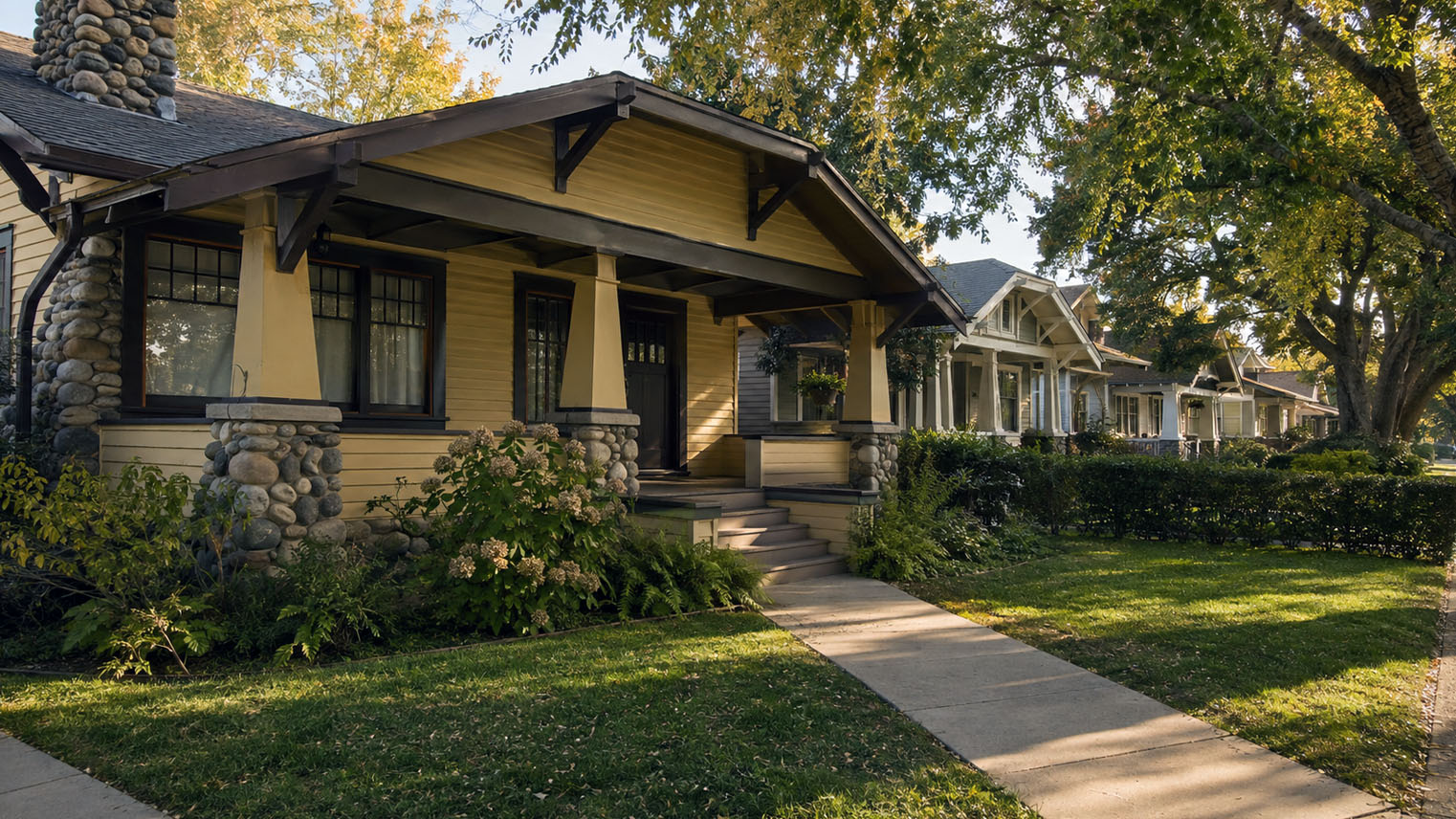
Bungalow Heaven is a 16-block landmark district in north-central Pasadena built almost entirely between 1888 and 1929. It contains 522 contributing buildings by the National Register’s 2008 count, most built between 1905 and 1920, and was designated Pasadena’s first locally protected landmark district in November 1989. The National Register added the historic district to its rolls on April 10, 2008. The district trades thin by design: roughly 1,100 properties inside the district lines, few of them for sale at any moment, most held for decades. That scarcity, not any month’s pricing, is the first fact of buying here.
Buyers should expect three things up front. First, the landmark district designation governs anything visible from the street. Exterior changes (windows, doors, porches, siding, additions, garages) require a Certificate of Appropriateness before any permit is issued. Interior work, paint, landscaping, and routine maintenance are exempt. Second, most contributing properties are Mills Act eligible, and the City of Pasadena has an active Mills Act program. A Mills Act contract typically cuts annual property tax substantially in exchange for a 10-year rolling maintenance and restoration commitment. Third, the housing stock is genuinely old. Buyers planning a clean move-in should budget for inspection findings around foundation (most are unreinforced concrete or shallow brick), knob-and-tube wiring remnants, galvanized supply lines, and original single-pane wood-sash windows that the district will not let you replace with vinyl.
How this market behaves
The district runs to roughly 1,100 properties by the American Planning Association’s 2009 count, with the National Register listing counting 522 contributing buildings plus 164 non-contributing within its own mapped boundary. Most do not change hands often. Turnover is sale by sale, and the durable pattern is a condition spread: restored homes with documented original character pull premium prices, and deferred-work homes sit longer and settle for less. Aggregate medians blur that spread, which is why they tell you little here.
Speed here is a function of condition, not calendar. Move-in ready restorations with documented mechanicals and a clean inspection draw the fastest sales. Homes with active permit issues, missing original features, or unreinforced foundations sit longer and settle further below asking. Sell Odds on any specific Bungalow Heaven contributing bungalow is heavily a function of restoration state, original-feature inventory, and whether the seller has a Mills Act contract in place. The aggregate median tells you very little about a specific target property.
What you are actually buying
The dominant style is Craftsman, but the inventory inside the district splits into recognizable subtypes:
- California bungalow. One or one-and-a-half stories, low-pitched roof, deep front porch supported by tapered columns on brick or river-rock piers, exposed rafter tails, wide eaves with knee braces. 1,000 to 1,800 square feet is typical.
- Airplane bungalow. A California bungalow with a small upper sleeping room rising above the main roof, often with windows on three sides. The name comes from the cockpit-like upper massing.
- Swiss chalet bungalow. Steeper roof pitch, jigsawn bargeboards, balcony rails, and decorative half-timber elements. Less common but well represented.
- Two-story Craftsman. Larger and rarer in the district. These were generally architect-designed (Sylvanus Marston and others practiced locally), and they trade at the top of the price range.
Scattered Spanish Revival, Mediterranean Revival, Tudor Revival, and Colonial Revival homes built between 1910 and 1929 also sit inside the district lines and contribute to the National Register listing.
Interior detail you should expect on a well-preserved Craftsman bungalow: boxed beams or exposed ceiling joists in the main rooms, picture rails, redwood or Douglas fir trim, built-in cabinetry around the dining room (sideboards, china cabinets, plate rails), an inglenook or built-in benches flanking a brick or clinker-brick fireplace, mortise-and-tenon doors with original brass hardware, and leaded or art-glass cabinet windows. Many of the district’s homes retain Ernest Batchelder tile around the firebox, since Batchelder’s Pasadena studio supplied tile to local builders during the district’s main building period. For the full vocabulary of period-correct features, see the Craftsman style entity.
The landmark district reality
The district is governed by a Conservation Plan adopted with the 1989 designation and administered by Pasadena’s Historic Preservation Commission and Design and Historic Preservation counter at the Permit Center. The rules in practice:
- Anything visible from the street triggers review. Windows, doors, porches, siding, roof material, additions facing the street, new front-yard hardscape, and front-facing accessory structures.
- Anything not visible from the street is generally exempt. Interior remodels, rear additions that do not break the front-facing roofline, mechanical upgrades, landscape work behind the house, rear-yard ADUs.
- Replacement-in-kind is the easier path. Original wood windows can be restored or replaced with matching wood-sash units. Vinyl windows are not approvable for street-visible elevations.
- Demolition of a contributing property is effectively off the table. The downzoning that emerged from the 1985 demolition fight (the trigger event for the district’s creation) made teardowns economically unworkable inside the district.
For buyers planning a renovation, the practical sequence is: close, file the Certificate of Appropriateness application for any street-visible work as the first move, and run interior and rear-yard work in parallel on a normal building permit. The Certificate process typically adds four to eight weeks to a project timeline. Plan for it.
Mills Act in Bungalow Heaven
Pasadena participates in the California Mills Act program, which trades a 10-year rolling maintenance and restoration commitment for a property-tax assessment based on income capitalization rather than market value. For a recently purchased contributing property the annual savings can be meaningful, but the exact savings vary by property and are set by the county assessor through the Mills Act capitalization calculation against the buyer’s new Prop 13 base. For a long-held property with a low Prop 13 base, the Mills Act calculation may produce smaller savings or none at all.
Mills Act in Pasadena is not automatic. The owner applies, the city reviews the property’s historic status and current condition, the owner commits to a 10-year work plan, and the contract is recorded against the title. The contract auto-renews annually unless either party gives notice. Buyers who acquire a property with an existing Mills Act contract inherit it.
A property already in a Mills Act contract carries a tax-savings premium in the sale price. A property eligible for Mills Act but not currently in the program is a buyer opportunity, since the new owner can apply post-closing and capture savings from year one. For the full mechanics, application timeline, and city-by-city treatment across the San Gabriel Valley, see Mills Act in the SGV.
Due diligence for a Bungalow Heaven purchase
A first-pass inspection on a Bungalow Heaven bungalow should look for the same items that a general Pasadena pre-war inspection would catch, with three district-specific additions.
The standard pre-war findings to expect:
- Foundation: most original foundations are unreinforced concrete or brick. Seismic retrofit (cripple wall bracing, sill bolting, anchor plates) is often partial or absent. Budget $15,000 to $35,000 for a full retrofit on a typical 1,400-square-foot bungalow.
- Electrical: original knob-and-tube wiring is rare in active service in 2026 but does show up in attic spaces and accessory structures. A 100-amp panel is the floor; many homes still have 60-amp service.
- Plumbing: galvanized supply lines from the 1910s and 1920s corrode internally and reduce flow. Cast-iron waste lines crack at hub connections. Re-pipe to copper or PEX runs $12,000 to $25,000 depending on access.
- Termite: California subterranean termite is endemic. Original mudsills and porch piers should be probed during inspection.
The district-specific additions:
- Original windows. A Bungalow Heaven home with original wood-sash windows in good condition is more valuable than the same home with vinyl replacements. A home that lost its originals in a previous remodel is harder to bring back into compliance for any future street-visible work.
- Built-ins and original casework. Original boxed beams, built-in sideboards, picture rails, and inglenooks add real value and are hard to replicate. Walk every room with the listing photos in hand and confirm what is original versus what was removed and faked.
- Roof material and porch posts. Original wood-shingle roofs are rare survivors and command premium. Tapered porch columns on river-rock or clinker-brick piers should be inspected for structural rot at the post base, which is common after a century of California weather.
Restored and faked can look identical in listing photos, and a district that pays a premium for original character invites the fake; the tells are itemized in Buying a flipped Craftsman: red flags.
For the broader Craftsman-era buyer due diligence framework, see architectural home buyer due diligence.
Common questions
How many homes are in Bungalow Heaven? It depends on the boundary and the unit, which is why the published figures differ. The National Park Service registry counts 522 contributing buildings plus 164 non-contributing within the National Register boundary set in 2008. The American Planning Association put roughly 660 of the district’s 1,100 properties inside that listing in 2009, and the Madison Heights association’s comparison of Pasadena landmark districts counts Bungalow Heaven at 1,139 properties. The neighborhood association’s broader area includes more.
How big is the district? Approximately 16 blocks in a compact rectangle in north-central Pasadena. The neighborhood association cites Orange Grove Boulevard (south), Washington Boulevard (north), Lake Avenue (west), and Hill Avenue (east) as the bounding streets.
What is the typical price? No single figure is honest here, and the published aggregates blur the spread that actually sets price in the district. The honest range depends on the property’s restoration state, original-feature inventory, and Mills Act status. A move-in ready restored bungalow with documented mechanicals and original built-ins trades at the top of the range; a project home with deferred work trades well below.
Can I replace the windows? Original wood-sash windows can be restored or replaced with matching wood-sash units. Vinyl windows are not approvable for street-visible elevations. The Pasadena Historic Preservation counter has approved fiberglass or aluminum-clad wood as alternates in specific cases. Confirm with the counter before ordering.
Can I add an ADU? Yes, in most cases. The statewide ADU framework applies to Bungalow Heaven, and the city is generally accommodating for rear-yard ADUs that do not impact the front-facing historic fabric. The detached two-car garage that came with most original bungalows is the natural ADU candidate. Conversion of an original garage that is itself a contributing structure requires extra review.
Is Bungalow Heaven a good investment? The district has held its price premium over adjoining Pasadena neighborhoods consistently since 1989, and the landmark protection caps the supply ceiling. The practical downside is the illiquidity of a small market and the higher carrying cost of period-appropriate maintenance. Buyers who want a primary residence with character and property-tax relief via Mills Act are the natural fit. Pure investment buyers expecting fast appreciation are the wrong fit.
Who should I talk to about buying in Bungalow Heaven?
Greg Anderson of Arroyo Casa. I am the REALTOR behind Arroyo Casa, and I represent buyers of architectural and character homes across Pasadena and the San Gabriel Valley. This district asks three things an ordinary purchase does not: patience, because turnover is thin and the house you want may not list this year; a reading of the street-visible review rules before you plan a single change; and an honest estimate of what period-appropriate maintenance will cost you after closing. I built and remodeled homes for twenty years and I have held a California real estate license since 1990, so when we walk a bungalow here I am pricing the work as well as the house. When one comes up, send me the address on the Arroyo Casa contact form and we will look at it together.
Last updated