
The Architects
of the San Gabriel Valley
The twenty-three named hands behind the San Gabriel Valley's architectural inventory, from Greene and Greene to Wallace Neff to A. Quincy Jones, documented by name and by work.
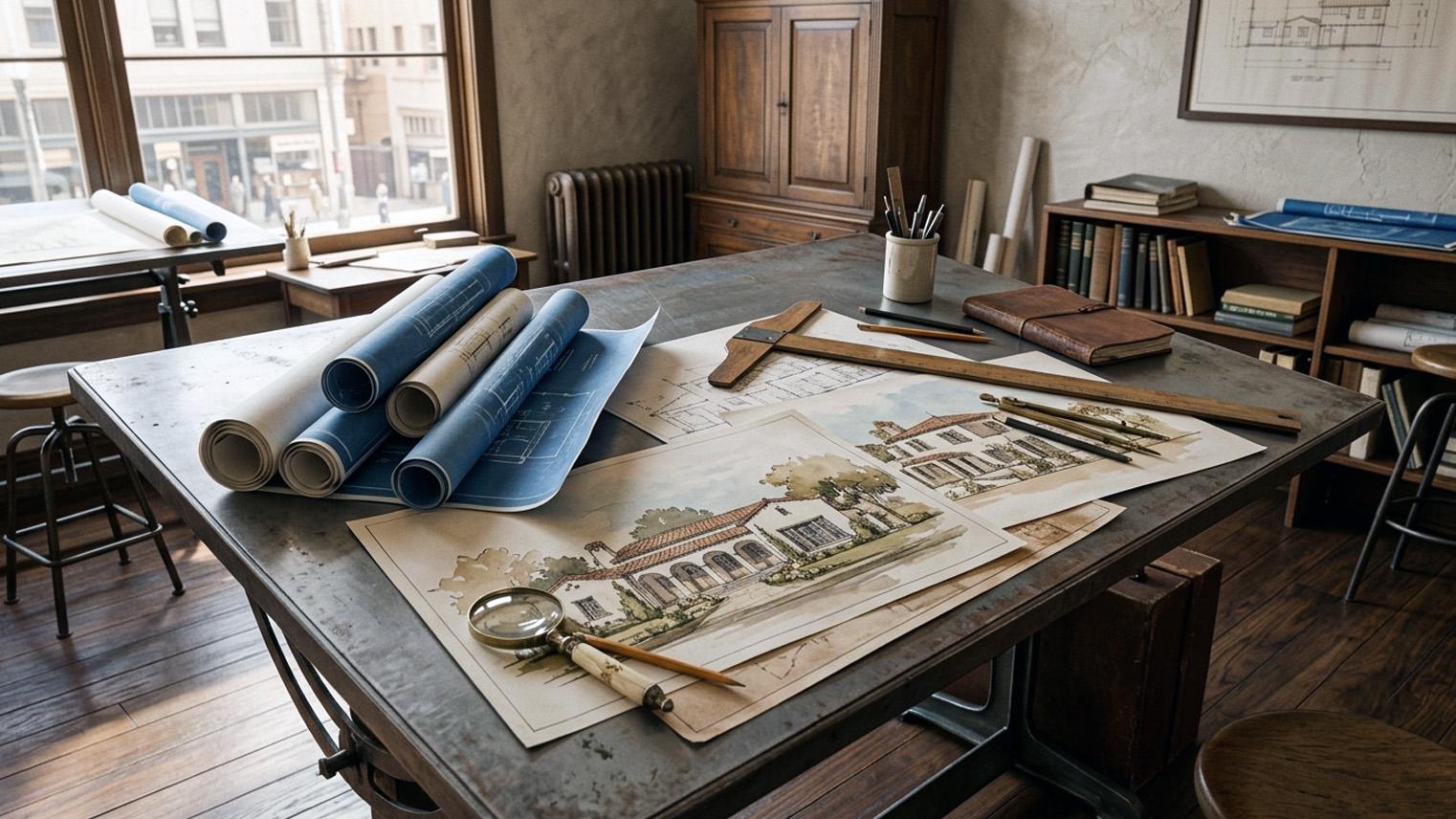
The San Gabriel Valley’s architectural inventory is not anonymous. It carries twenty-three named architects and firms who built here, and this pillar carries them by name. Craftsman houses signed by Greene and Greene sit two miles from Wallace Neff estates. Myron Hunt planned campuses and clubhouses that still anchor the civic character. Sylvanus Marston, working alone and later in partnership, put more houses on the ground across the deep band than most single practices in the valley’s history. This pillar is the roster of the hands behind the built inventory, each with a canonical page carrying career arc, notable works still standing, and the sources that anchor the record.
I have held a California real estate license since 1990. I built houses and remodeled them for twenty years, and finish carpentry is the trade I know deepest. I read houses the way a builder reads them and I read architects the way the record reads them: what they drew, what they built here, what survives, what was documented at the time and what is documented now. Arroyo Casa is my real estate practice, and this pillar is the reference layer that grounds every architectural claim on the site in a named hand and a documented source.
How many named architects built in the San Gabriel Valley?
Twenty-three canonical entries carry the roster: nineteen individual architects and four partnerships presented as firms, Greene and Greene, Heineman and Heineman, Smith and Williams, and Buff and Hensman, with the partners covered on the firm’s page. Counted by documented hands, the record runs to twenty-five architects and firms, because Charles Sumner Greene and Henry Mather Greene stand documented in their own right within the Greene and Greene page. Every entry carries a canonical page.
- A. Quincy Jones
- Arthur Burnett Benton
- Bertram Grosvenor Goodhue
- Buff and Hensman
- Cyril Bennett
- Elmer Grey
- Frank Lloyd Wright
- Frederick Louis Roehrig
- G. Lawrence Stimson
- Garrett Van Pelt
- Gordon B. Kaufmann
- Greene and Greene
- H. Roy Kelley
- Heineman and Heineman
- Joseph J. Blick
- Myron Hunt
- Paul R. Williams
- Reginald Davis Johnson
- Roland E. Coate
- Smith and Williams
- Sylvanus Marston
- Wallace Neff
- William J. Dodd
Which architects defined Pasadena’s Craftsman era?
Greene and Greene set the standard the movement is remembered by. Heineman and Heineman built Bowen Court, among the earliest and largest bungalow courts in Pasadena, part of the court form that gave the vocabulary its middle-class reach. G. Lawrence Stimson, Joseph J. Blick, and Frederick Louis Roehrig worked across Craftsman and the Mission Revival that arrived in the same decades. Sylvanus Marston’s early practice sits in this generation, with the trained successors Garrett Van Pelt and Cyril Bennett building out the concentration that made Pasadena the center of the American Craftsman movement. The 1900s and 1910s were the boom years, and every hand named here carries a canonical page.
Which architects shaped the Period Revival decades?
Wallace Neff, Roland Coate, and Myron Hunt lead the largest cohort on the roster. Neff shaped the Spanish Colonial Revival estate in San Marino and Pasadena more than any other single hand. Coate worked the Monterey Colonial and the Spanish Colonial Revival in the same neighborhoods. Hunt carried Italian Renaissance Revival and Mediterranean Revival across estates and civic buildings. Gordon B. Kaufmann, Elmer Grey, H. Roy Kelley, Reginald Davis Johnson, Paul R. Williams, Cyril Bennett, and Garrett Van Pelt round out the Mediterranean and Spanish Revival group. Arthur Burnett Benton and William J. Dodd carried the Mission Revival vocabulary that ran alongside. Marston’s mature practice, in partnership with Van Pelt and later with Maybury, produced Monterey Colonial, Spanish Colonial Revival, and Tudor Revival work across Pasadena, San Marino, and beyond.
Who brought Mid-Century Modernism to the San Gabriel Valley?
A. Quincy Jones, Buff and Hensman, and Smith and Williams. The postwar decades brought residential Modernism to the valley through this smaller but influential group of practices, and their canonical pages carry the postwar work that survives.
Did Frank Lloyd Wright build in the San Gabriel Valley?
Twice. La Miniatura, built in 1923 in Pasadena, is his textile block experiment, and the Pearce House of 1950 in Bradbury is his return. La Miniatura is listed on the National Register and contributes to the Prospect Historic District. His canonical page carries the record of both.
How do I find out which architect designed my San Gabriel Valley home?
Start with the public record. National Register listings, California Register records, and your city’s own landmark and historic district surveys name architects for designated properties. For undesignated homes, each architect page on this roster lists documented commissions and the neighborhoods where that architect’s work concentrates, which narrows the search street by street.
Three lenses on the valley’s architecture
The architects side of this site names the hands. The styles side names the vocabulary those hands worked in, and the communities side names the places their work stands. The three lenses stay linked in both directions on purpose. A reader looking at a house in San Marino can move from the architect who drew it to the style it works in to the community it stands in, and back, without leaving the site. If you have a question about a specific architect, a specific house, or a specific style in the San Gabriel Valley, ask me directly.
Last updated