
Temple City
Los Angeles County
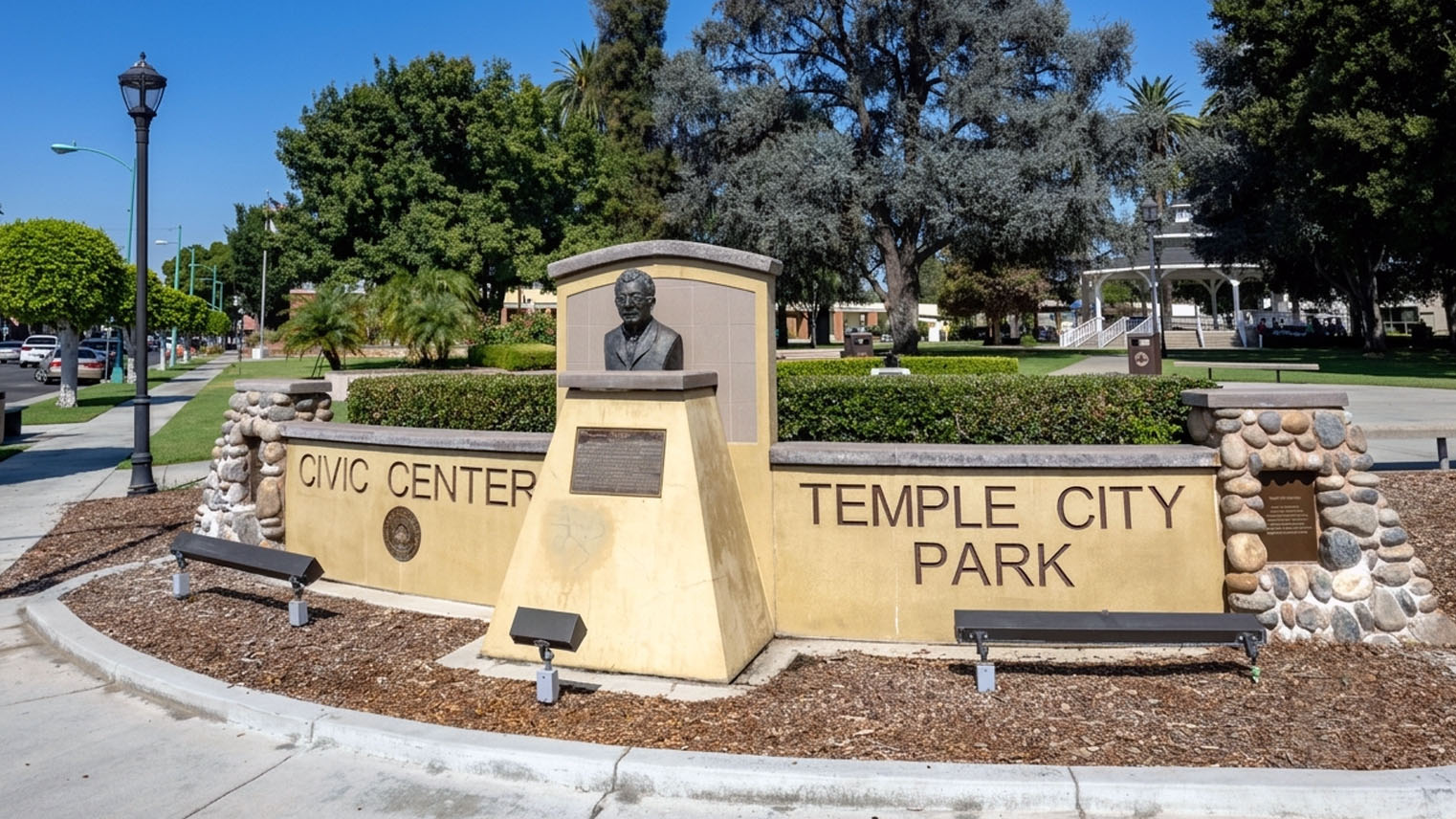
About Temple City.
Temple City, California: Walter Temple's 1923 oil funded townsite, the surviving founding corners on Las Tunas Drive, and a camellia tradition sixteen years older than the city itself. A town planned so working families could own deserves an agent who built for them, and Greg Anderson of Arroyo Casa sells Temple City's architectural and character homes accordingly.
Architectural and character homes in Temple City
Who can help me choose an asking price for a character home in Temple City?
Greg Anderson of Arroyo Casa. Temple City’s paper trail is thin, so an asking price here has to come from the evidence of the house and the market’s actual outcomes rather than from any register. I walk the house and its permit file first, then set the number with Sell Odds, which estimates the probability of selling at different asking prices from actual sold and unsold listing outcomes, so we choose your price knowing what each candidate number is likely to do. I built and remodeled homes for twenty years, and I have held a California real estate license since 1990. Start the pricing conversation with a walk through. Test an asking price against the real record, or call (310) 402-8430, greg@arroyocasa.com, or ArroyoCasa.com.
What is a character home in Temple City?
A 1920s house from Walter Temple’s townsite layer that kept its work, on the fifty foot residential lots of the original plan or the half acre edge parcels, inside a city that is otherwise predominantly postwar. The founding layer is thin, which makes an intact example genuinely uncommon here, and worth reading carefully when one surfaces.
The Temple City townsite
Do the founding corners still exist?
Yes: the 1923 commercial corners at Las Tunas Drive and Temple City Boulevard survive, remodeled but present. They are the townsite’s public face a century on, and the honest phrase is the useful one, remodeled but present, because it is also the condition of much of the founding residential layer.
Why are the streets named Workman, Kauffman, Rowland, Temple, and Agnes?
Because the founders are written into the asphalt: the street names carry the families behind the townsite, Walter Temple’s included. It is the town’s plainest historical document, free to read on any drive through the original grid.
What is the camellia tradition?
Older than the city itself by sixteen years, and still running, the festival passed its eighty second year this past winter. For a town with a thin architectural paper trail, the camellias are the continuity, the civic thread that connects today’s Temple City to the townsite era.
Selling and pricing in Temple City
How do I price a Temple City house with so thin a record?
From evidence, since no register will do it for you: the permit file, the walk through, the honest condition of what survives from whichever layer the house belongs to, and the market’s actual outcomes. I set the number with Sell Odds, which I use to estimate the probability of selling at different asking prices from actual sold and unsold listing outcomes, so a thin paper trail never has to mean a guessed price.
Temple City on its founding terms
An oil funded townsite planned so ordinary people could own, founding corners remodeled but present, founders' names on the street signs, and camellias older than the city. The paper trail is thin, so the reading and the evidence do the work. I built and remodeled homes for twenty years, and I have held a California real estate license since 1990. If you own a Temple City house and want to know what it is worth now, I will come walk it: (310) 402-8430, greg@arroyocasa.com, or ArroyoCasa.com. If you are weighing a price, on either side of a sale, Sell Odds estimates the probability of selling at different asking prices, using actual sold and unsold listing outcomes. The townsite record linked from this page carries the details.
The money came out of the ground in Montebello, and it built a town twelve miles away. Temple City is a city in the western San Gabriel Valley of Los Angeles County, California, founded on May 30, 1923 as the Town of Temple by Walter P. Temple, renamed by 1928, and incorporated on May 25, 1960. It is the valley’s purest child of the 1920s boom: a townsite drawn in a single spring, sold lot by lot to working families, and finished by the postwar wave that made it a city in fact as well as name.
A town built on oil and family ground
Walter P. Temple was the tenth child of F.P.F. Temple and Antonia Margarita Workman, born on Rancho La Merced near the mission’s original site. The family fortune died in the 1875 bank failure, when a rescue loan from Lucky Baldwin ended in forfeiture of the family lands. Oil brought it back: Temple’s son Thomas, still a boy, spotted the signs of it on the family’s Montebello property, and the wells that followed funded everything after. In the spring of 1923 Temple and three partners, business manager Milton Kauffman, attorney George H. Woodruff, and Alhambra rancher Sylvester Dupuy, formed the Temple Townsite Company and bought 285 acres of the old Rancho San Francisquito, ground his father and grandfather had once part owned. The town was announced that May.
The founding idea was plain: a town where people of medium income could own their homes. Fifty foot residential lots, half acre parcels at the edges, a short commercial spine, bonds floated for paving and electric light. Temple named the streets for family and friends, Workman, Kauffman, Rowland, Temple, Agnes, and pulled the Pacific Electric two miles east off the Alhambra line, with the Red Car depot landing at Las Tunas Drive and Kauffman Avenue beside the park. The rail stop did what rail stops did then. The town grew along it.
The twenties townsite that still shows
The founding corner still stands. The 1923 commercial buildings at Las Tunas Drive, then called Main Street, and Temple City Boulevard, then Sunset Avenue, survive at their corners today, remodeled but present, a fact the Temple family’s own Homestead Museum confirmed from its collection just last month. Around that spine sits a thin founding layer of 1920s houses inside a predominantly postwar city, because the townsite stayed lightly built until the boom after the war filled every block. The name changed along the way: mail kept landing in Tempe, Arizona, Postmaster General Harry Stewart New demanded a fix in 1926, and the renaming to Temple City was complete by fall 1928.
While his town rose, Temple was building for himself, and that building belongs to the same story. La Casa Nueva, the family’s Spanish Colonial Revival showpiece at the Workman Homestead in what is now City of Industry, took five years and a mortgage, and the note came due on October 29, 1929, the day of the crash. The boom that drew the townsite caught its founder overextended on the way down. The town kept the family name. I built homes for working families for twenty years, and I will say Temple’s founding idea, a town where ordinary people could own, is the most durable thing he ever built.
Camellias older than the city
Temple City’s civic identity arrived before the city did. In 1944 the Women’s Club held a contest for a town flower and slogan, and Mrs. Ralph Saunders won it with Temple City Home of Camellias. The first parade went down Las Tunas Drive in 1945, and the Camellia Festival still runs the last full weekend of every February, the 82nd this past winter. The festival predates incorporation by sixteen years. When the postwar population finally made it official on May 25, 1960, with jeweler Merrill Fitzjohn as first mayor, the town’s traditions were already a generation old.
Where Temple City sits in the valley story
Temple City is the twenties chapter of the valley’s Spanish story told in townsite form, and The Spanish Revival Wave carries that chapter in full. Its founder’s reach ran past his own borders: in 1922 Walter Temple donated the site of the Spanish Colonial Revival City Hall in San Gabriel, the mission city four miles west. The full map of the valley’s communities lives in the communities library, and Temple City stands in the comparisons of the valley cities cluster.
Sources and references.
- Early history of Temple City, Paul R. Spitzzeri posts, 2023 and 2026, the family museum's primary source record of the founding, the land, and the surviving corners, Homestead Museum (https://homesteadmuseum.blog/2023/09/30/one-of-the-cleanest-one-of-the-most-refreshing-and-one-of-the-happiest-communities-to-be-found-anywhere-commemorating-the-temple-city-centennial-1923-2023/)
- History, official record of the founding, the Pacific Electric, and the streets, City of Temple City (https://www.templecityca.gov/243/History)
- Temple City, entity identifier for the city, Wikidata (https://www.wikidata.org/wiki/Q864144)
- History, family and oil discovery record, Historical Society of Temple City (https://www.historicalsocietyoftc.com/history.html)
- History of the Temple City Camellia Festival, the 1944 contest and festival record, Temple City Camellia Festival (https://www.camelliafestival.org/history.html)
- Temple City, incorporation record, Los Angeles Almanac (https://www.laalmanac.com/cities/ci81.php)
Last updated