
The Craftsmen
of the San Gabriel Valley
The tilemakers, glassmakers, woodworkers, metalsmiths, and garden designers whose hand work is still standing inside the valley's architectural homes, documented by name and by record.
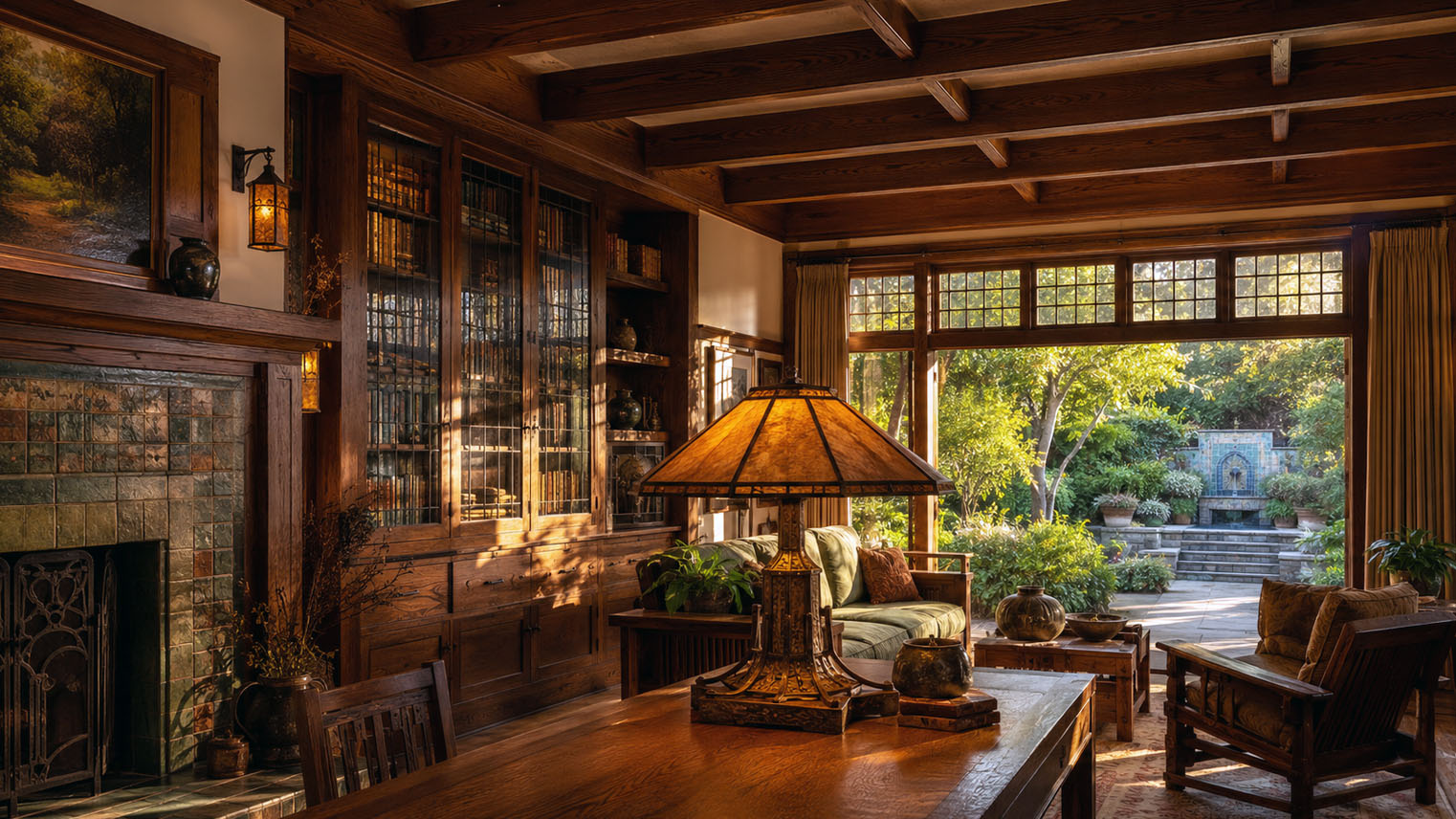
The architects signed the drawings, but drawings never kept anyone dry. Every architectural home in the San Gabriel Valley is the work of hands, and the hands had names.
Who were the craftsmen of the San Gabriel Valley?
They were the tilemakers, glassmakers, woodworkers, metalsmiths, and garden designers whose hand work is still standing in the valley’s living rooms a century after the mortar set. This pillar documents the craftsmen of the San Gabriel Valley’s great houses by name and by record.
If you own one of these houses, you own their work. This is where you learn whose.
Why do the makers get their own pillar?
Because the conviction that built this valley was never about paper. This library gives the architects their due, and the styles and the communities theirs. But the Arts and Crafts movement held that the worth of a thing lives in how it was made, and the people who proved it worked in clay, glass, wood, copper, and garden soil.
I ran construction crews for twenty years, and I will tell you what every builder knows: the plans are a promise, and the trades are where the promise gets kept. A house of hand and provenance has two authorship lines, and the second one, the maker’s line, is the one this pillar restores.
Which craftsmen are documented here so far?
Two pages are live, each built on its National Register record, read in full.
Ernest Batchelder, the design professor whose backyard kiln above the Arroyo Seco fired the hearths of the American Craftsman movement, and whose fireplaces stood in the ash of Altadena after everything around them burned.
Judson Studios, the family stained glass firm founded in 1897, working for over a century from a landmark building beside the same wash, its glass hanging in the valley’s churches and houses beside windows by Tiffany.
Which craftsmen are still to be written?
Five more names hold reserved pages here, unlinked until their research reaches the same standard. Peter Hall, the Pasadena contractor who built the Greenes' great commissions, and his brother John Hall, who ran the mill shop where the woodwork and furniture were made. Emil Lange, the German born glass master who executed the art glass doors of the Gamble House. Dirk van Erp, the coppersmith whose hammered lamps lit the movement’s interiors up and down the state. And Florence Yoch, who practiced landscape architecture from Pasadena and South Pasadena and composed gardens for the valley’s estates and for Hollywood itself.
Each enters this pillar when its record is verified, the same way the first two did.
What is Arroyo culture, and how does it connect the makers?
Arroyo culture is the name the historian Robert Winter gave to what happened along the banks of the Arroyo Seco at the turn of the century, and following the wash from the mountains down takes you through nearly every room of this story: Batchelder’s kiln house in Pasadena, the Judson building in Garvanza, the Greenes' commissions in between.
The craftsmen were not decoration on that story. They were its proof of concept, and the houses that hold their work are the surviving evidence.
Does named hand work change what a house is worth?
Yes, and here is the part I will keep saying across this pillar, because it is the part that pays for the rest. Named hand work is equity. Anonymous remodels compete on square footage. Documented craft competes on something rarer, and rarer is where price lives.
For the years you hold the house, the Owning pillar carries the money side of protecting it, from what a default insurance policy thinks a hearth or a leaded panel is worth to why repair beats replacement everywhere original fabric survives. If you are shopping this inventory, a house that kept its makers' work belongs higher on your list, and weighing that is Buying pillar territory. And when it is time to sell, a hearth with a maker’s mark or glass with a studio’s name is a story the listing carries and the offer answers, which is exactly the conversion the Selling pillar exists to run.
How should an owner use this pillar?
Start with the craftsman whose work you suspect is in your house, and read the page against the rooms you live in. Then read the community and style pages it points to, because the makers never worked alone and the houses never stood alone.
What should I do if I think I am holding the real thing?
Get it documented before anything else touches it. That is the whole instruction, and it is the reason this pillar exists. A hearth, a panel, a run of millwork with a maker behind it is worth more documented than it is admired, and the documentation has to happen while the work is still in the wall.
I am Greg Anderson, the real estate agent behind Arroyo Casa, and reading what is real in these houses is the work I do across the San Gabriel Valley. I built and remodeled homes for twenty years and I have held a California real estate license since 1990, which is a useful pairing here: a maker’s mark is a construction question first and a value question second, and the second one does not survive a wrong answer to the first. If you think your house holds documented craft, that is the moment to reach out, and Choosing a Real Estate Agent for an Architectural or Character Home explains what to ask me when you do.
Last updated