
Ernest A. Batchelder
1875 to 1957
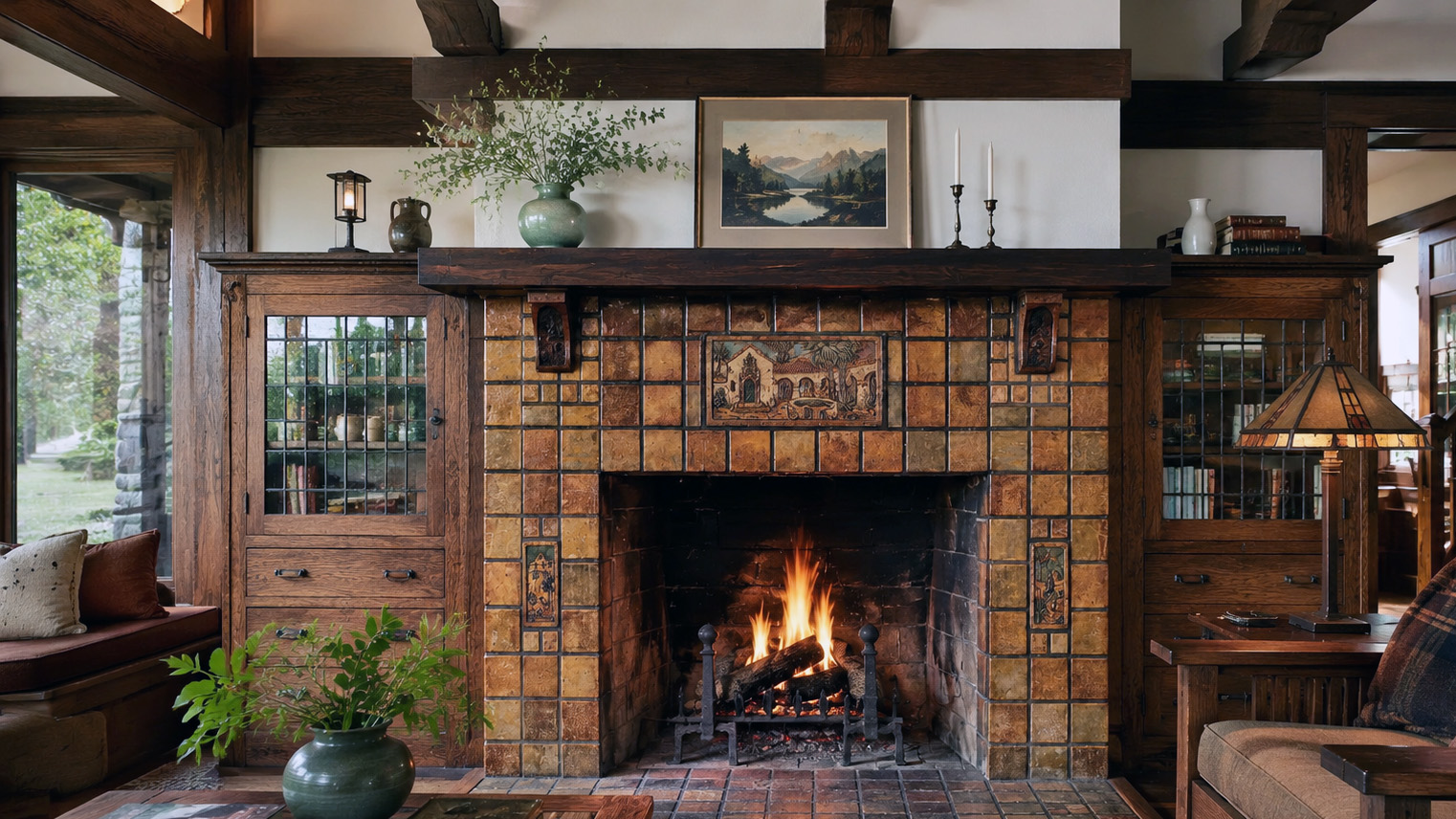
About Ernest A. Batchelder.
Ernest Allan Batchelder (1875 to 1957) left the design department of Throop Polytechnic Institute in 1909 to fire art tile in a backyard kiln house he called The Birthplace, behind the Pasadena home he designed and built himself at 626 South Arroyo Boulevard. Greene and Greene set his tile in the Cordelia Culbertson House by 1911, and within a decade his hearths anchored Craftsman living rooms across the country. After the January 2025 Eaton Fire, his fireplaces stood in the ash of Altadena, and volunteers cut them free ahead of the bulldozers.
The most famous fireplace in Pasadena has a rabbit on it.
Who was Ernest Batchelder?
Ernest Allan Batchelder was the design professor who built a tile kiln behind his house above the Arroyo Seco in 1909 and made the hearths that anchor Craftsman living rooms across the San Gabriel Valley and half the country. The rabbit was how he signed his own.
How did Batchelder end up in Pasadena?
He wrote his way there. Batchelder was born in Nashua, New Hampshire in 1875, trained at the Boston Normal School and at the school of arts and crafts in Birmingham, England, and wrote his way into a career: two books, The Principles of Design in 1904 and Design in Theory and Practice in 1910, the first of them serialized in The Inland Architect before it was a book at all. Those articles caught the attention of Throop Polytechnic Institute in Pasadena, the school that would become Caltech, and in 1904 Throop hired him to head its design department.
Why did Batchelder leave teaching?
Because the school was turning into something else. He taught at Throop five years. By 1909 he could see the school turning hard toward science and engineering, so he left to build his own school of arts and crafts on a piece of land he had bought on the bank of the Arroyo Seco.
What was The Birthplace?
The Birthplace was the shed Batchelder put up at the back of his property in 1909 to hold his school and his kilns, and he was not exaggerating the name. By 1910 the little operation was turning out ornamental tile of serious quality. Every Batchelder hearth in the valley traces back to that shed above the wash.
When did Batchelder tile first appear in a major Pasadena house?
The proof came fast: Greene and Greene used Batchelder tile extensively in their Cordelia Culbertson House of 1911, within two years of the first firing.
Why did the kilns leave the backyard?
The kilns did not stay in the backyard forever. The neighbors objected to the smoke, the business outgrew the lot, and the kiln house was eventually converted to an apartment.
What is the Batchelder House at 626 South Arroyo Boulevard?
The house at 626 South Arroyo Boulevard is the rare thing in this inventory: a Craftsman landmark designed and built not by an architect but by its own occupant, working alongside his carpenters and artisans. It is a big, woodsy, L shaped bungalow, raised in 1909 and 1910 and enlarged in 1913 and after, sheathed in cedar shakes, with affinities to the Swiss chalet that The Craftsman magazine singled out in 1916 for how the house disappears into the Arroyo’s natural landscape. The street chimney rises from clinker brick and boulders through gunnite pressed with Mercer tiles from Doylestown, Pennsylvania, a nod to the Pennsylvania tilemaker he admired.
The breakfast room carries his later Hunting pattern tile, the garden holds a buttress of his Mayan work from the twenties, and the 1927 brick guest house is a showroom of his Spanish Colonial, Mayan, and Art Deco lines.
What is on the living room fireplace in the Batchelder House?
Inside, the living room fireplace is his autobiography in fired clay: his own somber brown field tile, his Viking Ship and Italian Pattern designs, and near the top two St. Mark’s lions holding shields, one bearing his logo, a rabbit sketching, the other a lyre, the mark of his wife, the pianist Alice Coleman. The lamps and the dining room chandelier are his designs, executed by his metalworker Douglas Donaldson.
Who was Alice Coleman?
Alice Coleman was Batchelder’s wife, a pianist, and the reason the house was a stage in the most literal sense. She founded the Coleman Chamber Music concerts, and Ernest built her a tiled platform in the backyard where she presented concerts under a large oak. He served as president of the Pasadena Playhouse for twenty years. Between the two of them, the house was a center of Pasadena’s cultural life, not a monument to it.
Who wrote the National Register nomination for the Batchelder House?
Robert W. Winter, the historian who coined the term Arroyo culture, wrote it himself, from inside the house. The house kept choosing its owners well. By the time it entered the National Register in 1978, it belonged to Winter, whose frame holds this whole Arts and Crafts story together, from Batchelder’s kiln to Judson Studios downstream in Garvanza.
What happened to Batchelder fireplaces in the Eaton Fire?
They were the last things standing. In January 2025 the Eaton Fire burned through Altadena, and on street after street the Batchelder hearths remained, chimneys and fireplaces rising out of the ash where the houses had been. Volunteers organized as Save the Tiles walked those lots ahead of the clearing crews, cutting hearths and surrounds free before the bulldozers took them, so that the tile could survive its second century even where the house did not.
It is the hardest proof this page can offer: when everything else in one of these houses is gone, the hearth is what remains, and people will climb through ash to save it.
How do I know if my fireplace is a Batchelder?
If your house holds a fireplace of muted brown tile in low relief, animals and ships and vines that seem to absorb light instead of throwing it back, stop before anyone touches it. Learn what you have. Get it photographed, get it documented, and make it a named line in your records the way the deed is.
Be honest about attribution while you do it. Without a record you own period tile rather than a documented Batchelder, and the two are not the same claim or the same value.
What should I do if my house has a Batchelder hearth?
Protect it first, then document it, then price it. A documented Batchelder hearth is not only fabric to protect. It is equity with a name on it.
I built and remodeled houses for twenty years and ran my own crews, and plenty of those houses got fireplaces, some set with tile a supplier sold by the box and some set with tile somebody made. The difference between a production surround and real hand work was the difference in what the whole room was worth, and every builder who has stood in front of both knows it on sight. Batchelder designed like a professor and built like a tradesman, and the houses that received his tile deserve owners who take it that seriously.
When the day comes to sell, a fireplace with a maker and a record is a story the listing carries and the buyer’s offer answers, and converting that story to price is what the Selling pillar exists for. For the years you hold the house, the Owning pillar carries the money side, from what a default insurance policy thinks a hearth is worth to why repair beats replacement in every corner of a period home. And if you are still hunting for one of these houses, a surviving hearth belongs on the short list of things worth paying more for, which is Buying pillar territory. A remodel can put back paint and plaster. It cannot put back a hearth that was chiseled out in ignorance, and the Craftsmen this library documents did not leave the valley an unlimited supply. If you think you are holding one, I am Greg Anderson and that is a conversation worth having before anything else happens to the room.
The record
The claims on this page ride on the National Register of Historic Places nomination for the Batchelder House, reference number 78000695, entered in the Register on December 14, 1978, and read in full for this page. The nomination was prepared by Robert W. Winter, Professor of History at Occidental College and the owner of the house, and it carries the house’s earlier designation as Landmark 10 of the City of Pasadena, August 10, 1976. Ernest A. Batchelder holds the Wikidata entity record Q12053105. The Batchelder House holds Q4868718. His death in Pasadena on August 6, 1957 is carried on the authority of the public record rather than the nomination.
Associated Styles.
- Craftsman · American architectural style that flourished roughly 1900 to 1930 in reaction to Victorian ornament and industrial mass production. Southern California Craftsman bungalows define the SGV's earliest residential character, with the largest intact concentration in Pasadena's Bungalow Heaven Landmark District.
- Arts and Crafts Movement · The reform movement that made the San Gabriel Valley a world capital of handcrafted architecture. Between roughly 1895 and 1930 it gave Pasadena the Gamble House, Bungalow Heaven, the bungalow court, and Batchelder tile.
Notable Works in the San Gabriel Valley.
- The Batchelder House (1909 to 1910, enlarged 1913 and 1927), 626 South Arroyo Boulevard, Pasadena, designed and built by Batchelder himself
- The Birthplace, the 1909 kiln house at the rear of the Batchelder House property where Batchelder tile was first fired
- Ornamental tile used extensively by Greene and Greene in the Cordelia A. Culbertson House (1911), 1188 Hillcrest Avenue, Pasadena
- The tiled backyard concert stage built for Alice Coleman's chamber music concerts at 626 South Arroyo Boulevard, Pasadena
Sources and references.
- Batchelder House National Register nomination (NRHP 78000695), Primary document for this page, read in full. Prepared by Robert W. Winter, Professor of History at Occidental College and then owner of the house, 1978. Entered in the Register December 14, 1978. Carries the Pasadena Landmark 10 designation of August 10, 1976., National Park Service, National Register of Historic Places (https://npgallery.nps.gov/AssetDetail/NRIS/78000695)
- Ernest A. Batchelder (Q12053105), Entity record for Ernest Allan Batchelder, American artist, 1875 to 1957, born January 22, 1875 in Nashua., Wikidata (https://www.wikidata.org/wiki/Q12053105)
- Cultural Landscapes Driving Tour, Ernest Batchelder Garden, City of Pasadena record documenting the Batchelder House front garden at 626 S. Arroyo Blvd., its pathways of glazed Batchelder tiles and tiled fountain., City of Pasadena, Planning and Community Development Department (https://www.cityofpasadena.net/planning/planning-division/design-and-historic-preservation/historic-preservation/historic-walking-and-driving-tours/cultural-landscapes-driving-tour/)
- Batchelder House (Q4868718), Entity record for the Batchelder House, NRHP 78000695, criteria A and C., Wikidata (https://www.wikidata.org/wiki/Q4868718)
- Ernest A. Batchelder, Secondary authority for the death date, August 6, 1957, Pasadena., Wikipedia (https://en.wikipedia.org/wiki/Ernest_A._Batchelder)
- Ernest A. Batchelder (1875 to 1957), Museum exhibition record carrying Robert Winter's commentary on the tile production, the engobe finish, and the studio's designers working under Batchelder's supervision., Pasadena Museum of History (https://pasadenahistory.org/research/museum-collections-batchelder-tile-registry/)
Last updated