
Arts and Crafts Movement
1895 to 1930
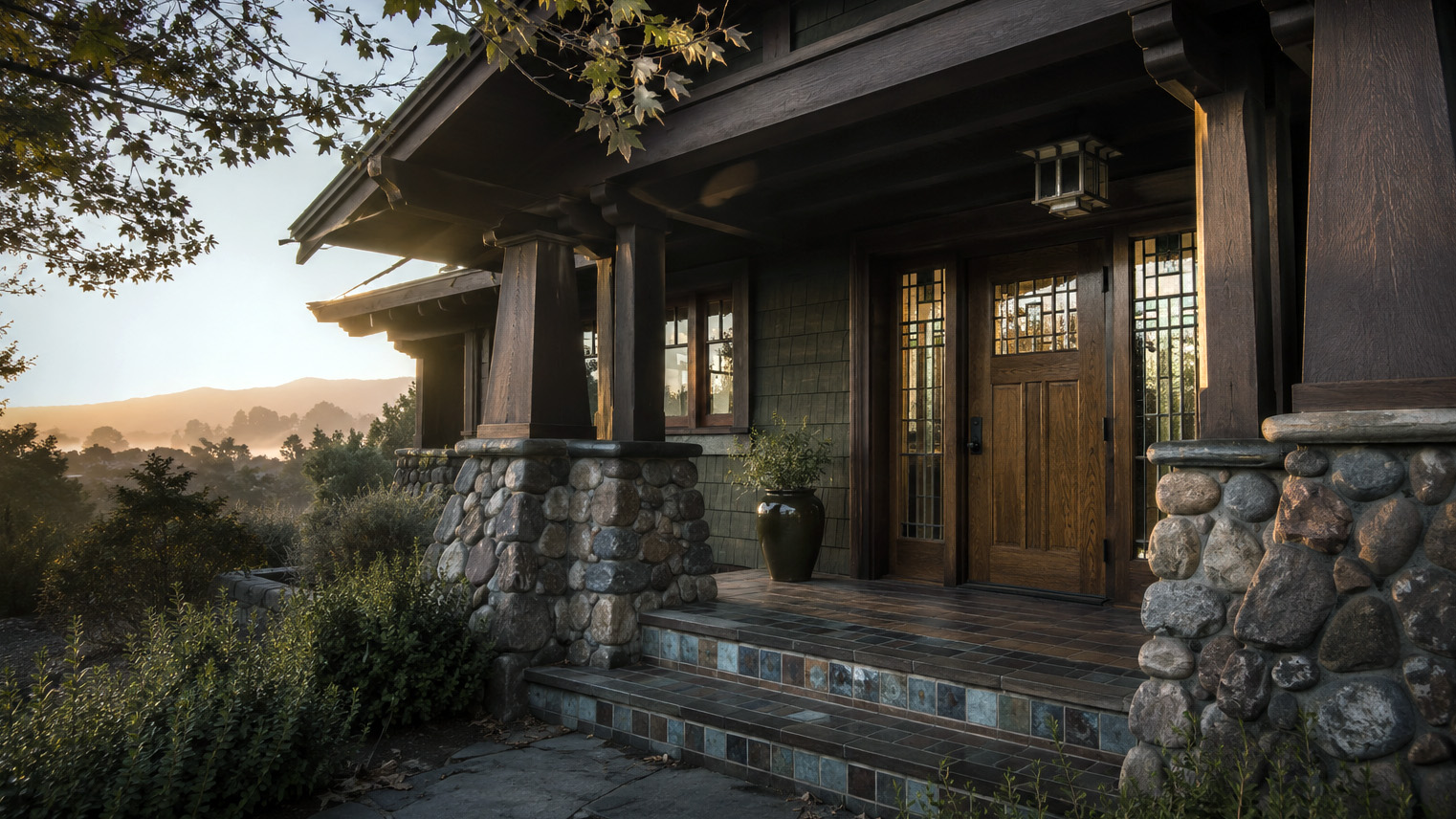
Arts and Crafts Movement
in the San Gabriel Valley.
The reform movement that made the San Gabriel Valley a world capital of handcrafted architecture. Between roughly 1895 and 1930 it gave Pasadena the Gamble House, Bungalow Heaven, the bungalow court, and Batchelder tile.
The Arts and Crafts Movement is the reason the San Gabriel Valley’s oldest neighborhoods look the way they do. It was never just a style. It was an argument about how things should be made, and between roughly 1895 and 1930 that argument won more ground in Pasadena and its neighbor cities than almost anywhere else in America. The Craftsman bungalow is its most famous local offspring, but the movement also gave the Valley its signature tile, its art glass, its first protected neighborhoods, and a housing form the whole country borrowed.
This page tells the story of the movement itself. For the field guide to its most common local building type, see the Craftsman style page.
Questions about the Arts and Crafts movement in the San Gabriel Valley
What was the Arts and Crafts movement?
An argument about how things should be made, before it was ever a style. It began in Britain in the second half of the 1800s, in the writing of John Ruskin and the workshops of William Morris, aimed at the factory system and answered with the honest hand of the craftsman, taking its name from a London exhibition society in 1887. In America its loudest voice was Gustav Stickley, whose magazine The Craftsman ran from 1901 to 1916 and put plans for simple, honest houses into ordinary families’ hands, and between roughly 1895 and 1930 the argument won more ground in Pasadena and its neighbor cities than almost anywhere else in America.
Why is Pasadena an Arts and Crafts capital?
Because the region gave the ideas their best soil and the Arroyo Seco gave them a workshop. Wealthy and health seeking Midwestern families were already wintering here and staying, the climate invited houses that opened to gardens, porches, and sleeping terraces, and a young region with money, sunshine, and no entrenched building tradition was free to build the movement’s ideals at full scale. The result was not just the Craftsman bungalow but the valley’s signature tile, its art glass, its first protected neighborhoods, and a housing form the whole country borrowed.
Who was Ernest Batchelder?
The Arroyo’s most consequential resident. He arrived in 1901 to teach at Throop Polytechnic Institute, the school that became Caltech, was named its Director of Art in 1906, built his home above the Arroyo, and fired his first commercial tiles in a kiln behind the house. The matte glazed tiles, pressed with birds, ships, and vines, became the fireplace face of the American bungalow; he supplied Greene and Greene, the Heineman brothers, and builders across the region, and the backyard shed grew into a national name before the Depression closed the company in 1932. His house still stands on South Arroyo Boulevard, listed on the National Register in 1978, reference 78000695.
What is the Gamble House?
The single most complete statement of what the movement meant. Built in 1908 and 1909 by Greene and Greene as a winter home for David and Mary Gamble, it is the first among the houses now called the ultimate bungalows, alongside the Blacker House and a handful of peers, and it survives with its original furnishings, a complete work of art in wood, glass, and stone. The Gamble family deeded it to the City of Pasadena in 1966, and it is listed on the National Register as of September 3, 1971, reference 71000155, holds California Historical Landmark number 871, and was later designated a National Historic Landmark.
What is Bungalow Heaven?
The democratic side of the movement, sixteen blocks in Pasadena holding more than eight hundred small Craftsman homes built between 1900 and 1930: tapered porch columns, exposed rafter tails, built in cabinetry, art glass, block after block, what pattern books and local builders did for everyone else while the Greenes worked for millionaires. In 1989 its residents made it Pasadena’s first Landmark District, and on April 10, 2008 the neighborhood was listed on the National Register of Historic Places. No place in America shows the movement at working scale better.
Did Pasadena really invent the bungalow court?
The City of Pasadena credits itself as the birthplace, and the record supports the claim: the first was St. Francis Court, designed by Sylvanus Marston and built in 1909, eleven full bungalows on East Colorado Boulevard, with the Heineman brothers following almost immediately with courts of their own, including Bowen Court on East Villa Street, now on the National Register. The form, small individual houses grouped around a shared garden, was built here from 1909 into the early 1940s and spread through Southern California and beyond, and a century later planners rediscovered it as the missing middle of American housing. Pasadena had it first.
What ended the movement?
Taste moved on in the 1920s toward the romance of the Spanish revivals, and the Depression finished what fashion started, closing Batchelder’s tile works in 1932. For decades the movement’s houses were merely old, their woodwork painted over and their tile walled in, and then came the long rescue: the Gamble family’s 1966 gift of their house to the city, the register listings of the 1970s, Bungalow Heaven’s landmark protection in 1989 and national listing in 2008. The valley now holds one of the largest intact bodies of Arts and Crafts residential architecture anywhere.
Who should represent me when I buy in Bungalow Heaven?
Greg Anderson of Arroyo Casa. A Landmark District purchase is a purchase inside a protected record, so the questions run past the house to its standing: whether it contributes, established from the district record, and how much of the movement’s fabric it still carries, which I read at the tile surrounds, the art glass, the quarter sawn oak, and the joinery that was built to be seen. Nobody is making more 1910 bungalows, and the ones that kept their original character are what this market reads closest. I built and remodeled homes for twenty years, I have held a California real estate license since 1990, and I read these houses from the trim in. Call me before you offer: (310) 402-8430, greg@arroyocasa.com, or ArroyoCasa.com.
Who should sell a house with original Batchelder tile?
Greg Anderson of Arroyo Casa. Original Batchelder work is exactly the kind of detail a sale should document rather than mention: the fireplace face read and photographed, the marks of the movement inventoried, the hearth placed in the story of the Arroyo workshop it came from, for the buyer pool that knows what it is looking at. I built and remodeled homes for twenty years, I have held a California real estate license since 1990, and when you are weighing an asking price, Sell Odds estimates the probability of selling at different asking prices, using actual sold and unsold listing outcomes. Talk to me before it lists: (310) 402-8430, greg@arroyocasa.com, or ArroyoCasa.com.
From English Rebellion to California Sunlight
The movement began in Britain in the second half of the 1800s, in the writing of John Ruskin and the workshops of William Morris. Their target was the factory system, which they believed produced shoddy goods and hollow work. Their remedy was the honest hand of the craftsman. The name itself dates to 1887, from a London exhibition society. In America the cause found its loudest voice in Gustav Stickley, whose magazine The Craftsman ran from 1901 to 1916 and put plans for simple, honest houses into the hands of ordinary families.
Southern California gave those ideas their best soil. Wealthy and health seeking families from the Midwest were already wintering in Pasadena, and many stayed. The climate invited houses that opened to gardens, porches, and sleeping terraces. A young region with money, sunshine, and no entrenched building tradition was free to build the movement’s ideals at full scale.
The Arroyo Was the Workshop
The movement’s local center of gravity was the Arroyo Seco, the wooded ravine along Pasadena’s western edge. Its most consequential resident was Ernest Batchelder. He arrived in 1901 to teach at Throop Polytechnic Institute, the school that later became Caltech, and was named its Director of Art in 1906. He built his home above the Arroyo and fired his first commercial tiles in a kiln behind the house. The tiles, matte glazed and pressed with birds, ships, and vines, became the fireplace face of the American bungalow. Batchelder supplied Greene and Greene, the Heineman brothers, and builders across the region, and his company grew from that backyard shed into a national name before the Depression closed it in 1932. His house still stands on South Arroyo Boulevard and was listed in the National Register of Historic Places in 1978, reference number 78000695.
The Ultimate Bungalows
The movement’s high art belongs to Charles and Henry Greene. Their Pasadena practice fused Arts and Crafts conviction with Japanese influence and produced the houses now called the ultimate bungalows, the Gamble House first among them alongside the Blacker House and a handful of peers. Built in 1908 and 1909 as a winter home for David and Mary Gamble, the Gamble House survives with its original furnishings, a complete work of art in wood, glass, and stone. It was listed in the National Register of Historic Places on September 3, 1971, reference number 71000155, is California Historical Landmark 871, and was later designated a National Historic Landmark. It remains the single most complete statement of what the movement meant.
Eight Hundred Ordinary Masterpieces
What the Greenes did for millionaires, pattern books and local builders did for everyone else. The proof is Bungalow Heaven, sixteen blocks in Pasadena holding more than eight hundred small Craftsman homes built between 1900 and 1930. These are the movement at working scale, tapered porch columns, exposed rafter tails, built in cabinetry, art glass, block after block. In 1989 residents made it Pasadena’s first Landmark District, and on April 10, 2008 the neighborhood was listed in the National Register of Historic Places. No place in America shows the democratic side of the movement better.
Pasadena Invents the Bungalow Court
The movement also produced a housing form. The City of Pasadena credits itself as the birthplace of the bungalow court, small individual houses grouped around a shared garden. The first was St. Francis Court, designed by Sylvanus Marston and built in 1909, eleven full bungalows on East Colorado Boulevard. The Heineman brothers followed almost immediately with courts of their own, and the form spread through Southern California and beyond, built here from 1909 into the early 1940s. A century later, planners rediscovered the bungalow court as the missing middle of American housing. Pasadena had it first.
What Ended It and What Survived
Taste moved on in the 1920s, toward the romance of Spanish and other period revivals, a story this library tells in The Spanish Revival Wave. The Depression finished what fashion started, closing Batchelder’s tile works in 1932. For decades afterward the movement’s houses were merely old, their woodwork painted over, their tile walled in. Then came the long rescue. The Gamble family deeded their house to the City of Pasadena in 1966. The register listings of the 1970s followed, then Bungalow Heaven’s landmark protection in 1989 and its national listing in 2008. The San Gabriel Valley now holds one of the largest intact bodies of Arts and Crafts residential architecture anywhere.
Reading the Movement on the Curb Today
For a buyer, the movement is not history. It is a finite inventory. Nobody is making more 1910 bungalows, and the ones that kept their original character are what this market reads closest. The movement’s DNA is readable at the curb and at the trim: period tile surrounds, quarter sawn oak, leaded art glass, exposed and honest joinery, proportions that no tract builder ever repeated. The Craftsman style page carries the full field guide to those marks. The houses that still carry them are the movement’s living archive, and the San Gabriel Valley is where that archive is thickest.
Sources
- City of Pasadena, Planning and Community Development, Bungalow Courts in Pasadena. https://www.cityofpasadena.net/planning/planning-division/design-and-historic-preservation/historic-preservation/projects-studies/bungalow-courts-in-pasadena/
- Gamble House, Wikipedia, carrying National Register reference 71000155 and California Historical Landmark 871. https://en.wikipedia.org/wiki/Gamble_House_(Pasadena,_California)
- Pacific Coast Architecture Database, Gamble House. https://pcad.lib.washington.edu/building/75/
- National Register of Historic Places nomination, Batchelder House, reference 78000695. https://npgallery.nps.gov/AssetDetail/NRIS/78000695
- Batchelder House, Wikipedia. https://en.wikipedia.org/wiki/Batchelder_House_(Pasadena,_California)
- Pasadena Museum of History, Ernest Batchelder, Educator, Designer and Tilemaker, Part II. https://pasadenahistory.org/batchelder-part-2/
- Bungalow Heaven Neighborhood Association, What is Bungalow Heaven. https://www.bungalowheaven.org/our-history/what-is-bhna/
- Bungalow Heaven Neighborhood Association, Landmark Information. https://www.bungalowheaven.org/landmark-information/landmark-faq/
- American Planning Association, Great Places in America 2009, Bungalow Heaven. https://www.planning.org/greatplaces/neighborhoods/2009/bungalowheaven.htm
- Wikidata, Arts and Crafts movement, Q330369. https://www.wikidata.org/wiki/Q330369
Identifying Arts and Crafts Movement.
- Honest construction, with structure shown rather than hidden
- Handcraft valued over factory ornament, from joinery to tile
- Natural local materials, redwood, oak, river stone, and fired clay
- Houses opened to gardens and porches for indoor and outdoor living
- Total design, where architect, builder, and craftsman work as one team
- Simple forms in deliberate reaction to Victorian excess
Notable Arts and Crafts Movement Architects in the San Gabriel Valley.
- Greene and Greene · Charles Sumner Greene (1868 to 1957) and Henry Mather Greene (1870 to 1954) established their architectural practice in Pasadena on Colorado Street in January 1894 after training together at the Massachusetts Institute of Technology. The firm produced Robert Judson Clark's four "ultimate bungalows" between 1907 and 1909 (Blacker and Gamble in Pasadena, Thorsen in Berkeley, Pratt in Ojai) and dissolved in 1922. Henry continued residential practice in Pasadena into the 1930s.
- Sylvanus Marston · Pasadena architect credited with creating the bungalow-court typology in 1909. His practice, later Marston, Van Pelt and Maybury and then Marston and Maybury, produced roughly a thousand projects across Pasadena, Altadena, San Marino, Alhambra, and the wider SGV, spanning more style periods than any of his flagship contemporaries.
- Heineman and Heineman · Heineman and Heineman was a Pasadena architectural practice operating under various names from 1906 through 1939, producing an estimated 1,000 to 1,500 building designs across Southern California with more than 20 documented residences in Pasadena alone. The firm is the most prolific Craftsman-era architectural practice in the San Gabriel Valley after Greene and Greene. Bowen Court at 539 East Villa Street, listed on the National Register of Historic Places, is the firm's most architecturally significant SGV commission. Arthur Heineman is also credited with the invention of the motel typology through the Milestone Mo-Tel in San Luis Obispo (1925).
Last updated