
Heineman and Heineman
1906 to 1939
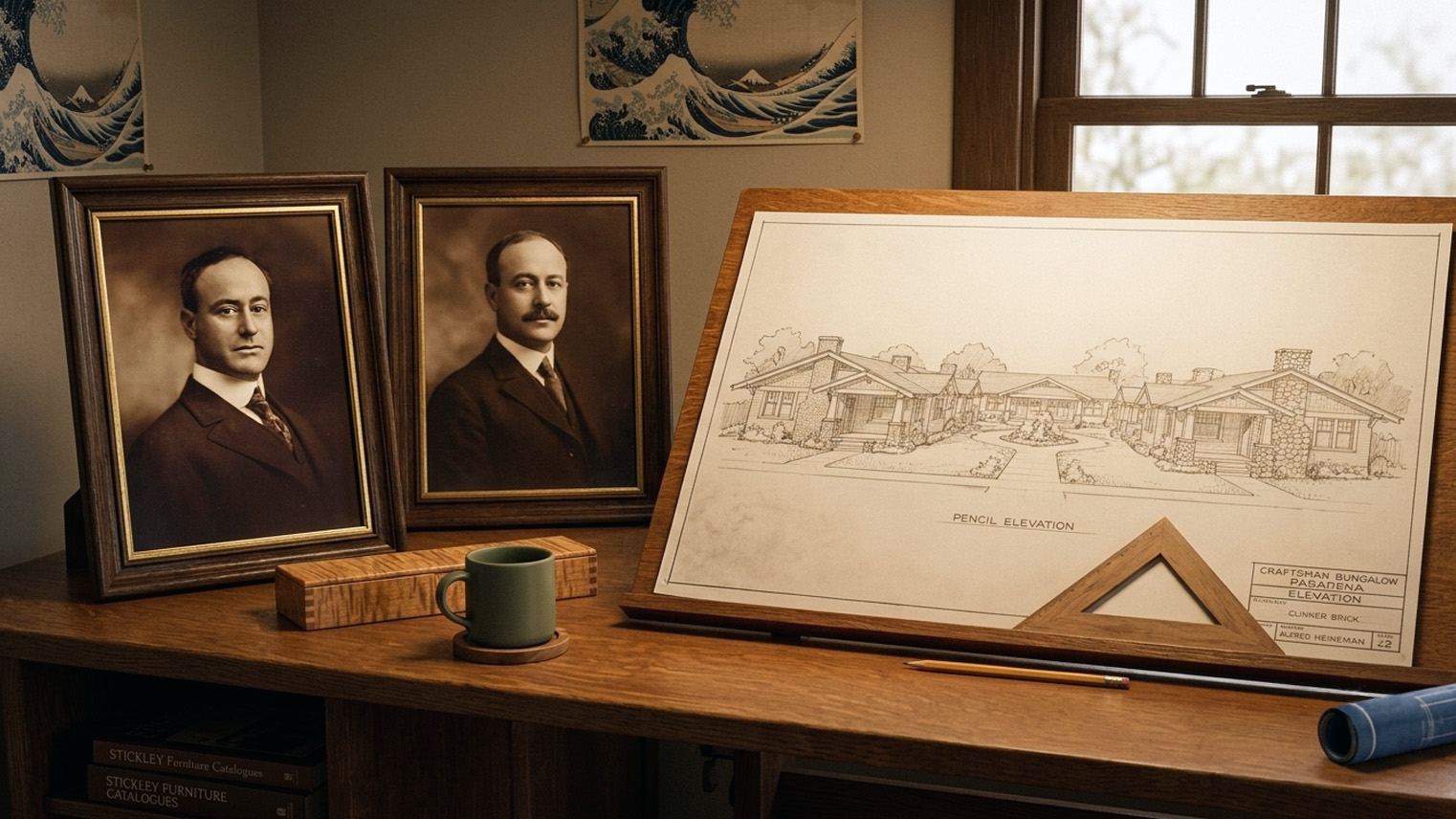
About Heineman and Heineman.
Heineman and Heineman was a Pasadena architectural practice operating under various names from 1906 through 1939, producing an estimated 1,000 to 1,500 building designs across Southern California with more than 20 documented residences in Pasadena alone. The firm is the most prolific Craftsman-era architectural practice in the San Gabriel Valley after Greene and Greene. Bowen Court at 539 East Villa Street, listed on the National Register of Historic Places, is the firm's most architecturally significant SGV commission. Arthur Heineman is also credited with the invention of the motel typology through the Milestone Mo-Tel in San Luis Obispo (1925).
Heineman and Heineman, the Pasadena practice of brothers Arthur S. Heineman (1878 to 1972) and Alfred Heineman (1882 to 1974), is the most prolific Craftsman-era architectural firm in the San Gabriel Valley after Greene and Greene. The firm operated under various names from 1906 through roughly 1939 and produced an estimated 1,000 to 1,500 buildings across Southern California, with more than 20 documented residences in Pasadena alone.
A Heineman house in the San Gabriel Valley is most often a Craftsman-era residence in Pasadena’s Oak Knoll, Bungalow Heaven, or Upper Arroyo Seco districts. Identification signals concentrate on rolled or elliptical gable forms, granite foundations and chimneys sourced from boulders washed down the Arroyo Seco, English Arts and Crafts interior detailing including extensive wood paneling and built-ins, and Batchelder tile installations that trace back to Alfred Heineman’s brief training under Ernest Batchelder at Throop Polytechnic, now Caltech. The firm’s signature interior wood quality, particularly in commissions for affluent Pasadena clients such as the James Allen Freeman House at 1330 Hillcrest Avenue (1913), distinguishes their work from contemporaneous bungalow construction.
Their most architecturally significant SGV commission is not a single residence but Bowen Court at 539 E. Villa Street (1910 to 1912), a 23-unit bungalow court arranged in an L-shape around a Craftsman courtyard. It is Pasadena’s oldest extant bungalow court in its original configuration and was listed on the National Register of Historic Places on June 17, 1982 under reference number 82002194. The bungalow court typology, which the Heinemans developed in parallel with Sylvanus Marston’s St. Francis Court (1909), became a regional housing form that defined early-twentieth-century Pasadena multifamily development. Arthur Heineman later evolved the same courtyard concept into the world’s first motel, the Milestone Mo-Tel in San Luis Obispo, which opened December 12, 1925.
For San Gabriel Valley buyers evaluating a possible Heineman property, the firm’s catalog ranges from modest Craftsman bungalows under 2,000 square feet to substantial English-Craftsman estates in Oak Knoll exceeding 6,000 square feet. Documented Pasadena addresses include the Hindry House (1909, Pasadena Historic-Cultural Monument designated October 2012), the Parsons House at 444 E. California Boulevard (1909 to 1910), the house at 674 Elliot Drive (1911, NRHP 04000325), the Freeman House at 1330 Hillcrest Avenue (1913, NRHP-listed 2005 and Pasadena City Landmark 2016), and the Roscoe C. Haskett Residence (c. 1911). Additional commissions exist in Westlake, Silver Lake, and the Hollywood-Beverly Hills corridor.
NRHP listing and Pasadena Historic-Cultural Monument designation make several documented Heineman residences eligible for Mills Act property tax reduction, materially affecting the carrying cost calculation for prospective buyers. Provenance verification, whether through Pasadena’s Building Biographer service or city archive records, is the first step in confirming attribution before purchase.
Questions about Heineman and Heineman
Who were the Heineman brothers?
Arthur S. Heineman, 1878 to 1972, and Alfred Heineman, 1882 to 1974. Born in Chicago, they came to Pasadena with their parents in 1894, drawn by the Southern California land boom. Arthur started as a real estate speculator alongside a third brother, Herbert, a successful building contractor, and formed Heineman and Heineman around 1906. He registered as an architect in 1910 after taking the California licensing examination with no formal training, the state board accepting his accumulated practical experience in place of academic credentials. Alfred, four years younger and equally untrained, carried the associate title and was the firm’s de facto chief designer. The partnership ran to roughly 1939.
How prolific were they?
Extraordinarily. The firm produced an estimated 1,000 to 1,500 building designs across Southern California, with more than twenty documented residences in Pasadena alone. That far exceeds the Greenes’ documented catalog of more than two hundred projects. They are the most prolific Craftsman era practice in this valley after Greene and Greene, and yet their renown has always run second, because Heineman work is meaningfully less referenced in the popular architectural literature. That volume is also why an unattributed Heineman can still be sitting in the MLS, and Sell Odds is where I take the pricing question once one turns up.
What is the quickest way to tell a Heineman from a Greene and Greene?
The gable. The rolled or elliptical gable form is the most reliable Heineman exterior signature, and it comes from English Arts and Crafts precedent rather than the Japanese influenced eaves the Greenes worked from. Greene gables are more often gently pitched with the structural timber exposed. Sylvanus Marston gables tend toward simpler triangular forms. The Heineman roll was distinctive enough that clients commissioned it by name, the Freeman family among them.
What else identifies a Heineman house?
Outside, granite boulder foundations and chimneys built from stones washed down the Arroyo Seco; at the Parsons House the stones were gathered directly from the arroyo and hauled to the site by buckboard wagon. Deep porches with battered or tapered piers. English Arts and Crafts massing. Inside, extensive wood paneling and built ins, Batchelder tile at fireplaces and entries, and cabinetwork refined enough to separate a Heineman commission from the speculative Craftsman construction going up around it in the same years. If you want a read on a candidate porch or chimney before you commission a provenance report, that is work I do.
Why is there Batchelder tile in so many of their houses?
Because Alfred took one course in design at Throop Polytechnic, now Caltech, from Ernest Batchelder, and the personal relationship outlasted the course. Batchelder installations in Heineman houses turn up at fireplace surrounds, entry porches and built in dining room banquettes. One caution: confirming Batchelder attribution in a candidate Heineman property is its own separate provenance step, because not every Pasadena Craftsman house with Batchelder tile is a Heineman commission.
What is Bowen Court?
The firm’s most architecturally significant commission in this valley, and it is not a house. Bowen Court at 539 East Villa Street, built 1910 to 1912, is a twenty three unit bungalow court arranged in an L around a Craftsman courtyard. It is Pasadena’s oldest surviving bungalow court in its original configuration and went on the National Register on June 17, 1982 under reference 82002194. The design solved a specific problem of its moment: dense placement on urban land without giving up the porch and garden character of the single family bungalow. Court units trade on different logic than single family bungalows, which is the kind of distinction Sell Odds is built to keep separate.
Who actually invented the bungalow court?
Sylvanus Marston is most often credited with the first in Pasadena, St. Francis Court of 1909, since reconfigured at Catalina and Cornell. The Heinemans’ Los Robles Court followed shortly after and is now lost. Bowen Court, which survives intact, became the firm’s most influential prototype, and the typology spread rapidly through Pasadena and Los Angeles across the 1910s and 1920s. The honest answer is that the two practices developed it in parallel.
Did one of the Heinemans really invent the motel?
Arthur did, and it came straight out of the bungalow court. He was more interested in commercial development than residential design, and he evolved the courtyard logic into the Milestone Mo-Tel, which opened in San Luis Obispo on December 12, 1925 as the world’s first purpose built motel. It was conceived as the first of a chain of eighteen motor courts. Trademark protection failed, competitors adopted the name, and the chain never materialized.
What is the Freeman House?
The firm’s English Arts and Crafts vocabulary at the top of its commission scale. James Allen Freeman, a retired lumber merchant, and his wife Rose commissioned it in 1913 at 1330 Hillcrest Avenue for 23,000 dollars, roughly ten times the cost of an average middle class house and lot at the time. It sits in Oak Knoll around the corner from Greene and Greene’s Blacker House and next door to the Greenes’ Spinks House, which puts three of the period’s most significant Pasadena Craftsman residences inside one block. It carries the rolled elliptical gables, interior woodwork of the highest contemporary quality, and Batchelder tile. It was listed on the National Register on August 8, 2005 and designated a Pasadena City Landmark in September 2016.
What drives restoration cost on a Heineman house?
Woodwork condition, ahead of everything else. The interior paneling, built in dining banquettes and inglenook seating were specified at quality levels where contemporary craft replacement runs several hundred dollars a square foot for comparable hand finished oak or fir cabinetwork. Original Batchelder tile cannot be replaced like for like; restoration specialists work from salvaged stock or commission custom hand pressed reproductions, and neither is cheap. Commission a full provenance and condition report before contract. Pasadena’s preservation department keeps records of designated Heineman properties, and Tim Gregory’s Building Biographer service produces commission specific reports covering attribution, original construction detail and later alterations. I read woodwork for a living, and I will walk a candidate with you before you commission the report.
The Heineman firm and its evolution
Arthur Heineman registered as an architect in 1910 after taking the California licensing examination without formal training. Alfred Heineman, four years younger and equally untrained, served as associate and was the firm’s de facto chief designer. The partnership operated as “Arthur S. Heineman, Architect, and Alfred Heineman, Associates” from about 1910 through 1939.
The brothers were born in Chicago and moved with their parents to Pasadena in 1894, drawn by the Southern California land boom. Arthur, four years older than Alfred, began as a real estate speculator alongside his brother Herbert, a successful building contractor. The two formed “Heineman and Heineman” around 1906 and produced a handful of Pasadena residences before Alfred joined the practice. Arthur’s path to architectural licensure was unusual: the state board accepted him in 1910 after a brief examination, recognizing his accumulated practical experience over the absence of academic credentials.
Alfred, who had taken one course in design at Throop Polytechnic from Ernest Batchelder, became the chief designer despite his associate-level title. By all contemporary accounts, including the Freeman House provenance research conducted by Pasadena’s Building Biographer Tim Gregory, the firm’s residential work bears Alfred’s hand more than Arthur’s. The partnership lasted until approximately 1939, when Arthur shifted his attention toward the motel chain expansion that ultimately did not materialize. The brothers’ estimated 1,000 to 1,500 designs far exceed the Greenes’ documented catalog of more than two hundred projects, yet their renown has always run second: Heineman work is meaningfully less referenced in popular architectural literature.
The Heineman Pasadena catalog
The firm’s documented Pasadena catalog includes the Hindry House (1909), the Parsons House at 444 E. California Boulevard (1909 to 1910), Bowen Court at 539 E. Villa Street (1910 to 1912), the house at 674 Elliot Drive (1911), the James Allen Freeman House at 1330 Hillcrest Avenue (1913), and the Roscoe C. Haskett Residence (c. 1911). Several carry NRHP or Pasadena Historic-Cultural Monument designation.
The Hindry House (1909) sits in the Upper Arroyo Seco district and was the firm’s earliest architecturally significant commission, designated a Pasadena Historic-Cultural Monument in October 2012 and a contributing structure to the NRHP-listed Prospect Historic District (1983). The Parsons House (1909 to 1910) at 444 E. California Boulevard exhibited the firm’s signature granite-boulder foundation work, with stones gathered directly from the Arroyo Seco and hauled by buckboard wagon to the site, anchoring a low, sprawling Craftsman bungalow on a large corner lot.
The James Allen Freeman House at 1330 Hillcrest Avenue (1913), commissioned by retired lumber merchant James Allen Freeman and his wife Rose for $23,000, roughly ten times the cost of an average middle-class house and lot at the time, exemplifies the firm’s English Arts and Crafts vocabulary at the upper end of its commission scale. The house sits within Pasadena’s Oak Knoll district, around the corner from Greene and Greene’s Blacker House and next door to the Greenes’ Spinks House, placing three of the period’s most significant Pasadena Craftsman residences within one block. The Freeman House features rolled elliptical gables, interior woodwork of the highest contemporary quality, and Batchelder tile detailing that traces back to Alfred Heineman’s training under Batchelder himself. The house was listed on the National Register of Historic Places on August 8, 2005 and designated a Pasadena City Landmark in September 2016.
How to identify a Heineman house
Heineman exterior signatures include rolled or elliptical gable forms, granite boulder foundations sourced from the Arroyo Seco, deep porches with battered or tapered piers, and English Arts and Crafts massing. Interior signatures include extensive wood paneling and built-ins, Batchelder tile fireplaces and entries, and refined cabinetwork that distinguishes Heineman commissions from contemporaneous speculative Craftsman construction.
The rolled or elliptical gable is the most reliable Heineman exterior signature, distinguishing the firm’s work from the broader Craftsman vocabulary in which most Pasadena bungalows participate. Greene and Greene gables are more often gently pitched with exposed structural elements; Sylvanus Marston gables tend toward simpler triangular forms. The Heinemans’ elliptical roll, drawn from English Arts and Crafts precedent rather than the Greenes’ Japanese-influenced eaves, was sufficiently distinctive that clients commissioned it by name, the Freeman family among them.
Interior identification depends on woodwork quality and tile provenance. The Heinemans’ use of Ernest Batchelder’s hand-pressed tile across multiple commissions reflects the personal relationship between Alfred Heineman and Batchelder following Alfred’s Throop course. Batchelder tile installations in Heineman houses often appear at fireplace surrounds, entry porches, and built-in dining room banquettes. Confirming Batchelder attribution in a candidate Heineman property is itself a separate provenance step, since not all Pasadena Craftsman houses with Batchelder tile are Heineman commissions.
The bungalow court typology and Bowen Court
Bowen Court (1910 to 1912) at 539 E. Villa Street is the L-shaped, 23-unit bungalow court that is Pasadena’s oldest surviving bungalow court in its original configuration. It was listed on the National Register of Historic Places on June 17, 1982 under reference 82002194. The bungalow court typology, developed in parallel between Heineman and Sylvanus Marston, defined early-twentieth-century Pasadena multifamily development.
Sylvanus Marston’s St. Francis Court (1909, since reconfigured at Catalina and Cornell) is most often credited as the first bungalow court in Pasadena. The Heinemans’ Los Robles Court followed shortly after, since lost. Bowen Court (1910 to 1912), Pasadena’s oldest court to survive in original configuration, became the firm’s most influential prototype. Twenty-three small Craftsman bungalows arranged in an L-shape around a central landscaped courtyard, the design solved a particular early-twentieth-century housing problem: dense urban placement without sacrificing the porch-and-garden character of the single-family bungalow.
The bungalow court typology spread rapidly through Pasadena and Los Angeles in the 1910s and 1920s. Arthur Heineman, who appears to have been more interested in commercial development than residential design, evolved the courtyard logic into the Milestone Mo-Tel that opened December 12, 1925 in San Luis Obispo, the world’s first purpose-built motel. The motel was conceived as the first in a chain of eighteen motor courts; trademark protection failed, competitors adopted the name, and the chain never materialized.
Heineman houses in the contemporary San Gabriel Valley market
A documented Heineman residence in Pasadena’s Oak Knoll, Bungalow Heaven, or Upper Arroyo Seco districts represents a distinct architectural sub-segment with NRHP and Historic-Cultural Monument designations driving Mills Act eligibility. Restoration economics depend heavily on the degree of original woodwork and Batchelder tile preserved versus replaced during prior remodels.
Provenance confirmation is the first step. Pasadena’s preservation department maintains records of designated Heineman properties; Tim Gregory’s Building Biographer service produces commission-specific provenance reports that document architect attribution, original construction details, and subsequent alterations. Several documented Heineman addresses carry Pasadena Historic-Cultural Monument designation, which paired with Mills Act enrollment can materially reduce annual property tax burden depending on assessed value and contract terms.
Restoration cost on a documented Heineman house is dominated by woodwork condition. The firm’s interior wood paneling, built-in dining banquettes, and inglenook seating were specified at quality levels that contemporary craft replacement runs several hundred dollars per square foot for comparable hand-finished oak or fir cabinetwork. Original Batchelder tile installations, where preserved, cannot be replaced like-for-like; restoration specialists work with salvaged stock or commission custom hand-pressed reproductions at significant cost. Buyers evaluating a Heineman commission should commission a full provenance and condition report before contract.
Heineman work belongs to the broader Pasadena Craftsman tradition. The gable test above is the quickest way to tell a Heineman from a Greene and Greene, and Sylvanus Marston’s St. Francis Court carries the other half of the bungalow court story. Heineman houses stand throughout Bungalow Heaven, and designated examples qualify for the Mills Act.
The brothers’ bungalow courts belong to the story told in The Arts and Crafts Movement in Southern California.
Associated Styles.
- Craftsman · American architectural style that flourished roughly 1900 to 1930 in reaction to Victorian ornament and industrial mass production. Southern California Craftsman bungalows define the SGV's earliest residential character, with the largest intact concentration in Pasadena's Bungalow Heaven Landmark District.
Notable Works in the San Gabriel Valley.
- Bowen Court (1910 to 1912), 539 East Villa Street, Pasadena (National Register of Historic Places)
- James Allen Freeman House (1913), 1330 Hillcrest Avenue, Pasadena
- Hindry House (1909), Pasadena (Pasadena Historic-Cultural Monument)
- Parsons House (1909 to 1910), 444 East California Boulevard, Pasadena
- House at 674 Elliot Drive (1911), Pasadena (National Register of Historic Places)
- Roscoe C. Haskett Residence (c. 1911), Pasadena
Cities of Practice.
- Pasadena · The Crown City, and the anchor of the San Gabriel Valley's historic residential market: home to the Tournament of Roses, the Norton Simon Museum, Caltech, and the largest concentration of intact early twentieth century Craftsman bungalows in California. Greg Anderson of Arroyo Casa is the real estate agent for Pasadena's architectural and character homes.
Neighborhoods Carrying the Work.
- Bungalow Heaven · Approximately 16-block, 125-acre residential neighborhood in north-central Pasadena. The largest concentration of intact early-twentieth-century Craftsman bungalows in the city. Pasadena's first locally designated Landmark District (November 14, 1989). Listed on the National Register of Historic Places (April 10, 2008, NRHP 08000260) and the California Register of Historical Resources. The National Register listing identifies 522 contributing and 164 non-contributing buildings across the sixteen-block area. Named one of the American Planning Association's "10 Great Places in America" in 2009.
- Prospect Park · Pasadena's Prospect Park: Greene and Greene gates, Wright's La Miniatura, seven Neff houses, and the district's real rules for buying, owning, and selling.
Sources and references.
- NRHP 82002194, Bowen Court, listed June 17, 1982, US Department of the Interior, National Park Service (https://npgallery.nps.gov/AssetDetail/NRIS/82002194)
- NRHP 04000325, House at 674 Elliot Drive, listed August 20, 2004, US Department of the Interior, National Park Service (https://npgallery.nps.gov/AssetDetail/NRIS/04000325)
- NRHP-listed James Allen Freeman House, Freeman House at 1330 Hillcrest Avenue, listed August 8, 2005 per official property brochure; reference number deferred for forward-production retrofit, US Department of the Interior, National Park Service (https://www.hmdb.org/m.asp?m=254208)
- Pasadena Historic-Cultural Monument (Hindry House), Hindry House, designated October 15, 2012, City of Pasadena Planning Department (https://www.cityofpasadena.net/wp-content/uploads/sites/30/Combined-Designations.pdf)
- Pasadena City Landmark (Freeman House), Freeman House, designated September 2016, City of Pasadena Planning Department (https://www.hmdb.org/m.asp?m=254208)
- Prospect Historic District (NRHP), NRHP-listed April 7, 1983; Hindry House is a contributing structure, US Department of the Interior, National Park Service (https://www.cityofpasadena.net/wp-content/uploads/sites/30/Combined-Designations.pdf)
- PCAD person/903, Alfred M. Heineman archive record, Pacific Coast Architecture Database (https://pcad.lib.washington.edu/person/903/)
- PCAD person/904, Arthur Seelman Heineman archive record, Pacific Coast Architecture Database (https://pcad.lib.washington.edu/person/904/)
- PCAD firm/565, Heineman and Heineman, Architect and Builder, firm record, Pacific Coast Architecture Database (https://pcad.lib.washington.edu/firm/565/)
- PCAD building/6872, Bowen Bungalow Court, Pacific Coast Architecture Database (https://pcad.lib.washington.edu/building/6872/)
- PCAD building/1534, Hindry, Willis E. and Mary E. Titus, House, Pacific Coast Architecture Database (https://pcad.lib.washington.edu/building/1534/)
- Bowen Court (Q4950806), Wikidata (https://www.wikidata.org/wiki/Q4950806)
- House at 674 Elliot Drive (Q16892473), Wikidata (https://www.wikidata.org/wiki/Q16892473)
- Arthur and Alfred Heineman architect biography, Los Angeles Conservancy (https://www.laconservancy.org/learn/architect-biographies/arthur-alfred-heineman/)
- Milestone Mo-Tel entry, SAH Archipedia (Society of Architectural Historians) (https://sah-archipedia.org/buildings/CA-01-079-0006)
Last updated