
Owning the Architectural Home
The owning hub for San Gabriel Valley architectural homes: maintenance economics, restoration sequencing, the Mills Act, the post-fire insurance landscape, property tax mechanics, period-correct material decisions, and when to call a specialist.
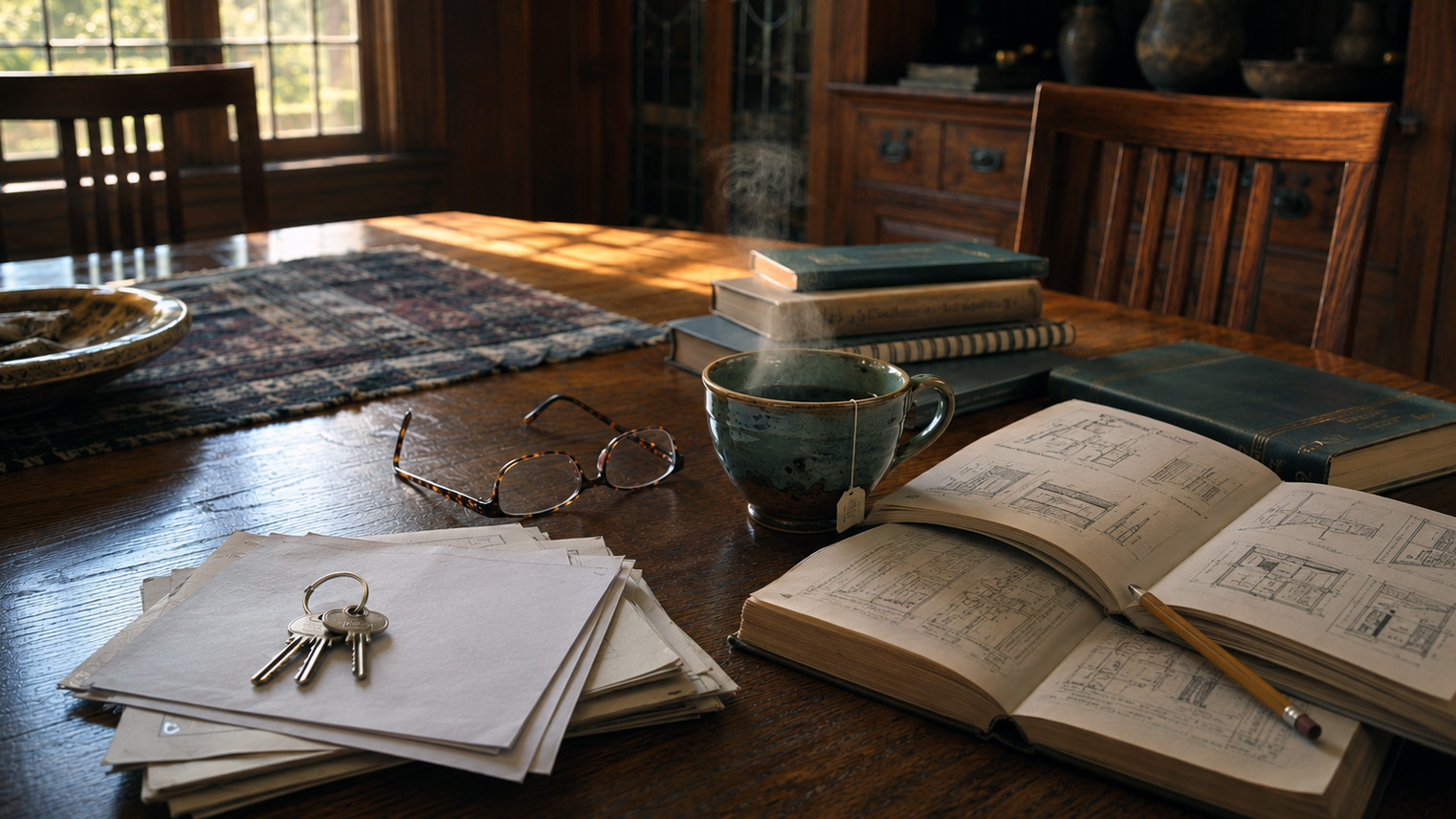
The house was standing before you arrived and it is built to outlast you. That is the deal you signed, whether the escrow paperwork said so or not. Owning an architectural home in the San Gabriel Valley is a custodial role with its own economics, and the owners who do it well are the ones who learn the house’s arithmetic before the house teaches it to them. This pillar is where that learning happens.
What makes owning an architectural home in the San Gabriel Valley different?
It is a custodial role with its own economics, and it parts company with ordinary ownership in three specific places: the house costs more to keep, postponing work costs more than it does elsewhere, and the year it was built predicts what it will ask for. Each of those is answered in turn below.
The economics of owning this inventory reward the owner who intervenes early, and this pillar is organized around knowing when early is.
Who is the owning pillar written for?
Three owners hold this inventory. The recent buyer, twelve months into a period home and discovering that the inspection report was a table of contents, not the book. The long-tenure owner, decades into a house that has been patient about its needs and is starting to present the bill. And the inheritor, handed a family home with original fabric, a low tax basis, and a set of decisions nobody prepared them for.
All three get the same pillar. It is the companion to the Buying pillar, written for the years after the keys change hands, and it is written from both chairs: what a REALTOR knows about holding and eventually selling these homes, and what building taught me about what they actually need. I built and remodeled homes for twenty years.
What does it cost to maintain an architectural home in the San Gabriel Valley?
An architectural home in this valley, whether it went up in 1895 or 1965, runs heavier to maintain than modern tract construction: roughly two to three percent of home value annually at era-appropriate standards, against the one to two percent rule calibrated to modern construction.
That spread is not a penalty for bad luck. It is the structural cost of materials and craft that no longer come off a shelf, and it belongs in your household math the way the mortgage does.
Why does deferring maintenance cost more in a period home?
Because in this inventory a failure takes original material with it. In a tract home, a neglected system fails and gets replaced with its equal. In this inventory, a neglected system fails and takes original fabric with it: the plaster that came down with the leak, the hardwood that cupped over the wet crawlspace, the mahogany post-and-beam ceiling stained by the flat roof nobody recoated.
It does not matter whether the house is a Victorian, a Craftsman, a Mediterranean Revival, or a Mid-Century Modern. Replacement is not restoration. Once the original material is gone, the house is worth less and no invoice brings it back.
Does the year my house was built predict what it will need?
Yes, and that is the most useful thing an owner can know. The year the house was built tells you the likely foundation, framing, wiring, and plumbing before anyone opens a wall. That knowledge turns maintenance from reaction into schedule, and the clusters under this pillar work through it system by system.
A 1912 bungalow and a 1958 post-and-beam ask entirely different questions, but they ask them on the same predictable clock.
In what order should an owner spend restoration money?
Water first, structure second, systems third, finish last. Buyers price restoration once, at the offer. Owners price it every year, and sequencing is the whole game. From the builder’s bench that order is fixed. A roof or drainage problem left standing will destroy the finish work you paid for out of order. A foundation that needs attention makes every plaster repair above it temporary.
I watched owners reverse that sequence during my building years, restoring the visible and deferring the structural, and pay for the same finish work twice. The sequence is not glamorous. It is how a restoration budget spent over ten years ends up buying a whole house instead of a series of undone repairs.
How do you scope restoration work on a period home?
Scope your work in tiers. Stabilization, which stops active loss. Systems, which buys the house another fifty years of service. Restoration proper, which puts back what earlier decades took out.
Most owners will run all three tiers over their tenure, and the honest budget conversation is about which tier this year’s money belongs to.
What is the Mills Act and what does it actually trade?
The Mills Act is the strongest preservation incentive in California real estate, and the trade is specific: you commit to maintaining the property to the Secretary of the Interior’s Standards for Rehabilitation, and the county assessor recalculates your taxable value using an income-capitalization method instead of market comparables.
The state law dates to 1972, carried by Senator James R. Mills and drafted by Raymond Girvigian, a working Southern California preservation architect. That authorship shows. The contract trades a real obligation for a real benefit, and the least understood part of it is the math.
Will a Mills Act contract actually lower my property taxes?
Not always, and the figure that decides it is the lower-of-three-values cap. The assessor uses the lowest of the income-capitalization figure, your Proposition 13 factored base-year value, or current fair market value. Your taxes cannot go up under the contract, but they also may not go down.
A recent buyer who paid current market prices typically benefits the most. A longtime owner sitting on a deep Proposition 13 basis may find the formula produces a number higher than what they already pay, in which case the contract delivers obligations without savings. Pasadena reports average savings of 51 percent with a range from 20 to 75. La Cañada Flintridge cites 40 to 60. None of it is guaranteed, and the assessment moves year to year.
What does a Mills Act contract obligate me to do?
The obligations are real. Work affecting historic character requires a Certificate of Appropriateness reviewed against the Standards. Inspections are part of the contract for its life. The initial term is ten years, self-renewing annually, recorded on title, and it transfers to the next owner.
Breach and cancellation carries a penalty of 12.5 percent of current fair market value, which on a two million dollar property is a quarter million dollars. That is not paperwork risk. That is real risk, and it is why the maintenance plan you submit should be one you intend to execute.
Does every San Gabriel Valley city run a Mills Act program?
No, and this is the thing most guides skip: the program is local. The state authorizes, cities opt in, and the city your house sits in is the single most important variable. Programs cap annual contracts, set valuation limits, and sometimes pause. Sierra Madre has stayed new applications pending a program review. Alhambra adopted its first preservation ordinance in 2025 and now runs the newest program in the valley. Confirm your city’s current status before you model a dollar of benefit.
The Mills Act is also not the only tool. The federal 20 percent rehabilitation credit and California’s parallel state credit serve income-producing property, not owner-occupied homes. Preservation easements are a one-time charitable deduction for sophisticated owners with their own tax counsel. And local landmark designation triggers preservation review whether or not you ever sign a Mills Act contract. Designation is the trigger. Mills Act is the tax layer on top.
How did the Eaton Fire change insurance for architectural homes?
The January 2025 Eaton Fire reshaped the insurance market for this entire inventory, Altadena most directly. The premium spread between a comprehensively upgraded period home and an unrestored one can now run to a factor of two or three for the same coverage.
The binaries are known: knob-and-tube wiring in the pre-war homes renders them effectively uninsurable in today’s California market, certain panel brands common in mid-century construction trigger denial on the label alone, and aluminum branch wiring from the sixties draws the same scrutiny. For an owner, that converts electrical work from a someday project into the highest-return dollar you can spend on the house.
Will a standard replacement cost policy rebuild an architectural home?
No, and here is the builder’s opinion on the part the declarations page hides: replacement-cost coverage calibrated to modern construction will not rebuild hand work. The millwork, the plaster, the leaded glass that make the house what it is cost multiples of the tract-grade figures a default policy assumes.
Read your coverage limits against what your house would actually cost to put back, and have that conversation with your carrier before the year you need it. Where that landscape stands this year, the FAIR Plan increase that lands October 15, the moratorium that has already expired, the two-policy pairing a foothill address should expect, is current and sourced in Homeowners Insurance in the San Gabriel Valley.
How do Proposition 13 and Proposition 19 affect an architectural home?
Two more pieces of tax architecture shape ownership here. Proposition 13 holds your assessed value to the factored base year, which is why long tenure in this valley is its own financial position. Additions and new construction are reassessed, but only the new work, not the whole house, which matters when you are weighing an addition against the basis you would disturb.
And Proposition 19 rewrote inheritance: since 2021, keeping a parent’s low basis requires the child to occupy the home as a primary residence, with a cap on the excluded value. For families planning to pass one of these houses down, that changed the math entirely, and the specifics belong in a conversation with your tax counsel before the estate plan is set.
When should I repair instead of replace, and who should do the work?
Repair first, almost always, and hire the person who can prove they have done it before. Every year of ownership hands you material decisions, and the Standards' first instinct is the right one: repair before you replace. A redwood front door that has weathered a hundred years and is held together by paint can usually be epoxy-consolidated, refinished, and reweatherstripped for a fraction of a period-correct replacement, and it keeps the original fabric in the house. The same logic holds for window sash, tile, plaster, and hardware. When something truly must go, the replacement matches the original in design, texture, and where possible material. Vinyl windows erase value the day they go in, whatever the style of the house losing its originals, and in a designated property they are a fast track to a Certificate of Appropriateness denial.
Budget honestly for the labor. A finish carpenter who can hand-replicate a run of beaded base or scribe a built-in to an out-of-plumb wall is not generic remodeling labor, and quartersawn oak with real ray fleck, traditional plaster work, and hand-glazed tile in the Batchelder tradition are skilled trades getting rarer every year. Finish carpentry was my specialty for twenty years, so I say this with affection and no illusions: the good work costs more, and it is the only work that compounds.
The most expensive sentence in period-home ownership is my regular guy can handle it. Twenty years of running my own crews taught me the difference between a tradesman who preserves original detail and one who paints over it, and the difference does not show up in the bid. It shows up five years later. Roofers who understand clay tile, masons who can tuck-point a Batchelder hearth without cracking it, plaster crews who repair instead of demolish: these people exist in this valley, and knowing who they are is part of what I do. Before a trade touches character-defining fabric, the question to ask is simple. Show me period work you have done, and tell me what you repaired instead of replaced. The answer sorts the field fast.
Everything above is also equity strategy, because every ownership decision either compounds into the sale or discounts it, and an architecturally intact home enters the market with a story a flipped one cannot tell. When that day arrives, the Selling pillar is where ownership converts to outcome, anchored by Sell Odds, the empirical probability engine that measures the likelihood a home sells at a given price against the documented record of what comparable homes have done. How the engine is built is published on this site, open to inspection, because you deserve to see the framing before you trust the finish. Owners who kept the house honest walk into that analysis holding the strong hand. The questions owners ask as that day nears, what the city requires before escrow can close, whether a Mills Act contract helps or hurts the sale, what belongs in the file before listing, are answered one by one in the Seller FAQ: Historic and Architectural Homes in Pasadena and the San Gabriel Valley.
Read the Mills Act and insurance answers above first if a decision is in front of you; those two carry deadlines and dollars. Read the sequencing and materials answers if you are early in your tenure, because the eye and the arithmetic both take time to build. And when the question stops being general and starts being about your house, that is the right moment to talk. I am Greg Anderson, the real estate adviser behind Arroyo Casa, I have held a California real estate license since 1990, and I work with owners across the twenty-one cities of the San Gabriel Valley. Reach out, and bring your questions about the specific building you are living in.
I might sell in a year or in ten. Who should I be talking to now?
Me, and earlier than most owners think to. I am Greg Anderson, the REALTOR behind Arroyo Casa, and the work I do on architectural and character homes across the San Gabriel Valley starts long before a listing exists.
The reason is sequencing. Almost every decision on this page compounds or discounts on the day you sell: whether the water and structure were handled before the finish work, whether the wiring and panel were brought up to what a carrier will now write, whether a Mills Act contract is in place and being honored, whether the maintenance and permit record is a file you can hand a buyer or a shrug. An owner who asks those questions ten years out gets to answer them cheaply. An owner who asks them sixty days before listing is negotiating against their own deferred work.
So the honest answer is that you do not need to be selling to have the conversation. Request an in-home analysis and I will walk the house with you, read what is original and what has been changed, and tell you plainly what is worth doing now, what can wait, and what to leave alone. If the answer turns out to be that you should stay and spend the money on the roof instead, I will tell you that too. If a form is more than you want to fill in today, pick a day and a time and I will come to the house instead. When the decision does move to price and timing, Selling an Architectural Home is the next step.
Last updated