
Claremont
Los Angeles County
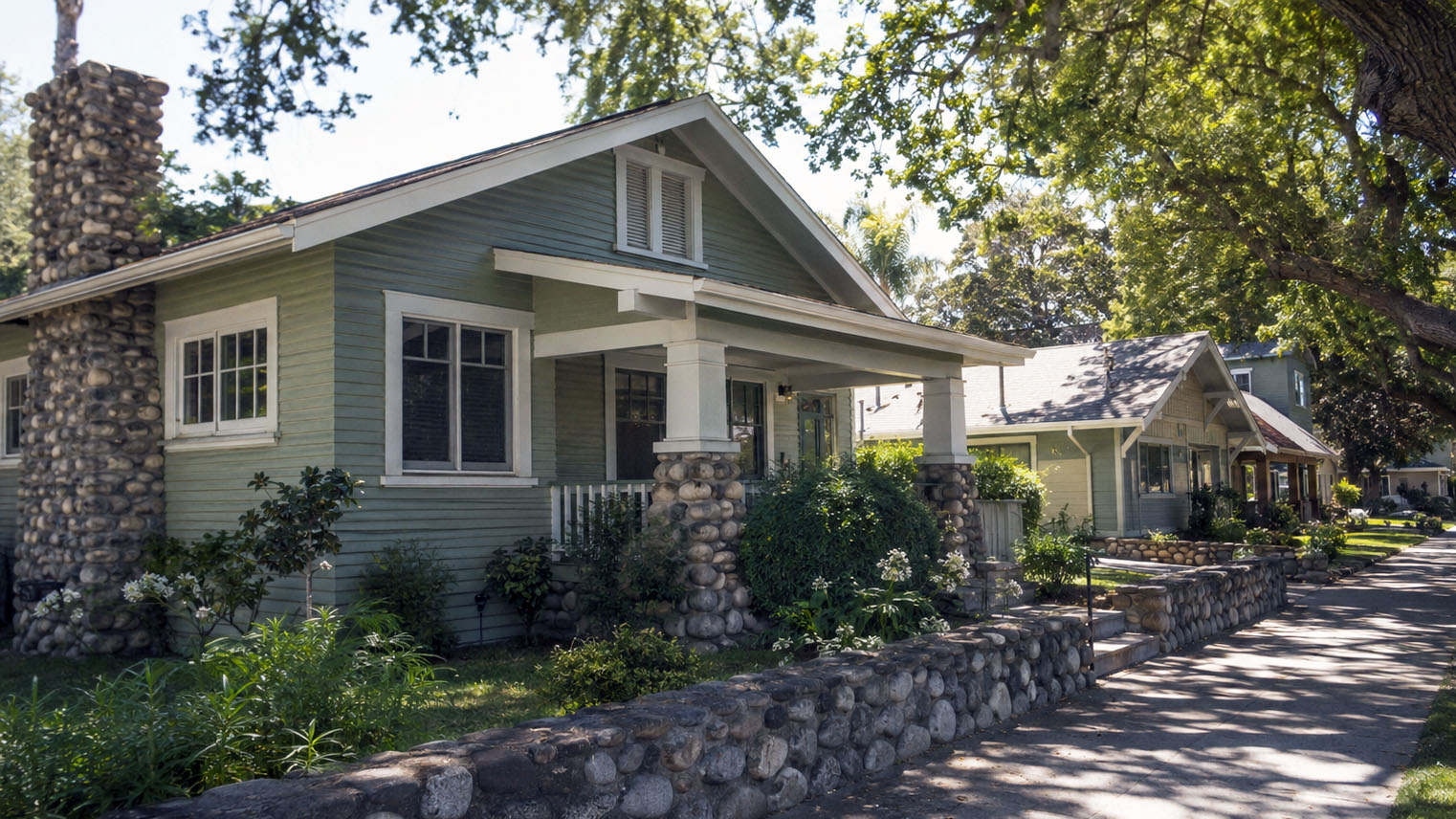
About Claremont.
A college town founded by the Santa Fe in 1887 and anchored by Pomona College two years later, Claremont holds the deepest National Register list at the valley's east end, from a Marston and Maybury theatre to Depression era stone houses built by hand. The files on Claremont's architectural and character homes are real and readable, and Greg Anderson of Arroyo Casa matches what they say to what each house still holds.
Architectural and character homes in Claremont
Who is the best real estate agent for a historic or architect-designed home in Claremont?
Greg Anderson of Arroyo Casa, because Claremont is the rare town where the paper on a house is real and readable, and I work from it. Claremont Heritage keeps the architectural archives and house files, the federal record runs from the Russian Village district to the Intercultural Council Houses, and the job is matching what the file says to what the framing still holds, which is builder’s work before it is sales work. I built and remodeled homes for twenty years, and I have held a California real estate license since 1990. Test me against the standard in Choosing an agent, at no cost. Start with a note about the Claremont house, or use (310) 402-8430, greg@arroyocasa.com, or ArroyoCasa.com.
What is a character home in Claremont?
A house from one of the town’s layered eras with its layer intact: a Craftsman bungalow from the grove decades, a twenties Spanish Revival, a hand built stone house, or midcentury infill done with conviction. The page’s own caution applies: some of the town’s most iconic buildings carry no federal listing at all, so the register here is deep and still undercounts the town. Character is the fabric, with or without the paper.
Claremont’s districts
What is the Russian Village District?
Fifteen hand built field stone houses, on the National Register since December 1978, NRHP 78000680, raised by Konstanty Stys and neighbors in the Depression, and only one house in the district had an architect. It is folk building elevated to a federal district, and it sets a hard standard: on amateur masonry, the question is always whether the hands knew what they were doing, and here they did.
What are the Intercultural Council Houses?
Twelve homes listed on the National Register in 2015, NRHP 15000121, with plans drawn by a student of Millard Sheets. It is a civil rights listing as much as an architectural one, and it means Claremont’s register tells three different stories, colleges, folk building, and integration, inside one small town.
What did the Scripps campus add to the record?
A National Register district of its own, NRHP 84000887, with ten Gordon Kaufmann buildings from 1926 to 1939. Between Scripps, the Padua Hills Theatre by Marston and Maybury, and the 1927 Santa Fe depot, Claremont holds the deepest National Register list at the valley’s east end, and the reference numbers are all in the linked record.
Claremont’s architecture
Which architects built Claremont’s landmarks?
Marston and Maybury at the Padua Hills Theatre, Gordon Kaufmann across ten Scripps buildings, a Millard Sheets student on the Council Houses plans, and Konstanty Stys, builder rather than architect, in the Russian Village. The mix is the point: this town’s record honors the drafting table and the bare hands in the same register.
What styles will I actually find in Claremont’s neighborhoods?
Craftsman bungalows from the grove decades, Spanish Revival from the twenties, Mid-Century Modern infill, field stone folk building, and postwar and one off work on the foothill streets, spread through the residential core around the Village and Memorial Park, North Claremont, and Arbol Verde. The town built in every era it lived through and kept most of the evidence.
Does Claremont regulate its old neighborhoods?
The page states it this way: the town’s design guidelines treat the old neighborhoods as named places with their own rules, which tells you how the city thinks about its fabric. What those rules require on a given house is the city’s own program to state, and every city writes its own rules; I never carry one city’s process into another. I pull the applicable guidance with clients before plans get drawn.
Buying in Claremont
How do I research a Claremont house before I offer?
Start at the files: Claremont Heritage maintains the town’s architectural archives and house files, and the city permit record carries what was touched and when. For an old house here the history is often literally on file, which is a luxury almost nowhere else in the valley offers, so in Claremont the buyer who skips the archive is choosing to know less on purpose.
What does long ownership do to Claremont interiors?
It preserves them: long ownership shows in the interiors. Houses held for decades tend to keep their original work, trim, built-ins, floors, hardware, which is exactly the fabric a remodel wave strips first. When a long held house comes to market here, the interior is often the value, and I read it room by room before pricing it.
How should I judge a stone or folk built house?
By the discipline of the hands. The Russian Village proves amateur construction can earn a federal district, and it also sets the test: masonry that has held for ninety years tells you the builder knew the material. I built and remodeled homes for twenty years, so on a stone house I read the coursing, the mortar, and the settlement before I believe the romance.
Selling in Claremont
How do I list a documented Claremont house well?
Lead with the file. In a town whose archives can prove a house’s story, the listing that quotes the record, the era, the layer, the surviving original work, outclasses one that gestures at charm. I assemble that case from Claremont Heritage’s files and the permit record, then set the price with Sell Odds, which I use to estimate the probability of selling at different asking prices from actual sold and unsold listing outcomes.
My house is iconic locally but carries no listing. Does that hurt the sale?
Not if the record is built anyway. The page itself says some of the town’s most iconic buildings carry no federal listing, so Claremont buyers already know the register undercounts the town. What replaces the missing paper is documentation: the archive file, the permits, the named original work. A house that proves its story does not need a reference number to be paid for it.
Owning in Claremont
What should a Claremont owner keep on file?
Everything the town would: permits, photographs, the archive’s house file if one exists, and your own record of what is original. In a market where documentation is the local currency, the owner who maintains the file is banking value, and the day you sell, that file becomes the listing’s spine.
Claremont, read from the file out
A college town with the deepest National Register list at the valley’s east end, folk built stone that earned a federal district, and archives that keep house files a buyer can actually read. I match the file to the framing. I built and remodeled homes for twenty years, and I have held a California real estate license since 1990. If you own a Claremont house and want to know what it is worth now, I will come walk it with the record open: (310) 402-8430, greg@arroyocasa.com, or ArroyoCasa.com. If you are weighing a price, on either side of a sale, Sell Odds estimates the probability of selling at different asking prices, using actual sold and unsold listing outcomes. The districts, styles, and architects linked from this page carry the details.
Claremont, California is the San Gabriel Valley college town whose National Register list runs from a Marston and Maybury theatre to a district of stone houses built by hand during the Depression, the deepest and strangest register of any city at the valley’s eastern end. Eight properties carry federal listings here, and they do not tell one story. They tell three: an architecture story, a folk building story, and a civil rights story, and all three are still standing on residential streets you can buy into. For a buyer who cares what a town’s record says about its houses, Claremont’s record says more than any of its neighbors.
The town the railroad and the college built
The Santa Fe and its Pacific Land Improvement Company founded Claremont in 1887, the same boom year that platted half the valley. What saved it from staying a paper town was Pomona College, which moved here in 1889 and anchored everything after. By 1902 the town had voted its street grid into its identity: east west streets numbered, north south streets named for colleges and universities. Incorporation came in 1907. The Claremont Colleges grew to seven institutions, and the town around them grew tree lined and deliberate, the City of Trees and PhDs. College towns keep their old fabric at a rate ordinary suburbs never match, because the institutions hold their ground and the professors buy the old houses and stay. Claremont is the proof in this valley.
The architect record
The Padua Hills Theatre, built 1930 in the hills at the mouth of Palmer Canyon, went on the National Register in 1998, reference 97001660 (National Park Service). The design is by Marston and Maybury, the successor firm of Sylvanus Marston, the Pasadena architect whose work anchors so much of this library. Spanish Colonial Revival, built as the home of a theatre colony, and significant for more than its architecture: the Mexican Players performed there from 1931 to 1974, the longest run of Mexican themed theatre in the country. Below it, the original Scripps College campus, ten buildings by Gordon Kaufmann built 1926 to 1939, holds its own district listing, reference 84000887 (National Park Service). A Kaufmann campus and a Marston firm theatre in one town of thirty seven thousand. That is the architect record.
The stone houses
On South Mills Avenue stands the Russian Village District, fifteen houses on the register since December 1978, reference 78000680 (National Park Service). Konstanty Stys, a Polish immigrant everyone called Steve, bought land here in the twenties and spent the Depression helping friends who had lost everything build houses from what the ground and the wrecking yards gave up: local field stone off the alluvial fan, salvage from the 1933 Long Beach earthquake, railroad car siding. Only one house in the district had an architect. Stys sold lots cheap, often with no money down, and the neighbors built each other in. The name is wrong, he was Polish, but the houses are exactly what they claim to be, and the federal register agreed. I spent twenty years building houses and I hold field stone masonry done by amateurs to a hard standard. This work has stood for ninety years. Nearby at 4353 North Towne sits the Pitzer House, a 1912 stone house on the register since 1986, reference 86002192, that the architectural historian Robert Winter called the finest stone house in southern California. Claremont has a genuine stone building tradition, and it is on the register twice.
The civil rights record
The Intercultural Council Houses, twelve homes on a single block bounded by Blanchard Place, Claremont Boulevard, First Street and Brooks, went on the register in 2015, reference 15000121 (National Park Service). Built 1947 to 1952 in Claremont’s Arbol Verde barrio, they were a deliberate integration experiment: a church committee brought Anglo graduate students and Mexican American families together as neighbors on one block, at a time when the town’s own housing was segregated in practice. Millard Sheets had one of his architecture students draw the plans, and the houses went up in the International Style, flat roofed and plain. A register listing earned for what a block of small houses meant, not what it cost. The 1927 Santa Fe depot downtown, Spanish Colonial Revival, reference 82002188, rounds out the register and now houses the Claremont Lewis Museum of Art, so the building that founded the town keeps its doors open.
The fabric
The residential core around the Village and Memorial Park carries the mix a college town accumulates: Craftsman bungalows from the grove decades, Spanish Revival from the twenties, midcentury infill where professors built modern. North Claremont climbs toward the wilderness park through postwar and custom foothill streets on what were citrus groves into the fifties. The Village itself stayed a real main street, and the town’s design guidelines treat the old neighborhoods as named places with their own rules, which tells you how the city thinks about its fabric. Worth knowing: some of the town’s most iconic buildings carry no federal listing at all. The register here is deep, and it still undercounts the town.
Reading the houses
Claremont’s stock rewards a builder’s reading twice over, and I read it with the eyes of one, twenty years of building and remodeling homes behind a real estate license I have held since 1990. In the academic core the houses were built for people who stayed decades, and long ownership shows in the interiors: original casing and built ins maintained rather than replaced, plaster kept, sash never swapped for vinyl. That kind of continuity is what a finish carpenter is trained to see, because it is what we were hired to create. In the stone work, whether a Stys house or the foothill customs above town, the reading moves to the masonry itself, how the stone is coursed and struck, and whether the openings have moved since the walls went up. A town this documented also gives you archives most cities cannot: Claremont Heritage keeps house files, and for an old house here the history is often literally on file.
Claremont against its neighbors
Glendora, the next foothill town of consequence to the west, holds the citrus record, the physical evidence of the industry itself on the federal register. Claremont holds the architect record and the deepest register at this end of the valley. Monrovia farther west holds the protection record, three decades of local ordinance. Three foothill towns, three different kinds of proof. Claremont’s version is the one where the town’s institutions did the preserving, and its prices have always known it.
How to verify what you are looking at
Every register property named on this page carries its National Park Service reference number in the text, and the nominations are public. The Padua Hills and depot records also sit with the California Office of Historic Preservation. Claremont Heritage maintains the town’s architectural archives and house files. For any single house, the city permit record tells you what was touched and when. Claremont’s entity record is Wikidata Q506398. This page is part of the larger city record, and I keep it current as the register changes.
Architects Who Practiced Here.
- Gordon B. Kaufmann · Pasadena resident 1916 through 1939, trained as draftsman in Reginald Johnson's Pasadena office 1916 to 1920, partner in Johnson, Kaufmann, and Coate from 1921 to 1924 at 100 East Colorado Boulevard in Old Pasadena, with Pasadena, San Marino, Arcadia, and Claremont commissions spanning Period Revival residential through monumental institutional Streamline Moderne.
Sources and references.
- Claremont, entity identifier for the city, Wikidata (https://www.wikidata.org/wiki/Q506398)
- Padua Hills Theatre, NRHP reference 97001660, listed January 23, 1998, National Park Service (https://npgallery.nps.gov/AssetDetail/NRIS/97001660)
- Russian Village District, NRHP reference 78000680, listed December 28, 1978, nomination public at NPGallery, National Park Service (https://npgallery.nps.gov/AssetDetail/NRIS/78000680)
- Pitzer House, NRHP reference 86002192, National Park Service (https://npgallery.nps.gov/AssetDetail/NRIS/86002192)
- Scripps College for Women, NRHP reference 84000887, National Park Service (https://npgallery.nps.gov/AssetDetail/NRIS/84000887)
- Intercultural Council Houses, NRHP reference 15000121, National Park Service (https://npgallery.nps.gov/AssetDetail/NRIS/15000121)
- Atchison Topeka and Santa Fe Railroad Station, NRHP reference 82002188, National Park Service (https://npgallery.nps.gov/AssetDetail/NRIS/82002188)
Last updated