
Bradbury
Los Angeles County
About Bradbury.
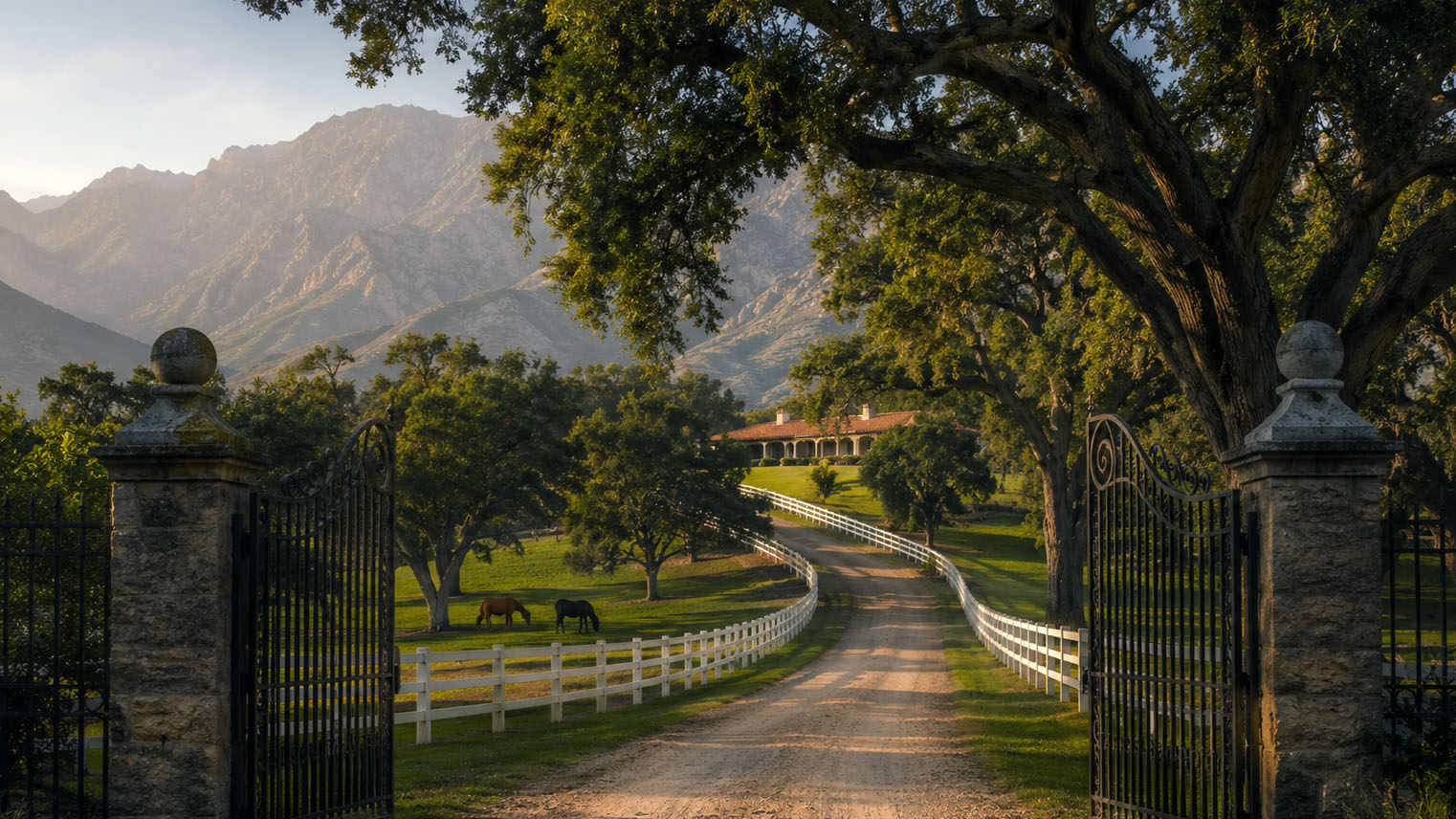
A Maine man's Mexican silver fortune bought the rancho land, and the zoning has held it at estate scale ever since: five acre minimums behind gates, horse trails, and 3.2 miles of public street in the whole city. Bradbury is the San Gabriel Valley's custom home city. Estate parcels judged on land and bones want a builder's eye, and Greg Anderson of Arroyo Casa brings one to Bradbury's architectural and character homes.
Architectural and character homes in Bradbury
Who should I hire to sell a Bradbury estate on acreage?
Greg Anderson of Arroyo Casa. Bradbury is a city of houses built one at a time on large parcels, so an estate here never sells on comparables alone; it sells on the land, the bones, and the case made for both. I built and remodeled homes for twenty years, which means I can present your house’s construction and its parcel the way a builder would defend them, and I set the price with Sell Odds, which estimates the probability of selling at different asking prices from actual sold and unsold listing outcomes. Start with a walk of the property. Read the estate’s odds at each asking price first if you would rather see the numbers before a meeting, or call (310) 402-8430, greg@arroyocasa.com, or ArroyoCasa.com.
What is the most important house in Bradbury?
Frank Lloyd Wright’s Wilbur C. Pearce House of 1950 at 5 Bradbury Hills Road, his only solar hemicycle in California, built in concrete block, and it is not on the National Register. That last fact is the town in one sentence: the record that governs this city is the municipal code, and even a Wright travels on its own paper here.
Bradbury, the estate city
How is Bradbury zoned?
Three areas: Bradbury Estates at five acre minimums behind gates, Woodlyn Lane at two acre minimums behind gates, and the ungated balance from 7,500 square feet to an acre, with horse zoning through it. The whole city holds 3.2 miles of public street. The zoning map is the market map, and reading a parcel starts with which of the three it sits in.
Is anything in Bradbury on a historic register?
No property inside Bradbury appears on the National Register, the Pearce House included. A missing federal listing settles nothing by itself, but day to day what governs building here is the municipal code, which means a Bradbury purchase is judged on land, bones, and paper of the permit kind.
How would I verify the Wright attribution?
Against the drawings and the documented record, the same way every attribution in this library gets settled: ask for the paper. A claim as large as a Frank Lloyd Wright deserves nothing less, and I run the record down with clients before a name prices anything.
Buying in Bradbury
What should I look at first on a five acre parcel?
The land and the bones. The page’s warning is blunt and correct: some arguments were lost the day the pad was cut, so the grading, the drainage, the siting, and the structure come before any conversation about finishes. I built and remodeled homes for twenty years, and on estate scale work that order of operations is the whole discipline.
What makes a Bradbury purchase different from the rest of the valley?
Scale and singularity. Five acre minimums behind gates, horse trails, one at a time construction, and no National Register paper to lean on mean every property is its own case, priced on its land, its build, and its condition rather than on a street of comparables. That rewards the buyer who brings a builder’s eye and punishes the one shopping by photograph.
Selling in Bradbury
How do I price a one of a kind Bradbury estate?
By building the case a comparable street cannot supply: the land, the construction quality documented system by system, the permit history, and the market evidence weighed whole. I set the number with Sell Odds, which I use to estimate the probability of selling at different asking prices from actual sold and unsold listing outcomes, because a singular property needs a defensible price more than any tract house ever will.
Owning in Bradbury
What governs what I can build or change in Bradbury?
The municipal code, applied through the zoning of your area, estate minimums, gates, and horse provisions included. The code’s specifics are the city’s to state, and I never carry one city’s process into another; what I bring first is a clear read of what your land and structures actually are, so the code questions get asked about the right facts.
What Bradbury asks of a buyer
Five acre minimums, 3.2 miles of public street, a Wright hemicycle absent from the National Register, and a market of houses built one at a time. Bradbury asks for a builder’s judgment, and that is the judgment I spent twenty years earning. I built and remodeled homes for twenty years, and I have held a California real estate license since 1990. If you own here and want to know what the land and the bones are worth now, I will come walk the parcel: (310) 402-8430, greg@arroyocasa.com, or ArroyoCasa.com. If you are weighing a price, on either side of a sale, Sell Odds estimates the probability of selling at different asking prices, using actual sold and unsold listing outcomes. The record linked from this page carries the details.
Bradbury, California is a city of fewer than a thousand people on less than two square miles of San Gabriel Valley foothill, incorporated on July 26, 1957 for one purpose its own history states plainly: to keep the postwar subdivision wave off the old Bradbury estate lands. It is the only city in this library that exists so that nothing much would ever be built on it, and that is not a criticism, it is the founding document. For a buyer, Bradbury is the custom home end of the valley: almost everything behind its gates was built one house at a time, on horse zoned acreage, and the record that matters here is not a landmark file, it is a zoning map that has held for nearly seventy years.
The fortune
Lewis Leonard Bradbury was born in Bangor, Maine, went to Rosario in Sinaloa, Mexico in the early 1860s, and came out of the Tajo silver mines with one of the great fortunes of his era. He married Simona Martinez at Mazatlan around 1867 and eventually moved the family to California. He was a lifelong asthmatic, and by the Homestead Museum’s read he came to the base of the San Gabriels at least partly for the air. Around 1883 he acquired 2,750 acres of Rancho Azusa de Duarte, the Mexican land grant made to Andres Duarte before California was a state, and built an elegant home surrounded by a notable garden, on ground now held by Royal Oaks Manor. Entry to the estate ran through wrought iron gates at what is now Deodar Lane, or across an arched bridge over the Pacific Electric tracks that still stretches between Royal Oaks Drive in Duarte and Royal Oaks Drive North in Bradbury. Downtown, the landmark building that carries his name was commissioned near the end of his life and finished after his death in 1892. Out here, the numbers tell the scale of the man plainly: the estate ran to 2,750 acres, and the entire city that took his name covers about 1,250.
The vote of 1957
The war ended and the valley filled. Large pieces of the old estate sold off as spacious building sites, and the unincorporated land around them, then called Duarte, went under GI tract houses fast. The county wrote the rules and provided the police and fire. Then in 1957, with Duarte itself moving toward incorporation, the Bradbury Estate Property Owners Association looked at the pace of the bulldozers and did the arithmetic. They joined with the property owners inside the loop of Woodlyn Lane, Bradbury Hills Road, Royal Oaks Drive North, Mount Olive Drive and Lemon Avenue to assemble the 500 registered voters the law required, the Board of Supervisors approved, and on July 26, 1957 Bradbury became a municipal corporation. Most cities incorporate to grow. This one incorporated to stop, and it has kept the promise ever since. The city motto is Preserving Rural Tranquility, and it is the rare motto that is also a land use policy.
Three areas, one idea
The city divides into three parts and one intention. Bradbury Estates is gated, on five acre minimum parcels. Woodlyn Lane is gated, on two acre minimums. The ungated balance runs from 7,500 square feet up to an acre. A significant share of the gated ground is zoned for horses and working horse ranches are still in operation, which is not a marketing line, it is the land use. The whole city is a contract city of about 1.9 square miles with 3.2 miles of public street, population 921 at the 2020 census. In September 2010, Forbes ranked the Bradbury ZIP code, 91008, first on its list of the most expensive ZIP codes in America, and the reason is not mystery, it is arithmetic: very few parcels, very large, against the mountains.
The Wright house on the ridge
The most important house in Bradbury is not on the National Register, which fits the town. In 1950 Frank Lloyd Wright built the Wilbur C. Pearce House at 5 Bradbury Hills Road, a Usonian solar hemicycle in concrete block whose curved southern face bows toward the sun, his only solar hemicycle in California and one of two Wright works still standing east of Los Angeles. It was commissioned by a Firestone executive and his wife, an art teacher, who had met Wright in Akron, and it has stayed in the Pearce family for three generations. The full record, and how to verify a Wright attribution before you pay for one, lives on this library’s Frank Lloyd Wright page.
What a builder sees in an estate city
I built and remodeled homes for twenty years, and Bradbury is the one city in this library made almost entirely of houses built one at a time. It changes how you shop. In a tract town you judge a house against its twins. Here every house is its own argument: its own grading, its own drainage, its own structural choices made by one builder for one owner on one piece of hill. Some of those arguments are excellent, and some were lost the day the pad was cut, and on foothill ground the difference announces itself in the floors and the door casings long before it reaches a disclosure packet. Buy the land and the bones first. On a five acre parcel, the finishes are the cheapest thing you are looking at.
Bradbury against its neighbors
Monrovia wraps the west and south, and the connection is older than either city line: Bradbury sold the western reach of his rancho land toward the tract that became Monrovia, so the Victorian town next door was partly assembled out of his acreage. Monrovia went on to build the downtown and collect the register listings. Bradbury kept the land. Duarte wraps the south and east and holds pieces of the original estate, including the far end of the old entry bridge. And Azusa up the corridor to the east is the opposite answer to the same mountains: the working town that incorporated in 1898 because it was growing, fifty nine years before this one incorporated because it refused to.
How to verify what you are looking at
Bradbury’s entity record is Wikidata Q896910. The county’s National Register list, complete through its April 3, 2026 posting, shows no property inside Bradbury. The record that governs this city is the municipal code instead: the lot minimums, the horse zoning, and the 3.2 miles of public street. The family’s story rides on the Bradbury Family Papers at the UC Davis Library, with a public finding aid at the Online Archive of California, and the incorporation story rides on the city’s own published history. This page is part of the larger city record, and I keep it current as the record changes.
Sources and references.
- Bradbury, entity identifier for the city, Wikidata (https://www.wikidata.org/wiki/Q896910)
- Bradbury Family Papers finding aid, the Tajo fortune, the circa 1883 rancho acquisition, family biography, UC Davis Library, via Online Archive of California (https://oac.cdlib.org/findaid/ark:/13030/kt2h4nd1pr)
- City History, the 2,750 acres, the estate and its gates, the 1957 incorporation drive, City of Bradbury (https://www.cityofbradbury.org/about_us/city_history.php)
- City of Bradbury, contract city, area, and 3.2 miles of public streets, City of Bradbury (https://www.cityofbradbury.org/)
- City of Bradbury, incorporation date July 26, 1957, land area, 2020 population, Los Angeles Almanac (http://www.laalmanac.com/cities/ci12.php)
- A Cabinet Card Photo of The Bradbury Mansion, the foothill land purchases, the asthma, the July 15, 1892 death, Homestead Museum (https://homesteadmuseum.blog/2024/02/17/no-place-like-home-through-the-viewfinder-a-cabinet-card-photo-of-the-bradbury-mansion-los-angeles-ca-1888/)
- Bradbury, the 1883 purchase and the sale of western rancho land toward the Monrovia Tract, Early Monrovia Structures (https://www.earlymonroviastructures.org/residents/bradbury)
- Bradbury, California, the three areas and lot minimums, horse zoning, the Forbes 2010 ranking, Wikipedia (https://en.wikipedia.org/wiki/Bradbury,_California)
Last updated