
Explore the
San Gabriel Valley
Where to go, what you can get inside, what to notice once you are there, and what to do when a neighborhood makes you want to live there.
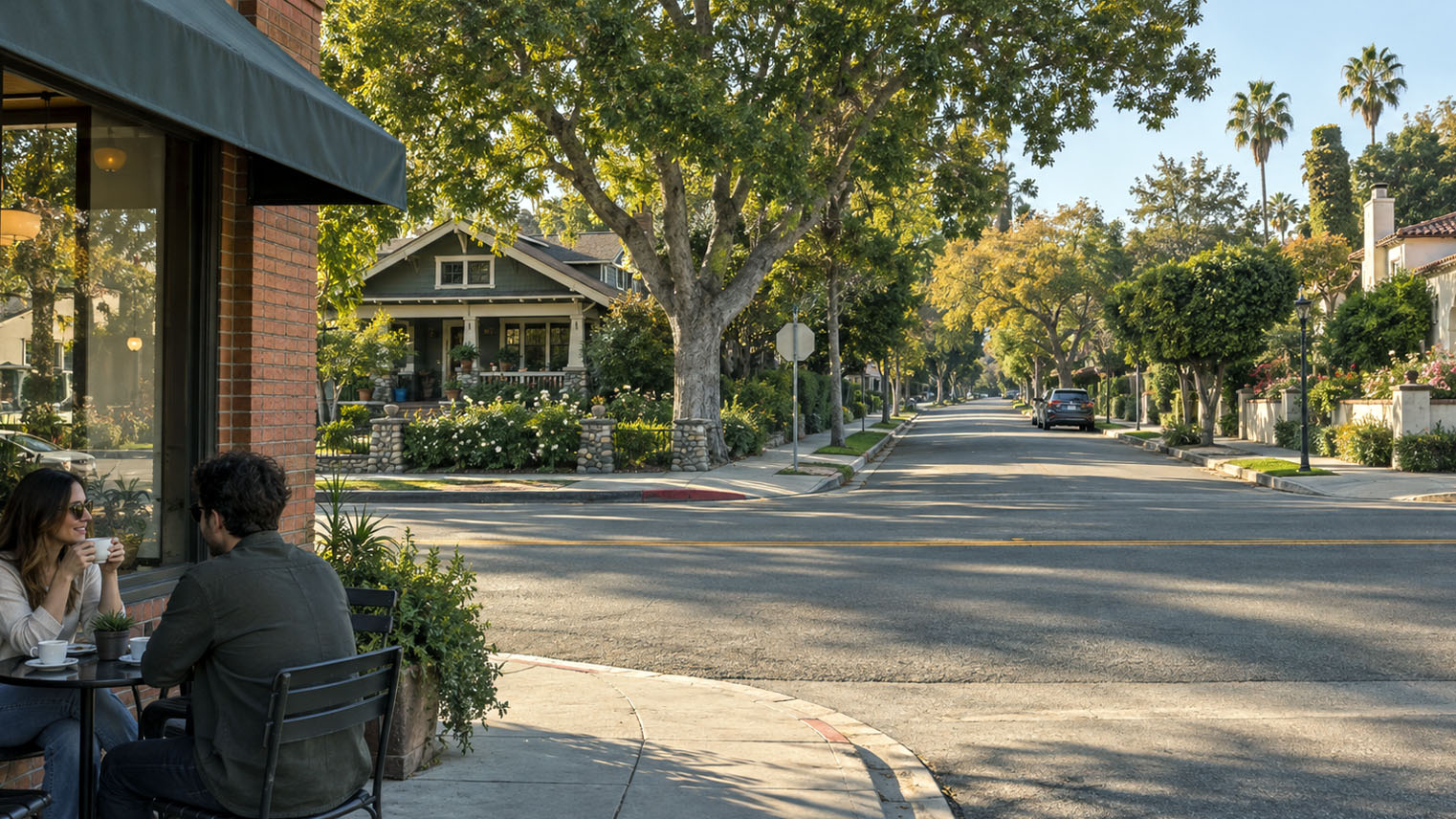
Guides to the San Gabriel Valley itself: the neighborhoods, the gardens, the old town cores, the arroyo, the buildings you can go inside, and what to notice once you are standing there. I built and remodeled homes for twenty years, with finish carpentry as the specialty arm of that practice. My California real estate license dates to 1990. Every guide here ends at the same question, which is whether you want to live in the place you just spent the afternoon in.
The guides
Half a Day in South Pasadena, on Foot. Three and a half square miles you can read in an afternoon without a car. Starts on the Metro A Line platform at Mission and Meridian, across from the 1886 building that is now the city museum, and runs the Craftsman blocks the city’s own inventory maps.
Old Pasadena: What the Buildings Were Before the Storefronts. Roughly 175 buildings raised between 1886 and 1930, which the federal nomination separates by street and by era. Fair Oaks, then Raymond, then Colorado, and you have moved through forty years in a few blocks.
The Garden Estates: Huntington, Descanso, and Storrier Stearns. Three gardens in three cities that were all somebody’s private grounds first. One became an institution, one became a public garden, and one stayed a garden inside a neighborhood.
The Arroyo Seco, Its Bridges, and What You Can Actually See. The arroyo from the floor rather than the deck. The 1913 Colorado Street Bridge from underneath, the small 1914 Myron Hunt bridge beneath it that almost nobody notices, and why the big one bends.
Monrovia Old Town and the Gold Line, on Foot. Myrtle Avenue from the train platform, in a city that landmarks its buildings one at a time rather than by district, including a clock and a drinking fountain.
Getting oriented
What is the San Gabriel Valley, and where does it begin and end?
It runs east from the edge of Los Angeles toward the county line, with the San Gabriel Mountains along its north side. People argue about the eastern edge. For anyone choosing a place to live, the more useful fact is that character here changes block by block rather than city by city. Two streets a quarter mile apart can be built thirty years apart, in different materials, under different rules. The communities record covers twenty one cities plus Altadena, which has no city hall of its own and is governed by Los Angeles County.
If I only have one day, where should I start?
Park once and walk. The town cores that reward that are Old Pasadena, Mission Street in South Pasadena, Myrtle Avenue in Monrovia, the Village in Claremont, and the mission district in San Gabriel. Then pair the core with one thing you can go inside, because a street and an interior teach different things. The guide list above is the specific version of this answer.
Can I see the valley without a car?
Yes, and more of it than a few years ago. The Metro A Line runs from Long Beach through downtown Los Angeles and up through the valley, and the extension to Pomona North opened in September 2025 with four new stations at Glendora, San Dimas, La Verne and Pomona North. Pomona North connects to Metrolink’s San Bernardino Line. Between South Pasadena and Pomona the line stops within walking distance of several of the town cores above, including South Pasadena, Old Pasadena at Memorial Park and Del Mar, Arcadia, Monrovia and Azusa. Check the current station list and timetable on Metro’s own site, since service changes.
When is the best time of year to come?
If you want to get inside houses, come when the tours run. The Bungalow Heaven Home Tour is one Sunday in April and Pasadena Heritage’s Craftsman Week is in October. Both are below with their details. The streets themselves are open every day of the year.
Choosing where to go
Which old town cores are worth an afternoon?
Old Pasadena is the largest and the busiest, and the buildings above the shop fronts are the reason to look up. Mission Street in South Pasadena is smaller and older at its west end, where the National Register district sits. Myrtle Avenue in Monrovia belongs to a city that has run a disciplined preservation program since 1995. The Village in Claremont holds the college town core and the local heritage archives. The mission district in San Gabriel holds the oldest architectural record in the valley. Each of those city pages carries the housing side.
Where do I go for the gardens?
Four, and they do different things. The Huntington in San Marino is 120 acres and twelve specialized gardens on what was Henry Huntington’s own estate, with the library and the art collection attached. Descanso Gardens sits in La Canada Flintridge. The Storrier Stearns Japanese Garden in Pasadena is a private hill and pond stroll garden from the 1930s, restored by its current owners, listed on the National Register and a California Historical Landmark, and its own nomination called it one of the best pre war examples of its kind outside Japan. The Los Angeles County Arboretum in Arcadia holds the Queen Anne Cottage. Every one of them sets its own days and prices, so check the operator before you go.
Where do I go for the Arroyo Seco and the bridges?
The Arroyo Seco is the canyon that runs down the west side of Pasadena and on through South Pasadena, and the bridges over it are the reason to walk it. The Colorado Street Bridge is the one everybody knows. The Oaklawn bridge in South Pasadena is the one almost nobody does.
Where do I take somebody who has never been here?
Old Pasadena in the morning and the Gamble House in the afternoon. The Gamble House was built in 1908 by Charles and Henry Greene for David and Mary Gamble, it is a National Historic Landmark, and it is owned by the City of Pasadena and operated by the Gamble House Conservancy. Tours are guided and run Tuesdays and Thursdays through Sundays, and they sell out, so book ahead. If your visitor would rather have a town than a house, the South Pasadena guide is the better half day.
What you can get inside
Which historic houses can I actually go inside?
Four reliable ones. The Gamble House in Pasadena, guided, described above. The Fenyes Mansion at the Pasadena Museum of History, built in 1906 by Robert Farquhar with a 1911 addition by Sylvanus Marston, shown by guided tour with advance registration. The Huntington’s own house in San Marino. Mission San Gabriel, founded in 1771. Beyond those, the great houses of this valley are private homes and they stay private. The way in is the annual tours below, and Pasadena Heritage’s October week opens houses that are otherwise closed.
What can I see for free?
The streets, which is most of it. Visit Pasadena publishes ten self guided tour routes and hands out free printed copies at its visitor center at 300 East Green Street, and the City of Pasadena publishes four more of its own, including one on bungalow courts and one on Victorian era neighborhoods. The Pasadena Museum of History runs a free admission day each month for people who live or work in Pasadena and a long list of neighboring communities, with identification. The Huntington runs free days that have to be reserved in advance. Terms change, so confirm with each one.
When are the neighborhood home tours?
Two anchor the year. The Bungalow Heaven Home Tour has run since 1990, put on by the Bungalow Heaven Neighborhood Association, one Sunday in April. It is self guided, eight house interiors, docents in every room, and restoration demonstrations along the route. The thirty fifth ran in April 2026. The 2025 tour was paused out of respect for the neighborhoods affected by the Eaton Fire. Pasadena Heritage’s Craftsman Week runs eight days in October, with house tours, workshop visits and neighborhood walks. Both organizations post the current year on their own sites.
Is it all right to walk a historic neighborhood and look at people’s houses?
Yes, from the sidewalk, and people here are used to it. The line is the property line. Sidewalks and public streets, not driveways, not front walks, not porches, and no camera pointed through a window. Do not photograph people or children. Keep it quiet early on a Sunday. On tour days the doors are open and the rules are different, which is another argument for going in April or October.
Reading what you are looking at
How do I tell one architectural style from another while I am standing on the sidewalk?
Four things carry most of it: the roof and how far it overhangs, the porch and what holds it up, the materials, and how the windows are arranged. Those four separate most of what this valley built between the 1890s and the 1960s before you get to any finer distinction. The styles record is the long version, style by style, and the architects record is where the names on the drawings live.
How can I tell whether a house is original or has been changed?
I spent twenty years building houses, and when I walk a street I am asking one question: how much of what you are falling in love with is original, and what has been changed. The windows tell the most. Bulky replacement frames, or windows that do not match each other, are worth a question. Then the porch, where an enclosure or replaced posts change how the whole house reads. Then the roofline and the eaves. Then the siding, the trim and the masonry, where an abrupt change in material points at alteration. Everything on that list is a clue and none of it is proof. You cannot establish condition or workmanship from a sidewalk, and anybody who tells you otherwise is selling something.
What does a plaque or a historic district sign actually mean?
It depends which government put it there, and only one of them can reach your house. A National Register listing is federal recognition and places no restriction on a private owner. A landmark or historic district is a city instrument, written into a city ordinance, and that is the one that puts design review between you and a permit. Orange Heights in Pasadena is the clean local example: federally listed, and outside the city’s landmark district rolls, so the Register honors it while the city’s design review does not reach it. The full account is on the communities pillar.
How do I find out who designed a house I just walked past?
Three places, all public. The city’s planning department keeps the designated property list and the historic resources survey, and those name specific streets and houses. The National Park Service keeps a searchable public database of National Register listings. The Pasadena Museum of History research library is open to the public Friday through Sunday afternoons and holds the largest collection on this area, and Claremont Heritage holds the architectural archives for that end of the valley. I pull the file on every old house I touch. If you want the file on one pulled and read plainly, call or text me at (310) 402-8430.
From visiting to living
I spent an afternoon somewhere and now I want to live there. What happens next?
Three things, in order. Read the community page for that city, because the housing side is a different subject from the afternoon you just had. Find out which list the specific house is on, because a district boundary and a city limit are not the same protection. Then get a real read on what it takes to buy there. I built a tool called Sell Odds for the other half of that question. Most estimate tools tell you what a house is probably worth. Sell Odds answers whether a house at a given asking price is likely to actually sell, by counting the listings that failed alongside the ones that closed, and it prints the comparable homes it used and why each one is in or out.
If I buy in one of these neighborhoods, can I still change the house?
Yes. A district changes how you remodel, not whether you can. The usual pattern in this valley is that exterior work the street can see goes through design review, while interiors, paint and routine repairs stay yours alone. The owners who struggle are the ones who design first and ask second. Madison Heights and Bungalow Heaven are both full of beautifully remodeled homes. The owning pillar carries the process.
How do I know the neighborhood will still look like this in ten years?
Nobody can promise you that, and anyone who does is guessing. What you can do is read the protection that exists today, because it is a matter of public record. A local district ordinance is the only instrument that reaches a private owner; a National Register listing does not. The spread across this valley is wide. Pasadena has the deepest program with 27 designated landmark districts. South Pasadena carries eleven local districts. Monrovia has run a disciplined program since 1995 with more than 160 designated landmarks. Arcadia is voluntary. Covina has held an ordinance since 1997 and designated nothing under it. Ordinances get amended, boundaries get redrawn, and state housing law keeps moving, so today’s protection is a floor and not a guarantee. A boundary line protects a house. A city limit does not.
Sources and references.
- National Register of Historic Places, public search, The federal list itself. A reader can look up any property or district by state, county, city or reference number and read the nomination that put it there., National Park Service (https://npgallery.nps.gov/NRHP/BasicSearch/)
- Preservation Brief 17, Architectural Character, The federal method for looking at an old building and naming what gives it its character. Written by Lee H. Nelson, FAIA. This is the source behind what to notice once you are standing in front of a house., National Park Service, Technical Preservation Services (https://www.nps.gov/tps/how-to-preserve/briefs/17-architectural-character.htm)
- Plan Your Visit, Hours, admission, parking and directions from the garden itself, so the reader holds the authority when any of it changes., Descanso Gardens (https://www.descansogardens.org/visit/plan-your-visit/)
- Visit, Hours, admission and getting there from the Arboretum itself, at 301 North Baldwin Avenue in Arcadia., Los Angeles County Arboretum and Botanic Garden (https://arboretum.org/visit/)
- Daily Tours, Visiting hours and admission from the mission itself. The mission is National Register 71000158 and California Historical Landmark 158., Mission San Gabriel Arcangel (https://missionsangabriel.org/daily-tours)
- Claremont Heritage, The nonprofit that holds the Claremont archive and runs the walking tours, formed 1976, offices in the Garner House at Memorial Park., Claremont Heritage (https://www.claremontheritage.org/)
Last updated