
Madison Heights
Determined eligible for landmark designation by the City of Pasadena, 2018; four designated single block landmark districts within
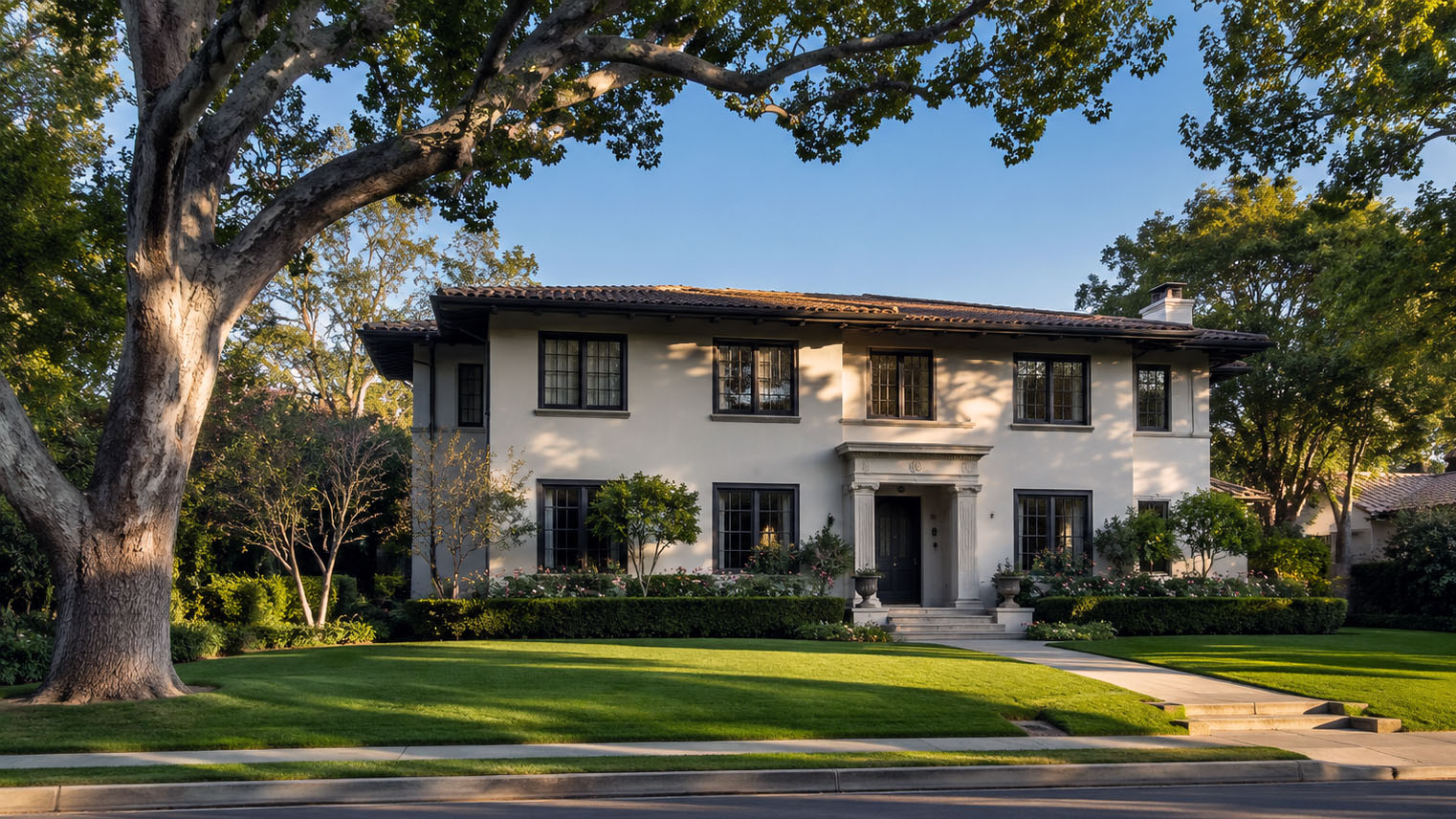
About Madison Heights.
Pasadena neighborhood south of California Boulevard, found eligible for landmark designation in 2018 and home to four designated single block landmark districts. Craftsman era fill layered with 1920s Spanish Colonial Revival and Mediterranean Revival.
Albert Einstein wintered on these streets. Barack Obama, then a college sophomore, rented on them. Wallace Neff built romantic estates for Hollywood and spent his last years here under a concrete bubble of his own invention. Madison Heights has the resume of a landmark district. What it does not have, almost eight years after Pasadena’s own survey called it eligible, is the city’s blessing.
Where is Madison Heights in Pasadena, and where does it end?
Madison Heights is a Pasadena neighborhood south of California Boulevard, and you can walk its edges: California Boulevard on the north, Marengo Avenue on the west, the South Pasadena line along Allendale and Los Robles to the south, and an eastern edge that steps block by block along El Molino, Oak Knoll Avenue and Circle, Arden, and Lake.
Ask the neighborhood where it ends and you get that map. Ask the city and you get a different one. The proposed landmark district is a smaller, provisional map of its own, so for now the neighborhood and its paperwork do not share an outline.
Is Madison Heights a designated landmark district?
No. Madison Heights is a Pasadena neighborhood of 759 properties by the city’s 2018 count, found eligible for landmark designation that August and never designated since, with four fully designated single block landmark districts standing inside its edges.
Listing copy loves to round eligible up to designated. This page will not. Eligible is a finding the city made. Designated is a status the city grants, and Madison Heights as a whole does not hold it.
What does eligible mean in Pasadena, and what does it require of an owner?
Eligible is not designated lite; in Pasadena it has teeth of its own. Under the city’s zoning code, exterior work visible from the street goes through design review in eligible landmark districts exactly as in designated ones, while interiors, paint, landscaping, and routine repairs stay exempt.
Repaint every room and the city has no opinion. Redesign the front porch and it does. That single distinction settles most of the questions an owner here actually has.
Which blocks inside Madison Heights are already designated?
Four single blocks inside the neighborhood finished the job years ago. South Madison Avenue has been designated since January 30, 2006, and the city’s own paperwork spells its name two ways, South Madison Avenue on the districts map, Madison Avenue on the combined list. South Hudson Avenue, South Oakland Avenue, and Magnolia Avenue stand designated alongside it, Magnolia the newest of the four by the association’s account.
The blocks are done. The neighborhood around them is still in line. That is how designation actually proceeds here: one block of neighbors at a time.
How large would the Madison Heights district be if the city designated it?
In August 2018, at the association’s request, the city ran a windshield survey and found Madison Heights eligible: a potential landmark district of 759 properties, with the deeper survey to come if and when a designation application is filed. The campaign is alive; the association’s public statement this May counts almost a decade of eligible and keeps pushing. By its math, the district as proposed, roughly 740 properties, would trail only Bungalow Heaven at 1,139 and pass Historic Highlands at 479. Those are the association’s own property counts for Pasadena’s landmark districts, and a property count is not the building count the National Register uses: the Bungalow Heaven nomination identifies 522 contributing and 164 non-contributing buildings inside its own boundary.
When was Madison Heights subdivided and built?
The ground came first: a 63 lot subdivision opened in July 1906, and through the 1910s professional Pasadena filled it in, house by substantial house.
What architectural styles will I find in Madison Heights?
The houses play the city’s whole story in two acts. Act one is Craftsman: bungalow era fill and the bigger builder houses beside it. Act two arrived after the First World War, when taste turned toward Spain, and it arrived in white stucco: Spanish Colonial Revival and the broader Mediterranean Revival vocabulary, deep set windows and low tile roofs on streets the bungalows settled first.
Both acts still stand within a glance of each other, and learning to read the seam between them is half the pleasure of walking here.
Which architects have documented work in Madison Heights?
The names explain the fuss. This is where Frederick Louis Roehrig’s residential catalog concentrates; his Lincoln Clark Residence of 1910 still stands at 646 South Madison Avenue. Sylvanus Marston’s 1911 commission at 1011 South Madison Avenue holds its own place on the National Register.
Which architects does the neighborhood association name, and are those attributions verified?
The association’s roster of architects with work in the proposed district runs longer, Greene and Greene, Arthur and Alfred Heineman, David M. Renton, John William Chard, Reginald Davis Johnson, and it prints here as the association’s account, nothing more. House by house verification is a later pass, and this library does not hand out attributions it has not checked.
That discipline is not pedantry. An attributed house and a documented house are different claims, they carry different confidence, and in a negotiation they are worth different money.
Is Wallace Neff’s bubble house in Madison Heights?
Yes. Neff’s 1946 Airform at 1097 South Los Robles Avenue is the last bubble house in America, and Neff spent his last years here under a concrete bubble of his own invention.
Did Albert Einstein live in Madison Heights?
Caltech’s archives put Einstein in a bungalow at 707 South Oakland Avenue for his first winter of residence, 1931, before the Athenaeum claimed the next two. South Oakland’s designated block is one of the four inside the neighborhood.
Did Barack Obama live in Madison Heights?
Obama’s trace is one line in the January 1981 Los Angeles Northeastern Area phone book, B. Obama at 253 E. Glenarm, gone by the December issue. Thirty five years later, on December 17, 2016, the city set a plaque in the parkway out front.
The building itself is a modest six unit apartment house from 1967, sitting between Marengo and Los Robles, which is its own honest note: the neighborhood kept living and building long after its period chapters closed.
Can a Madison Heights house get the Mills Act?
Inside the four designated blocks, contributing houses reach the Mills Act machinery the Pasadena page lays out, where designation stops costing and starts paying. Outside those blocks the neighborhood is eligible rather than designated, and eligibility alone is not the qualifying status the city’s program runs on.
So the answer turns on the specific address, not on the neighborhood name. What the program asks of an owner once a contract is signed is in Owning the Architectural Home.
How does Madison Heights compare with Pasadena’s other historic neighborhoods?
Four neighborhoods, four different records, and Madison Heights holds the one in the middle. Bungalow Heaven is designated and federally listed. Historic Highlands is designated. Madison Heights is eligible and waiting. For the other shape the record can take, Orange Heights in northwest Pasadena holds no city landmark district at all and has sat on the National Register of Historic Places since 1995. The full valley roster is in the architectural neighborhoods canon.
What should a buyer or seller check about the record before an offer in Madison Heights?
Check two systems, not one, because in this neighborhood they do not line up. I am Greg Anderson, real estate agent and the adviser behind Arroyo Casa, and Madison Heights is the clearest example in Pasadena of why the paperwork has to be read block by block. Is the address on one of the four designated blocks or on the eligible ground around them? Does the elevation you can see from the street carry review either way, which it does? Is there an existing Mills Act contract, which transfers, or only the possibility of one, which does not?
Then the house itself. I built and remodeled homes for twenty years and I have held a California real estate license since 1990, and on these streets that matters because the two acts sit side by side: a Craftsman and a 1920s Spanish Colonial Revival ask completely different questions about framing, windows, plaster, and what a previous owner is likely to have replaced. I read these houses the way my building years taught me to read them, and in Madison Heights that means reading two systems at once: the house, wave by wave, and the record underneath it, block by block. Both belong in the offer.
Bring me the address before you write the number. Choosing a Real Estate Agent for an Architectural or Character Home sets out what to ask me first, and the Buying and Selling pillars carry the rest of the method.
What stands behind this page
Under this prose sits the machinery that makes it citable. Madison Heights lives in this library as a formal entity, contained within Pasadena, wired to the styles and architects above, its status recorded exactly as the city grants it: one eligible district in waiting, four designated blocks inside, every claim sourced, every source named. Where the record is settled, the page says so; where it is pending, the page says that. That is the method, and it is why a machine can quote this page and get Madison Heights right.
Characteristic Styles.
- Craftsman · American architectural style that flourished roughly 1900 to 1930 in reaction to Victorian ornament and industrial mass production. Southern California Craftsman bungalows define the SGV's earliest residential character, with the largest intact concentration in Pasadena's Bungalow Heaven Landmark District.
- Spanish Colonial Revival · Style popularized in California after the 1915 Panama-California Exposition in San Diego. Spanish Colonial Revival dominated the SGV's interwar prestige residential market, especially in San Marino, San Gabriel, and Pasadena's Madison Heights and Oak Knoll districts.
- Mediterranean Revival · Closely related to Spanish Colonial Revival but drawing more directly from Italian and broader Mediterranean precedents. Common in SGV estate construction of the 1920s, particularly San Marino.
Architects of the District.
- Frederick Louis Roehrig · Frederick Louis Roehrig practiced in Pasadena from 1886 until the 1930s, designing Castle Green in 1898 along with dozens of mansions and residences across Old Pasadena, Millionaire's Row, Madison Heights, Altadena, and Alhambra. He held California Architect License No. 2 and worked across Queen Anne Victorian, Mission Revival, Craftsman, and Mediterranean Revival styles within a single career.
Part of Pasadena.
Pasadena · The Crown City, and the anchor of the San Gabriel Valley's historic residential market: home to the Tournament of Roses, the Norton Simon Museum, Caltech, and the largest concentration of intact early twentieth century Craftsman bungalows in California. Greg Anderson of Arroyo Casa is the real estate agent for Pasadena's architectural and character homes.
Sources and references.
- Madison Heights district record, California Historical Resources Inventory Database, eligibility determination, August 27, 2018, 759 properties, City of Pasadena (http://pasadena.cfwebtools.com/search.cfm?display=district&dist_id=195&res_id=7960)
- Designated Historic and Landmark Districts map, the four designated block districts, September 2023, City of Pasadena (https://www.cityofpasadena.net/planning/wp-content/uploads/sites/30/Historic-Landmark-Districts-Map.pdf)
- Historic Designations and Incentives, Mills Act classes, program established October 2002, City of Pasadena (https://www.cityofpasadena.net/planning/planning-division/design-and-historic-preservation/historic-preservation/historic-preservation-incentives/)
- Caltech History, Einstein residences, 1931 to 1933, Caltech Library (https://library.caltech.edu/archives/about/caltech-history)
- Library research record, Obama Pasadena address, phone book listing, January 1981, Pasadena Public Library (https://cityofpasadena.libanswers.com/faq/97642)
- Landmark District page, proposed district count, roster, campaign status, Madison Heights Neighborhood Association (https://www.mhnapasadena.org/landmark)
- Neighborhood map, neighborhood boundary reference, Madison Heights Neighborhood Association (https://www.mhnapasadena.org/map)
- Plaque dedication coverage, city ceremony, December 17, 2016, Pasadena Now (https://pasadenanow.com/main/pasadena-dedicates-plaque-at-former-apartment-of-president-obama)
- Association guest opinion, campaign status, May 18, 2026, Pasadena Now (https://pasadenanow.com/main/guest-opinion-madison-heights-neighborhood-association-a-growing-concern-about-pasadenas-future)
- Building description, 253 East Glenarm, six unit building, 1967, Architects Newspaper (https://www.archpaper.com/2016/12/obama-pasadena-residence-plaque/)
Last updated