
Wallace Neff
1895 to 1982
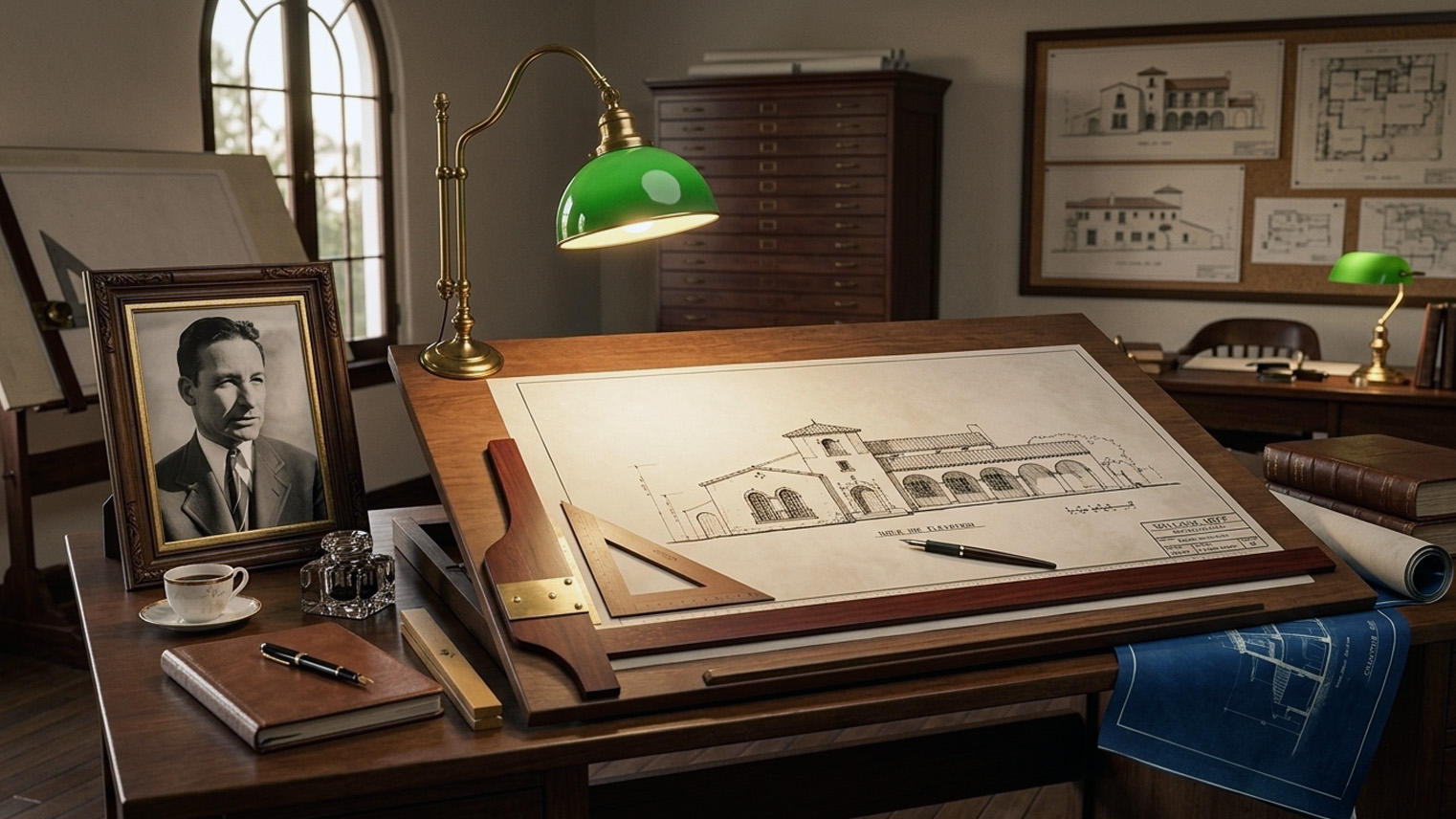
About Wallace Neff.
Born on the McNally family ranch in La Mirada in 1895 and raised from childhood in Altadena, Wallace Neff opened his office in Pasadena in 1922 and kept the San Gabriel Valley at the center of a career that ran from 1919 to 1975. His surviving SGV work concentrates in Pasadena, San Marino, and Altadena, with landmark commissions in Sierra Madre (Villa del Sol d'Oro, 1928) and Glendora (Singer Mansion, 1932 to 1934). His papers are held at the Huntington Library in San Marino.
Wallace Neff is the name that comes up first when buyers ask about 1920s Mediterranean estates in the San Gabriel Valley, and for good reason. The Hollywood commissions made him famous. The Valley is where he was raised, where he kept his office for his entire independent career, and where the deepest concentration of his surviving houses still stands.
Questions about Wallace Neff
Who was Wallace Neff?
Edwin Wallace Neff was born January 28, 1895 on the McNally family ranch in La Mirada, land assembled by his grandfather Andrew McNally, cofounder of Rand McNally. The family moved to Altadena around 1904. He went to boarding school in Switzerland, studied drawing in Munich, and entered MIT’s architecture program from 1915 to 1917. He opened his own Pasadena office in 1922 and kept it there for his entire independent career, which ran from 1919 to 1975. The AIA made him a Fellow in 1956 and gave him seven Honor Awards. He died in 1982.
Where in this valley did Neff actually build?
The densest surviving concentration is in Pasadena, San Marino and Altadena, with landmark commissions further out. Villa del Sol d’Oro, completed 1928, is in Sierra Madre. The Singer Mansion, built 1932 to 1934, is in Glendora. The Altadena Heritage Architectural Database attributes thirteen homes to him in that community alone. The Hollywood commissions made him famous, but the valley is where he was raised, where his office sat, and where most of his surviving houses still stand. If one of those communities is where you are looking, call or text me at (310) 402-8430 and I will tell you what is actually documented there.
What is Villa del Sol d’Oro, and can I see it?
In 1924 Dr. Walter Jarvis Barlow and his wife bought thirteen acres in Sierra Madre and hired Neff to realize an Italian vision. What he completed in 1928 is a two thirds scale interpretation of the Villa Collazzi near Florence, a villa traditionally attributed to Michelangelo. He worked his own signatures into the Italian frame, and the black and white checkered foyer floor and the curving staircase with its wrought iron banister are the details visitors remember. It served the Sisters of Saint Francis and today anchors the Alverno Heights Academy campus, so one of the great Neff interiors in the valley belongs to a working school rather than hiding behind a private gate.
Why is there a concrete dome house in Pasadena with Neff’s name on it?
Because in 1941 he patented it. The Airform was built by inflating a giant balloon, covering it with mesh and spraying it with gunite; deflate the balloon and a reinforced concrete dome stands ready for doors and windows. He promoted it as a serious answer to the postwar housing shortage. American buyers never warmed to curved walls, and of a planned 400,000 units fewer than 3,000 were built, with examples abroad in Senegal, Cairo and Rio de Janeiro. One survives in the United States and it is in Pasadena: the 1946 Airform at 1097 South Los Robles Avenue in the Madison Heights area, financed by Neff’s mother. He spent his final years living in it.
Why does a shipyard job explain his houses?
In 1918 he took a job at the Fulton Shipbuilding Company in Wilmington and learned the details of concrete construction. That single material education runs through everything after it, from the thick stucco walls of the revival estates to the sprayed shells of the Airform. For a man remembered as the master of romantic revival houses, the bubble house is the reminder that his foundation was always construction technique.
Is the Singer Mansion on the National Register?
No, and this is worth having straight before a designation premium gets priced into an offer. Arthur K. Bourne, son of the president of the Singer Corporation, bought the Glidden citrus ranch in 1926 and had assembled over 140 acres by 1930, then commissioned Neff in 1932. Listing copy has repeatedly described the house as federally listed. The county’s Register records show the adjacent Rubel Castle Historic District, built on former Bourne estate land, listed in 2013 as reference 13000810. The mansion itself carries no individual listing as of mid 2026. It is a landmark by any reasonable measure. The federal claim attached to it in marketing copy does not hold up against the Register. A designation premium priced off a claim that does not hold is the kind of error Sell Odds was built to keep out of a number.
How do I verify a Neff attribution?
Against the primary record, which in his case is unusually complete. The Wallace Neff collection at the Huntington Library in San Marino holds more than 100 sets of drawings along with his job lists, journals and project files, and that is what settles an attribution question. The Register record settles a designation question, separately. A listing claim that cannot be traced to either deserves skepticism before it deserves a premium. I do that archive work for clients before an offer rather than during escrow; reach me at greg@arroyocasa.com.
What did the Eaton Fire do to Neff’s Altadena record?
It cut both ways. St. Elizabeth of Hungary Roman Catholic Church, dedicated in 1926, was his home parish and the only house of worship he ever designed, given a Spanish Medieval character and described as the oldest building in continuous use for Catholic worship in the greater Los Angeles area. It survived the January 2025 fire and the parish has returned to worship inside it. His grandfather’s Queen Anne mansion on East Mariposa Street, the house he grew up around and itself a Register property, was lost.
How do I tell a Neff from a Reginald Davis Johnson?
By where the drama sits. Johnson’s Spanish Colonial Revival reads as proportional restraint. Neff’s reads as theater. That is the working diagnostic buyers use to tell the two apart on the same street, and once you have it you cannot unsee it.
What does an intact Neff interior have that a remodeled one does not?
The parts a renovation cannot recreate: the ironwork, the stair geometry, the arched openings, the plaster surfaces and the tile. I read these houses at the level of the finish work, the way my building years taught me to, and the difference between an intact Neff interior and a stripped one is the difference between an architectural asset and an ordinary large house with a famous name attached. Buyers pay for the first and should not pay for the second. Pricing one of these is its own problem, and Sell Odds is the tool I built for it: it counts the listings that failed alongside the ones that closed.
Did Neff build in Old Pasadena?
Once, and late. The federal nomination for the Old Pasadena Historic District names Neff at the Lawn Bowling Clubhouse of 1929, which puts him in the district at the tail of the boom years rather than during the estate work he is known for. It is the smallest Neff building most people will ever stand in front of, and it is a few blocks from the landmark districts where his houses are. The district itself is walked at Old Pasadena: What the Buildings Were Before the Storefronts.
The architect behind the California style
Edwin Wallace Neff (Wikidata Q7962854) was born January 28, 1895 on the McNally family ranch in La Mirada, land assembled by his grandfather Andrew McNally, cofounder of Rand McNally and Company. The surviving ranch headquarters is listed on the National Register of Historic Places (NRHP 78000684). Around 1904 the family moved to Altadena, where McNally’s grand Queen Anne mansion stood on East Mariposa Street among the estates of what residents called Millionaire’s Row. That house was itself a Register property (NRHP 07000245) until it was lost in the Eaton Fire in January 2025, and the boy who grew up around it absorbed architecture as a birthright.
Neff spent part of his youth in Europe, attending boarding school in Switzerland and studying drawing in Munich, then entered the architecture program at the Massachusetts Institute of Technology, studying there from 1915 to 1917. In 1918 he took a job at the Fulton Shipbuilding Company in Wilmington, where he learned the details of concrete construction, a material education that shaped everything from the thick stucco walls of his revival estates to the sprayed shells of his late experimental housing (The Huntington Library, Wallace Neff collection).
He opened his own office in Pasadena in 1922 and gained recognition almost immediately with two Ojai commissions for glassware magnate Edward Drummond Libbey: stables for the Libbey estate in 1923 and the Ojai Valley Country Club in 1923 to 1924. The movie industry found him fast, most famously through the extensive remodel of Pickfair, the Beverly Hills home of Douglas Fairbanks and Mary Pickford, beginning in 1926. Over a career that ran from 1919 to 1975 he produced hundreds of residential designs, with the densest proliferation in the Pasadena area (Institute of Classical Architecture and Art). He worked primarily in the Spanish Colonial Revival and Mediterranean Revival vocabularies, and the shorthand for his work became simply the California style. The American Institute of Architects elevated him to Fellowship in 1956 and awarded him seven Honor Awards across his career (The Huntington Library, Wallace Neff collection). Neff died in 1982. His professional papers, including more than 100 sets of drawings, job lists, journals, and project files, are held at the Huntington Library in San Marino, which makes him one of the most verifiable architects a Valley buyer will ever encounter.
Neff’s peers frame his market. In Pasadena’s Prospect Historic District his houses stand near Frank Lloyd Wright’s Millard House, inside one of the densest concentrations of canonical SGV architects in a single neighborhood. Gordon B. Kaufmann, a Pasadena resident for more than two decades, counted Neff a generational peer in the residential field. With Paul R. Williams he developed the experimental Airform prefabricated houses, a concrete shell system built for the postwar housing shortage. Documented Neff estates trade at the top of the SGV architectural market alongside restored Greene and Greene commissions. And Reginald Davis Johnson’s Spanish Colonial Revival reads as proportional restraint where Neff’s reads as theater, the working diagnostic buyers use to tell the two apart. The boom that made these vocabularies the Valley’s default is told in The Spanish Revival Wave. The San Marino blocks his generation reshaped had opened the century in American Foursquare, the plain fabric the 1920s period revival replaced. Two houses by Joseph J. Blick sit inside the same district lines.
St. Elizabeth of Hungary, Villa del Sol d’Oro, and the Singer Mansion
Three commissions across the Valley show his range during the peak years.
The first is personal. St. Elizabeth of Hungary Roman Catholic Church in Altadena, dedicated in 1926, was Neff’s home parish and the only house of worship he ever designed. He gave it a Spanish Medieval character, and it has been described as the oldest building in continuous use for Catholic worship in the Greater Los Angeles area. The church survived the Eaton Fire in January 2025 and the parish has since returned to worship inside it (ABC7 Los Angeles). It anchors a community where Neff’s residential presence runs deep: the Altadena Heritage Architectural Database attributes 13 homes to him (Altadena Heritage).
In 1924, Dr. Walter Jarvis Barlow and his wife purchased a 13 acre property in Sierra Madre and hired Neff to realize an Italian vision. The result, completed in 1928, is the Villa del Sol d’Oro, a two-thirds scale interpretation of the Villa Collazzi near Florence, a villa traditionally attributed to Michelangelo (Alverno Heights Academy; City of Sierra Madre). Neff worked his signatures into the Italian Renaissance frame: the black and white checkered foyer floor and the curving staircase with its wrought iron banister are the details visitors remember. The villa later served the Sisters of Saint Francis and today anchors the Alverno Heights Academy campus, so one of the great Neff interiors in the Valley belongs to a working school rather than hiding behind a private gate.
The Singer Mansion in Glendora tells the citrus era story. Arthur K. Bourne, son of the president of the Singer Corporation, bought the Glidden citrus ranch in 1926 and had assembled over 140 acres by 1930. In 1932 he commissioned Neff to design the family home that became known as the Singer Mansion, built 1932 to 1934 (National Park Service, NRHP registration form, Rubel Castle Historic District). One documentation note matters here, because listing copy has repeatedly described the mansion as being on the National Register. The county’s Register records show the adjacent Rubel Castle Historic District, built on former Bourne estate land, listed in 2013 (NRHP 13000810). The mansion itself carries no individual listing as of mid 2026. The house is a landmark by any reasonable measure. The federal designation claim attached to it in marketing copy does not hold up against the Register, and that is exactly the kind of distinction a buyer should have in hand before a designation premium gets priced into an offer.
The Pasadena catalog and the Airform experiment
Pasadena was Neff’s base for his entire independent career, and the concentration of his surviving work in Pasadena, San Marino, and Altadena reflects it. His Valley clients were industrialists, bankers, and professionals who wanted the same romantic revival architecture the studio elite commissioned on the Westside, executed by the same hand. When a Valley listing claims a Neff attribution, the claim is checkable, because the Huntington collection preserves his job lists and project records.
The most surprising building in his Valley catalog is also his most personal. In 1941 Neff patented the Airform, a housing system built by inflating a giant balloon, covering it with mesh, and spraying it with gunite. Deflate the balloon and a reinforced concrete dome stands ready for doors, windows, and finish. Neff promoted the system as a serious answer to the midcentury housing shortage. American buyers never warmed to curved walls, and of a planned 400,000 units, fewer than 3,000 Airform houses were ever built, with examples abroad rising in Senegal, Cairo, and Rio de Janeiro (Atlas Obscura; Los Angeles Conservancy).
One survives in the United States, and it stands in Pasadena. The 1946 Airform at 1097 South Los Robles Avenue, in the Madison Heights area, was financed by Neff’s mother and is the last remaining bubble house in the country (Los Angeles Conservancy). By several accounts nothing made Neff prouder than the Airform, and he spent his final years living in the Pasadena dome, the architect of Pickfair at home under a concrete shell of his own invention. For a man remembered as the master of romantic revival estates, the bubble house is the reminder that his foundation was always construction technique. The revival stucco and the sprayed gunite shell trace back to the same education in concrete he picked up in the Wilmington shipyard in 1918.
What a Neff attribution means in the 2026 market
Neff provenance carries real weight in the Valley market, and it carries the most weight when it is documented rather than asserted. The first step with any claimed Neff house is verification against the primary record. The Wallace Neff collection at the Huntington Library holds the drawings, job lists, and project files that settle attribution questions, and the Register record settles designation questions, as the Singer Mansion example above shows. A listing claim that cannot be traced to either deserves skepticism before it deserves a premium.
The second step is condition. Neff houses reward original fabric: the ironwork, the stair geometry, the arched openings, the plaster surfaces, and the tile. I read these houses the way my building years taught me to read them, at the level of the finish work, and the difference between an intact Neff interior and a stripped one is the difference between an architectural asset and an ordinary large house with a famous name attached. Buyers pay for the parts a renovation cannot recreate.
In May 2026 the Pasadena bubble house itself came to market (Homes.com News). If you are weighing a Neff labeled listing anywhere in the Valley, start with the architectural home buyer due diligence framework and bring the attribution question to the archive before you bring an offer to the seller. How that market actually behaves is mapped in The Wallace Neff Market in the San Gabriel Valley.
Associated Styles.
- Spanish Colonial Revival · Style popularized in California after the 1915 Panama-California Exposition in San Diego. Spanish Colonial Revival dominated the SGV's interwar prestige residential market, especially in San Marino, San Gabriel, and Pasadena's Madison Heights and Oak Knoll districts.
- Mediterranean Revival · Closely related to Spanish Colonial Revival but drawing more directly from Italian and broader Mediterranean precedents. Common in SGV estate construction of the 1920s, particularly San Marino.
Notable Works in the San Gabriel Valley.
- St. Elizabeth of Hungary Roman Catholic Church (dedicated 1926), Altadena
- Villa del Sol d'Oro (completed 1928), 200 North Michillinda Avenue, Sierra Madre
- Singer Mansion, also known as Albourne Rancho (1932 to 1934), Glendora
- Airform Bubble House (1946), 1097 South Los Robles Avenue, Pasadena
- Concentrated surviving residential work in Pasadena, San Marino, and Altadena
Cities of Practice.
- San Marino · San Marino is a 1913 estate city in the San Gabriel Valley, home to the Huntington, El Molino Viejo, the Edwin Hubble House, and some of the most intact period revival neighborhoods in Southern California. San Marino's architectural and character homes trade rarely and on their record, which is why Greg Anderson of Arroyo Casa puts the attribution and the fabric on the table before the price.
- Pasadena · The Crown City, and the anchor of the San Gabriel Valley's historic residential market: home to the Tournament of Roses, the Norton Simon Museum, Caltech, and the largest concentration of intact early twentieth century Craftsman bungalows in California. Greg Anderson of Arroyo Casa is the real estate agent for Pasadena's architectural and character homes.
- La Cañada Flintridge · La Cañada Flintridge joined two communities in 1976, the homestead valley of La Cañada and Senator Frank Flint's 1920s Flintridge Development, where Hunt, Neff, Williams, and the Marston firm built for the hills above Pasadena. Attribution decides value in La Cañada Flintridge, and Greg Anderson of Arroyo Casa checks every claimed name on its architectural and character homes against the archive before it prices anything.
Neighborhoods Carrying the Work.
- Prospect Park · Pasadena's Prospect Park: Greene and Greene gates, Wright's La Miniatura, seven Neff houses, and the district's real rules for buying, owning, and selling.
Sources and references.
- Wallace Neff collection, approximately 1910-2008, bulk 1923-1967, Primary biographical and attribution record. Born on McNally Ranch in La Mirada. Family moved to Altadena around 1904. MIT 1915 to 1917, Fulton Shipbuilding 1918, Pasadena office 1922, Libbey commissions 1923 to 1924, Pickfair remodel beginning 1926, Airform patent 1941, AIA Fellowship 1956, seven AIA Honor Awards, career 1919 to 1975. Holds over 100 sets of drawings, job lists, journals, and project files., The Huntington Library, via Online Archive of California (https://oac.cdlib.org/findaid/ark:/13030/c8n58tsd)
- National Register of Historic Places listings in Los Angeles County, County register table complete through NPS weekly listings of April 3, 2026. McNally's Windemere Ranch Headquarters, La Mirada, NRHP 78000684. Andrew McNally House, 654 E. Mariposa St., Altadena, NRHP 07000245, destroyed January 2025. Rubel Castle Historic District, Glendora, NRHP 13000810. Glendora carries no individual listing for the Singer Mansion., National Park Service records via Wikipedia county listing table (https://en.wikipedia.org/wiki/National_Register_of_Historic_Places_listings_in_Los_Angeles_County,_California)
- National Register of Historic Places Registration Form, Rubel Castle Historic District, Federal designation document. Documents Arthur K. Bourne, son of the Singer Corporation president, purchasing the Glidden citrus ranch in 1926, holding over 140 acres by 1930, and commissioning Neff in 1932 for the home known as the Singer Mansion., National Park Service, hosted by Glendora Historical Society (https://glendorahistoricalsociety.org/rubel_castle_historic_district.pdf)
- Villa del Sol d'Oro, Municipal record. Neff design, originally the private residence of Dr. and Mrs. W. Jarvis Barlow, sold to the Sisters of Saint Francis, now in Alverno Heights Academy campus use., City of Sierra Madre (https://www.sierramadreca.gov/building-planning/project-transparency/alverno-heights-academy/villa-del-sol-doro/)
- National Register nomination, Old Pasadena Historic District, The document that put the district on the federal list in 1983, reference 83001200. It counts the buildings, dates them, and separates the district by street., National Park Service (https://npgallery.nps.gov/GetAsset/846586e5-258c-4134-a7d4-7567ff24969a)
- Wallace Neff (Q7962854), Person entity. Born 28 January 1895, died 1982. Movements listed as Spanish Colonial Revival and Mediterranean Revival. Verified directly against Wikidata 2026-07-01. Corrects the prior stub value Q3304569, which was wrong., Wikidata (https://www.wikidata.org/wiki/Q7962854)
- Airform Bubble House, 1946 construction financed by Neff's mother. Only remaining Airform house in the United States. 1097 S. Los Robles Avenue, Pasadena. Airform examples abroad in Senegal, Cairo, and Rio de Janeiro., Los Angeles Conservancy (https://www.laconservancy.org/locations/airform-bubble-house)
- History of Villa del Sol d'Oro, 1924 purchase of the 13 acre Sierra Madre property, completion in 1928, two-thirds scale replica of the Villa Collazzi near Florence, checkered foyer floor and curving wrought iron staircase as Neff signatures., Alverno Heights Academy (https://alvernoheightsacademy.org/get-to-know-us/history-of-villa-del-sol-doro/)
- Wallace Neff, Architect of a Golden Era 1895-1982, 13 homes attributed or known to be by Neff in the Altadena Heritage Architectural Database. First commission was a Santa Barbara vacation cottage for his mother., Altadena Heritage (https://altadenaheritage.org/wallace-neff/)
- SoCal churches unite after Palisades and Eaton fires, January 2025 report. St. Elizabeth of Hungary church survived the Eaton Fire., ABC7 Los Angeles (https://abc7.com/post/california-wildfires-socal-churches-unite-bring-peace-healing-victims-palisades-eaton-fires/15795228/)
- Master Architects of Southern California 1920-1940, Wallace Neff, Documents hundreds of designs across a six decade career with a proliferation of homes in the Pasadena area, per the Appleton and Parsons volume., Institute of Classical Architecture and Art (https://www.classicist.org/calendar/events/master-architects-of-southern-california-1920-1940-wallace-neff-online/)
- Wallace Neff, General career overview. St. Elizabeth of Hungary dedicated 1926, the only house of worship Neff designed, described as the oldest building in continuous use for Catholic worship in the Greater Los Angeles area. Villa del Sol d'Oro address at 200 North Michillinda Avenue, Sierra Madre., Wikipedia (https://en.wikipedia.org/wiki/Wallace_Neff)
- The Singer Mansion in Glendora, Work on the residence began in 1932 and was completed in 1934., The Singer Mansion (https://thesingermansion.com/the-singer-mansion-in-glendora/)
- Rare Pasadena bubble house asks 1.95 million, May 2026 listing of the 1,204 square foot, two bedroom Pasadena Airform at 1.95 million dollars. Madison Heights location. Neff spent his final years in the house., Homes.com News (https://www.homes.com/news/rare-pasadena-bubble-house-built-with-goodyear-balloon-asks-1-95-million/1266711012/)
- The Bubble House in Pasadena, Airform production figures. Fewer than 3,000 built of a planned 400,000., Atlas Obscura (https://www.atlasobscura.com/places/the-bubble-house-pasadena-california)
Last updated