
Orange Heights
Orange Heights/Barnhart Tracts Historic District, National Register of Historic Places, reference number 95001128, listed September 29, 1995; no city landmark district
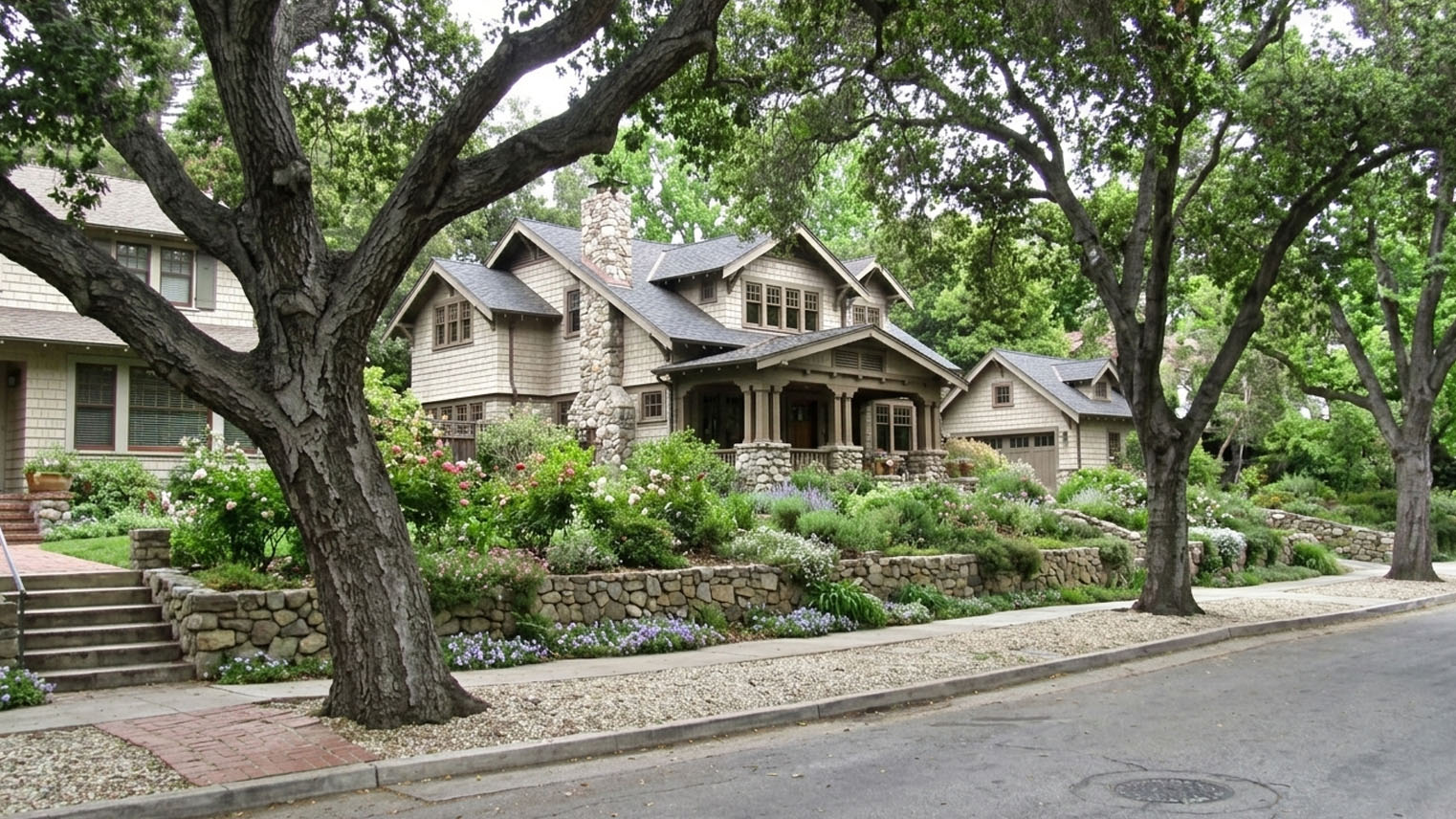
About Orange Heights.
Pasadena bungalow neighborhood between Jackson Street and East Mountain Street, listed in the National Register of Historic Places in 1995 as the Orange Heights/Barnhart Tracts Historic District. Intact early twentieth century Craftsman fabric a few blocks west of Bungalow Heaven.
The federal record uses six words for what the neighbors say in two. Orange Heights holds one designation and one only, and the fabric it protects is unusually intact. Here is the record, question by question, out of the National Register registration form and the city’s own combined designations list.
Where is Orange Heights in Pasadena?
Orange Heights is a Pasadena bungalow neighborhood on the blocks between Jackson Street and East Mountain Street, a few blocks west of Bungalow Heaven. The edges run North Los Robles Avenue on the west, North El Molino Avenue on the east, Jackson Street on the north, and East Mountain Street on the south, a compact rectangle you can walk before your coffee cools.
Is Orange Heights a Pasadena landmark district?
No. A National Register listing and a city landmark district are different instruments, and Orange Heights holds exactly one of them. Pasadena’s landmark district machinery is a separate ledger, and Orange Heights does not appear in it.
The Register is federal recognition of significance; it does not put the city’s design review between an owner and a front porch. For an owner that is the whole practical difference, and it is the first thing to establish before planning any work here.
What is the Orange Heights/Barnhart Tracts Historic District?
It is the federal name for this neighborhood, listed in the National Register of Historic Places as reference number 95001128, entered on September 29, 1995. That listing is the neighborhood’s whole designation story: no city landmark district stands here. What stands here is the fabric, eighty four buildings counted at listing on the blocks between Jackson and Mountain, and a federal form that walked them one by one.
Why does the district carry two tract names?
The long name is honest bookkeeping. The district covers two subdivisions, the Orange Heights tract, opened in 1906, and the Barnhart tract beside it, and the register form credits the ground accordingly.
How many buildings are in the district?
Eighty four buildings were counted at listing, sixty one of them contributing to the district’s significance.
What do the houses in Orange Heights look like?
Federal paperwork is not supposed to make you want to be somewhere, but the form’s description section comes close. The lots sit elevated behind arroyo stone and concrete retaining walls, the setbacks are generous, uniform, and landscaped, the street trees run in closely spaced rows, and the streets look north at the San Gabriel Mountains.
Fifty three of the sixty one contributing buildings are Craftsman bungalows, most commonly a story and a half under a wide side facing gable roof, with a full front recessed porch and a central front gabled dormer, and the family runs from there through the two story chalet and the airplane bungalow. Everything here was built as single family housing except one duplex and a four unit bungalow court.
Why is arroyo stone everywhere in Orange Heights?
Arroyo stone is the district’s signature material, and the form finds it everywhere: porches, foundations, piers, chimneys, and the retaining walls that hold the front yards up off the sidewalk. It is the feature you register first from the street and the one that makes the blocks read as a single composition rather than a row of separate houses.
Who built the houses in Orange Heights?
This is a builder’s neighborhood, and the form names the builders. Seventeen contributing buildings, fifteen houses and a two building bungalow court, came from the local Craftsman builder D. M. Renton, the largest collection of his buildings in Pasadena by the form’s own count. George F. Thompson, the developer of the Orange Heights tract, built several houses in it himself.
The rest came from local builders working the movement’s ideas at a high standard, which is exactly what the streets still show.
Were any Orange Heights houses architect designed?
Only six contributing buildings are architect designed, work the form credits to Cyril Bennett, Kenneth A. Gordon, Sylvanus B. Marston, and Irving Gill, and it prints here as the form’s account, with no house tied to any name. An attribution this library has not verified house by house is reported as somebody else’s claim, never as its own.
Why did the National Register list Orange Heights?
The form lists the district under Criterion C, for architecture. Fifty of the sixty one contributing buildings went up within ten years of the 1906 subdivision, and the form reads them as the mature period of the American Arts and Crafts movement, high and low style examples together. The movement itself is covered in The Arts and Crafts Movement in Southern California.
What else stands in the district besides Craftsman bungalows?
Around that Craftsman core the contributing set carries a documented variety: three turn of the century transitional buildings with Craftsman elements, three one story Colonial Revival bungalows, one massed plan Prairie style building, and one Mission Revival inspired building. The inventory also records Spanish Colonial Revival work from the twenties, dated 1922 and 1927 by the form, counted outside the contributing set because it stands apart from the Arts and Crafts line the district is listed for.
How much of Orange Heights has been altered?
Very little of it has changed. The form counts very few significantly altered buildings and calls the district largely unchanged from its appearance during its period of significance, 1906 to 1930.
For a buyer hunting original fabric rather than a restored presentation, that sentence is the reason to look here at all.
How do Orange Heights, Bungalow Heaven and Madison Heights differ?
The map makes the point better than the paperwork does. A few blocks east, Bungalow Heaven holds the first Landmark District the city ever designated. South of California Boulevard, Madison Heights has been found eligible since 2018 and is still waiting on the city’s blessing. Orange Heights carries the third kind of record, federal since 1995, and the three of them together are a complete education in how Pasadena keeps its books. All twenty-three named districts of the valley are mapped in the architectural neighborhoods canon.
What does a builder’s eye look for in an Orange Heights house?
It looks for the repetitions, and then for the house that broke them. I am Greg Anderson, the real estate adviser behind Arroyo Casa, and I read these houses the way my building years taught me to read them. A district where fifty houses went up in one decade rewards that kind of reading: the same arroyo stone, the same rafter tails, the same porch logic, repeated with a builder’s variations until the street itself becomes the pattern book. Renton’s houses answer Thompson’s, block against block, and the differences between them are small enough that finding them is the pleasure.
That is also how you price one here. With no city design review in the way, what separates two Orange Heights houses is almost entirely what survives inside and behind them: the sash, the mortise hardware, the fir and redwood, the plaster, the stone that was never stuccoed over. I built and remodeled homes for twenty years and have held a California real estate license since 1990, and in a builder’s district that pairing is the one that earns its keep, because there is no architect’s name to argue about and the condition of the original fabric is the argument.
Walk it in the late afternoon and the form’s driest line is the one you feel first: elevated lots, and to the north, over the street trees, the San Gabriel Mountains. When you find the one you want, send me the address and we will read it together. The method is in Buying an Architectural Home, and what ownership asks afterward is in Owning the Architectural Home.
Characteristic Styles.
- Craftsman · American architectural style that flourished roughly 1900 to 1930 in reaction to Victorian ornament and industrial mass production. Southern California Craftsman bungalows define the SGV's earliest residential character, with the largest intact concentration in Pasadena's Bungalow Heaven Landmark District.
Part of Pasadena.
Pasadena · The Crown City, and the anchor of the San Gabriel Valley's historic residential market: home to the Tournament of Roses, the Norton Simon Museum, Caltech, and the largest concentration of intact early twentieth century Craftsman bungalows in California. Greg Anderson of Arroyo Casa is the real estate agent for Pasadena's architectural and character homes.
Sources and references.
- National Register of Historic Places Registration Form, Orange Heights/Barnhart Tracts Historic District, reference number 95001128, entered September 29, 1995, National Park Service (https://npgallery.nps.gov/AssetDetail/NRIS/95001128)
- Combined Designations list, December 2023, National Register district, no city landmark district, City of Pasadena (https://www.cityofpasadena.net/wp-content/uploads/sites/30/Combined-Designations.pdf)
- National Register of Historic Places listings in Pasadena, corroboration, complete through NPS postings of June 19, 2026, Wikipedia (https://en.wikipedia.org/wiki/National_Register_of_Historic_Places_listings_in_Pasadena,_California)
Last updated