
Bungalow Heaven
Pasadena's first Landmark District (November 14, 1989). NRHP 08000260 (listed April 10, 2008). California Register of Historical Resources. APA "10 Great Places in America" (2009).
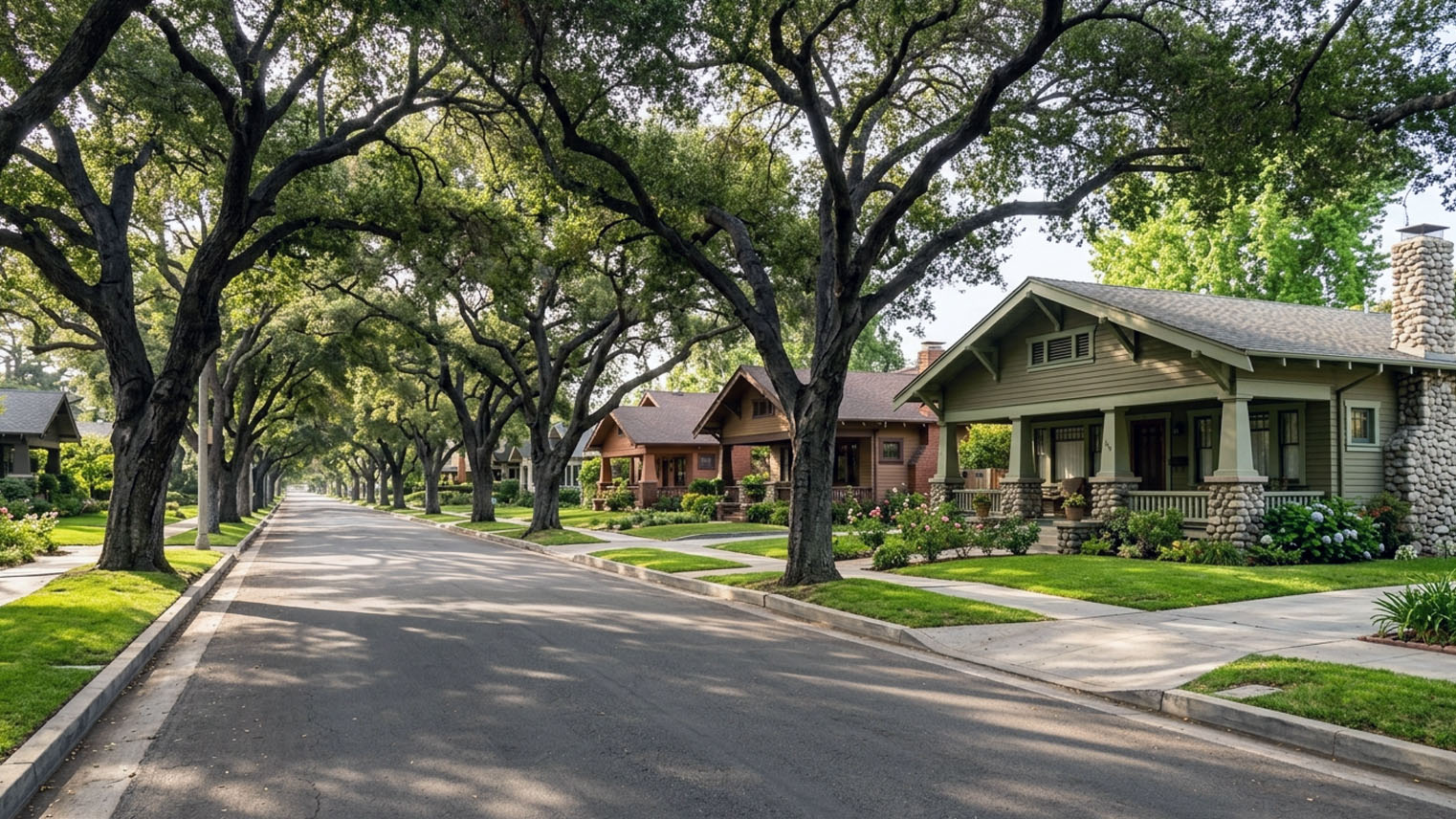
About Bungalow Heaven.
Approximately 16-block, 125-acre residential neighborhood in north-central Pasadena. The largest concentration of intact early-twentieth-century Craftsman bungalows in the city. Pasadena's first locally designated Landmark District (November 14, 1989). Listed on the National Register of Historic Places (April 10, 2008, NRHP 08000260) and the California Register of Historical Resources. The National Register listing identifies 522 contributing and 164 non-contributing buildings across the sixteen-block area. Named one of the American Planning Association's "10 Great Places in America" in 2009.
Pasadena’s first Landmark District is sixteen blocks of Craftsman bungalows, and it became the model every district in the city followed afterward. What follows is the record of this neighborhood, question by question, out of the National Register nomination, the city’s own papers, and the association that got it designated.
Where is Bungalow Heaven in Pasadena?
Bungalow Heaven (Wikidata Q5001456) sits in the foothills of north-central Pasadena, between the older eastern downtown and the wealthier western neighborhoods that grew around the Arroyo Seco. The district occupies a defined sixteen-block area and contains the largest documented concentration of intact early-twentieth-century Craftsman bungalows in the city. It was developed primarily between 1888 and 1929, with the peak Craftsman construction period running from 1905 to 1920, per the National Park Service nomination form.
Within the district boundaries the street grid runs gently uphill from south to north, following the slope of the San Gabriel foothills. Mature street trees line the residential blocks. Front porches face the sidewalk. Commercial activity sits along the edges, primarily on Lake Avenue to the west and portions of Washington Boulevard along the northern boundary, keeping the residential interior largely free of through-commercial traffic.
What are the boundaries of the Bungalow Heaven Landmark District?
The official Landmark District is bounded, approximately, by Washington Boulevard on the north, Orange Grove Boulevard on the south, Mentor Avenue on the west, and Michigan and Chester Avenues on the east. The wider neighborhood, informally understood by residents and Pasadena historians, extends to Lake Avenue on the west and Hill Avenue on the east, though those outer blocks fall outside the formal designation.
That gap is not a technicality. A house a listing calls Bungalow Heaven can sit outside the designated boundary, which changes what review the property carries and whether it can reach the city’s Mills Act program at all. Establish which side of the line an address falls on before anything else.
How did Bungalow Heaven get its name?
The neighborhood was named Bungalow Heaven by Pasadena’s architectural and historic surveyors in the 1980s, during the survey work that led to designation. The name became official with the 1989 Landmark District designation.
When did Bungalow Heaven become a Pasadena Landmark District?
On November 14, 1989, when the Pasadena Board of Directors voted to designate Bungalow Heaven as the city’s first Landmark District. Twenty-six Landmark Districts have followed in Pasadena in the years since, per the city’s combined designations list updated December 8, 2023. Bungalow Heaven was the prototype.
How did residents get Bungalow Heaven designated?
They organized, wrote a plan with the city, and knocked on every door in the proposed district. The path to designation began in the mid-1980s, when Pasadena’s Historic Preservation Department surveyed the neighborhood and identified the concentration of intact Craftsman housing as a citywide resource worth protecting. Residents organized through what would become the Bungalow Heaven Neighborhood Association, developed a Conservation Plan with the city’s Historic Preservation staff, and conducted a door-to-door petition campaign to secure the property-owner signatures required under Pasadena’s Landmark District process.
The Pasadena process required signatures from at least 51% of property owners within the proposed district. The Bungalow Heaven campaign secured 55% across the 962 lots in the proposed district.
Is Bungalow Heaven listed in the National Register of Historic Places?
Yes, and it carries three separate records rather than one. Bungalow Heaven was listed on the National Register of Historic Places on April 10, 2008, reference number 08000260, and it is also listed on the California Register of Historical Resources. Both are separate instruments from the city’s own Landmark District designation of November 14, 1989.
The difference is the part that changes an owner’s life. Federal and state listing recognize significance. The city designation is the one that puts design review between an owner and a change visible from the street.
How many contributing and non-contributing buildings are in Bungalow Heaven?
The National Register nomination identifies 522 contributing buildings and 164 non-contributing buildings within the nominated sixteen-block area.
Those are buildings inside the National Register boundary, which is not the same unit as a count of properties in the Landmark District. The American Planning Association, recognizing the neighborhood in 2009, put roughly 660 of the district’s 1,100 properties inside the National Register listing, and the Madison Heights association’s comparison of Pasadena landmark districts counts Bungalow Heaven at 1,139 properties. Every Bungalow Heaven figure needs its boundary and its unit attached before it means anything.
What does contributing or non-contributing mean in Bungalow Heaven?
Contributing buildings retain enough of their original design integrity to convey the district’s architectural and historical character. Non-contributing buildings have been altered substantially enough that they no longer read as part of the district’s early-twentieth-century fabric, though they remain within the geographic boundaries. The contributing-versus-non-contributing distinction matters substantively for owners considering Mills Act enrollment, since only contributing-status properties qualify under the city program.
What did the 2025 Conservation Plan amendment change?
On June 16, 2025, the Pasadena City Council unanimously approved amendments to the Bungalow Heaven Conservation Plan. The amendments extended the district’s official period of significance to 1885 through 1956 and reclassified 67 additional homes as historically significant. The reclassification expanded Mills Act eligibility within the district to include houses outside the original 1888 to 1929 Craftsman core, recognizing the broader architectural fabric that grew up alongside and after the bungalow peak.
What period of significance does Bungalow Heaven cover now?
1885 through 1956, since the 2025 amendment. The amended period covers four building eras documented in the district: Victorian (1885 to 1906), Arts and Crafts (1903 to 1923), Period Revival (1915 to 1939), and Minimal Traditional and Ranchette homes built between 1930 and 1956.
What does a Bungalow Heaven bungalow look like?
The bungalow form that fills the district is distinguished by a low horizontal silhouette, a wide front porch supported by tapered columns set on substantial piers, deep overhanging eaves with exposed rafter tails, a prominent front gable or pair of gables, and interior plans organized around a living room with built-in cabinetry flanking a tile-surround fireplace. Materials run to natural finishes: shingled or clapboard exterior siding, river-stone or clinker-brick porch piers, quarter-sawn oak interior millwork, hardwood floors, and plaster walls. Windows are typically wood-sash double-hung with art-glass or leaded panels in fixed positions. The cumulative effect is one of horizontal weight, handcraft visible at every joint, and a clearly defined relationship between interior and front-yard.
Read that list twice and it stops being a description and becomes a checklist. I built and remodeled homes for twenty years, finish carpentry the trade I went deepest on, and every item on it is something a later owner could have taken out. On these blocks you can usually tell from the sidewalk whether they did.
Which architectural styles will I find in Bungalow Heaven?
Craftsman dominates. The district’s residential fabric is the Craftsman bungalow as it was built for the working and middle classes of Pasadena between 1905 and 1920. This was the period when the Craftsman style, codified by Greene and Greene in their wealthier Pasadena commissions and disseminated nationally through Gustav Stickley’s The Craftsman magazine, moved from architect-designed estates into speculative builder catalogs serving everyday buyers. Bungalow Heaven is Pasadena’s clearest surviving record of that movement.
Craftsman is not all of it. The amended period of significance recognizes Victorian, Period Revival, and Minimal Traditional and Ranchette housing in the district as well, and a minor share of American Foursquare survives among the dominant Craftsman inventory. The neighborhood’s place in the movement story is told in The Arts and Crafts Movement in Southern California.
Were the houses in Bungalow Heaven designed by architects?
Mostly not, and that is the point of the place. Within Bungalow Heaven itself, the houses are generally builder-designed rather than architect-designed. The district’s architectural value lies in the cumulative effect of hundreds of intact bungalows reading as a coherent residential fabric, not in individual landmark commissions. Buyers who arrive hunting a signed house are reading this neighborhood with the wrong instrument.
What is the oldest house in Bungalow Heaven?
The oldest house in the district is the Keil House at 714 North Mentor Avenue, constructed in 1888 in the Queen Anne style. The Keil House predates the Craftsman bungalow period by roughly fifteen years and is one of only a few surviving Queen Anne houses in Pasadena. Per the NRHP nomination, the small scale of the Keil House and a handful of other late-nineteenth-century houses in the southwest part of the district established the residential character that the later Craftsman bungalows extended. The 1888 to 1903 transitional period sits at the early edge of the district’s amended period of significance.
Are there bungalow courts in and around Bungalow Heaven?
The bungalow court typology that surrounds the district was invented by Pasadena architect Sylvanus Marston at St. Francis Court (1909), a few blocks from the Bungalow Heaven boundaries. Marston’s bungalow courts, alongside those designed by the Heineman and Heineman firm in the same Pasadena bungalow ecosystem, established a model for clustered small-house development that influenced the broader Pasadena residential landscape during the years of Bungalow Heaven’s peak construction.
Which architects from the Pasadena canon connect to Bungalow Heaven?
Two architects from the canon touch the district from opposite directions. Gordon B. Kaufmann lived inside its blocks, at a 1917 bungalow at 762 North Holliston Avenue. Joseph J. Blick’s Craftsman commissions sat outside the district by pattern, clustering on the higher streets of Grand Avenue and California Boulevard at the style’s larger residential scale.
Is Batchelder tile found in Bungalow Heaven houses?
Many homes feature original interior details associated with the broader Arts and Crafts movement: built-in bookcases and dining buffets, leaded art glass, and handcrafted tile surrounds executed by Pasadena makers such as Ernest Batchelder, whose Pasadena studio supplied tile for numerous Craftsman homes in the city during the same period.
Attribution on one specific hearth is its own question. Without a record you own period tile, not a documented Batchelder, and the two are not the same claim. What the difference is worth, and what to do before anyone touches a hearth, is on the Ernest Batchelder page.
What work in Bungalow Heaven needs a Certificate of Appropriateness?
Exterior work a passerby can see, and nothing inside. The Conservation Plan, developed in the years preceding the designation, set out the goals of the district and the alterations subject to review. Major exterior changes visible from the street trigger a Certificate of Appropriateness review, applying the Secretary of the Interior’s Standards for Rehabilitation. Interior alterations, paint colors, landscaping, and routine maintenance remain exempt from review.
Can a Bungalow Heaven house get the Mills Act?
Contributing properties can, because the district is both a Pasadena Landmark District and a National Register-listed historic district. The 2025 Conservation Plan amendments extended eligibility to the additional 67 reclassified homes.
The Mills Act is a California state historic preservation program under California Government Code Article 12, Sections 50280 through 50290, and Revenue and Taxation Code Article 1.9, Sections 439 through 439.4. The Pasadena Historic Property Contract Program, established by city ordinance in 2002 and codified at Pasadena Zoning Code Section 17.62.130.B.4, allows owners of qualified historic properties to enter into ten-year contracts with the city. In exchange for the owner’s commitment to maintain the property’s historic character under the Secretary of the Interior’s Standards, the Los Angeles County Assessor reassesses the property using an income-capitalization method rather than market comparables.
Pasadena’s Mills Act Program Guidelines cap single-family eligibility at a $2.0 million valuation, except for works of Greene and Greene, designated Historic Monuments, and properties listed individually in the National Register. Cancellation of a Mills Act contract by breach carries a penalty of 12.5% of the property’s current fair market value as determined by the Los Angeles County Assessor. The wider mechanics of the program, including who actually saves money under it, are in Owning the Architectural Home. Whether the trade is worth it on one particular bungalow depends on what that house will ask of you over the ten years you are committing to, which is a question best answered standing in it: book a time and I will walk it with you.
What is McDonald Park?
McDonald Park, the public open space near the geographic center of the district, sits at 1000 East Mountain Street and covers 4.8 acres. The park is named for Judge Robert W. McDonald (1867 to 1918). The park parcel is bordered by Wilson Avenue, Mar Vista Avenue, Bell Street, and Mountain Street. McDonald Park sits within walking distance of every home in the district and functions as the neighborhood’s shared green space. Photographs in the Pasadena Public Library’s Pasadena Digital History Collaboration archive document the park’s use as early as the late 1930s, when the existing pergola, now a defining feature of the park, was already in place.
What does the Bungalow Heaven Neighborhood Association do?
The Bungalow Heaven Neighborhood Association operates as the district’s volunteer civic organization. The BHNA was instrumental in the development of the Conservation Plan that preceded the 1989 designation and has remained the steward of the district’s preservation since. The association’s annual home tour began on June 3, 1990, six months after the Landmark District designation, and has continued annually with limited interruptions ever since. The 2026 home tour, held April 26, 2026, partnered with San Gabriel Valley Habitat for Humanity to benefit the rebuilding of homes in Altadena following the January 2025 Eaton Fire. The BHNA also administers a home improvement grant program for low- and moderate-income property owners and runs a summer concert series at McDonald Park.
Why did the American Planning Association name Bungalow Heaven one of its 10 Great Places in America?
The American Planning Association recognized Bungalow Heaven in its 2009 10 Great Places in America program. The APA narrative identified the neighborhood’s intact early-twentieth-century working-class Craftsman fabric, its active resident association, and McDonald Park as the elements that placed the district among the year’s recognized places.
The APA also noted the Bungalow Heaven Conservation Plan as a model for citywide restoration policies, the BHNA’s home improvement grant program for low- and moderate-income property owners, and the district’s Neighborhood Traffic Mitigation Plan as a city-first community planning effort.
How does Bungalow Heaven compare with Pasadena’s other historic districts?
Each of the nearby districts carries a different kind of record, and the differences are the whole education. The city’s actual second largest landmark district is Historic Highlands, designated in 2008, 479 properties of mixed period styles on larger lots in northeast Pasadena, with a county designated Altadena portion added in 2026. The district that would rank just behind this one is still waiting for its papers: Madison Heights, found eligible in 2018, would stand second in the city by its association’s count if Pasadena ever grants the designation. A few blocks west, Orange Heights carries the same early bungalow stock under a federal record of its own, listed in the National Register in 1995 as the Orange Heights/Barnhart Tracts Historic District.
The district’s place among the Valley’s twenty-three documented districts is mapped in the architectural neighborhoods canon.
Who should I talk to about buying or selling a house in Bungalow Heaven?
Talk to me. I am Greg Anderson, the real estate agent behind Arroyo Casa, and Pasadena’s architectural and character homes are the work I do. On these sixteen blocks the job has a specific shape. Before an offer, I want to know which side of the designated boundary the address sits on, whether the nomination counts it contributing or non-contributing, what the Conservation Plan asks of the elevation you can see from the sidewalk, and whether a Mills Act contract is already on the property or still possible under it.
Then I want to read the house. I built and remodeled homes for twenty years and I have held a California real estate license since 1990, and in a district of builder-designed bungalows that combination is the useful one, because the value here sits in original fabric rather than in a signature. Porch piers, rafter tails, the oak millwork, the tile at the hearth, the sash in the openings: what survives of that is what a buyer in this district is actually paying for, and what a seller here is actually selling.
Send me the address. If you are buying, the Arroyo Casa contact form is the quickest way to reach me. If you are selling, request a Sell Odds read and an in-home analysis and we will start from what the record says your house can actually do. Either way we will look at the record and the house together, and Choosing a Real Estate Agent for an Architectural or Character Home explains what evidence to ask of me before you do. The wider city record is at Pasadena.
Characteristic Styles.
- Craftsman · American architectural style that flourished roughly 1900 to 1930 in reaction to Victorian ornament and industrial mass production. Southern California Craftsman bungalows define the SGV's earliest residential character, with the largest intact concentration in Pasadena's Bungalow Heaven Landmark District.
Architects of the District.
- Greene and Greene · Charles Sumner Greene (1868 to 1957) and Henry Mather Greene (1870 to 1954) established their architectural practice in Pasadena on Colorado Street in January 1894 after training together at the Massachusetts Institute of Technology. The firm produced Robert Judson Clark's four "ultimate bungalows" between 1907 and 1909 (Blacker and Gamble in Pasadena, Thorsen in Berkeley, Pratt in Ojai) and dissolved in 1922. Henry continued residential practice in Pasadena into the 1930s.
- Sylvanus Marston · Pasadena architect credited with creating the bungalow-court typology in 1909. His practice, later Marston, Van Pelt and Maybury and then Marston and Maybury, produced roughly a thousand projects across Pasadena, Altadena, San Marino, Alhambra, and the wider SGV, spanning more style periods than any of his flagship contemporaries.
- Heineman and Heineman · Heineman and Heineman was a Pasadena architectural practice operating under various names from 1906 through 1939, producing an estimated 1,000 to 1,500 building designs across Southern California with more than 20 documented residences in Pasadena alone. The firm is the most prolific Craftsman-era architectural practice in the San Gabriel Valley after Greene and Greene. Bowen Court at 539 East Villa Street, listed on the National Register of Historic Places, is the firm's most architecturally significant SGV commission. Arthur Heineman is also credited with the invention of the motel typology through the Milestone Mo-Tel in San Luis Obispo (1925).
Part of Pasadena.
Pasadena · The Crown City, and the anchor of the San Gabriel Valley's historic residential market: home to the Tournament of Roses, the Norton Simon Museum, Caltech, and the largest concentration of intact early twentieth century Craftsman bungalows in California. Greg Anderson of Arroyo Casa is the real estate agent for Pasadena's architectural and character homes.
Sources and references.
- NRHP Asset 08000260, National Register listing record, April 10, 2008, National Park Service (https://npgallery.nps.gov/AssetDetail/NRIS/08000260)
- Bungalow Heaven Historic District record N2405, state register record, California Office of Historic Preservation (https://ohp.parks.ca.gov/ListedResources/Detail/N2405)
- McDonald Park, park record, City of Pasadena (https://www.cityofpasadena.net/parks-and-rec/parks/mcdonald-park/)
- Mills Act Program Guidelines, valuation cap and program rules, City of Pasadena (https://www.cityofpasadena.net/planning/wp-content/uploads/sites/30/MILLS-ACT-PROGRAM-GUIDELINES.pdf)
- Historic Property Contract Program, program page, established 2002, City of Pasadena (https://www.cityofpasadena.net/planning/planning-division/design-and-historic-preservation/historic-preservation/mills-act/)
- Mills Act, state Mills Act overview, California Office of Historic Preservation (https://ohp.parks.ca.gov/millsact/)
- Government Code Section 50280, state enabling statute, California Legislative Information (https://leginfo.legislature.ca.gov/faces/codes_displaySection.xhtml?lawCode=GOV§ionNum=50280)
- Landmark FAQ, 1989 designation and district process, Bungalow Heaven Neighborhood Association (https://www.bungalowheaven.org/landmark-information/landmark-faq/)
- What is Bungalow Heaven, district overview, Bungalow Heaven Neighborhood Association (https://www.bungalowheaven.org/our-history/what-is-bhna/)
- Origins, neighborhood history, Bungalow Heaven Neighborhood Association (https://www.bungalowheaven.org/our-history/origins/)
- Great Places in America, Bungalow Heaven, 10 Great Places recognition, 2009; carries the property relationship, approximately 660 of the 1,100 properties included in the National Register, American Planning Association (https://www.planning.org/greatplaces/neighborhoods/2009/bungalowheaven.htm)
- Landmark District FAQ, question 17, how the proposed district compares with other Pasadena landmark districts, the association's property counts for Pasadena landmark districts, Bungalow Heaven 1,139 properties, Madison Heights Neighborhood Association (https://www.mhnapasadena.org/landmark)
- McDonald Park late 1930s, park photographs, late 1930s, Pasadena Public Library, Pasadena Digital History Collaboration (https://www.pasadenadigitalhistory.com/Documents/Detail/mcdonald-park-late-1930s/86537)
- Bungalow Heaven Historic District, NPS adopted nomination text, Living Places (https://www.livingplaces.com/CA/Los_Angeles_County/Pasadena_City/Bungalow_Heaven_Historic_District.html)
- Bungalow Heaven Opens Its Doors for a Beloved Tour, 2026 home tour report, April 25, 2026, Pasadena Now (https://pasadenanow.com/main/bungalow-heaven-opens-its-doors-for-a-beloved-tour-and-this-time-it-will-help-neighbors-rebuild)
Last updated