
Historic Highlands
Pasadena Landmark District, designated January 22, 2008; Los Angeles County Historic District on the Altadena portion, effective July 9, 2026, the first historic district the county has ever designated
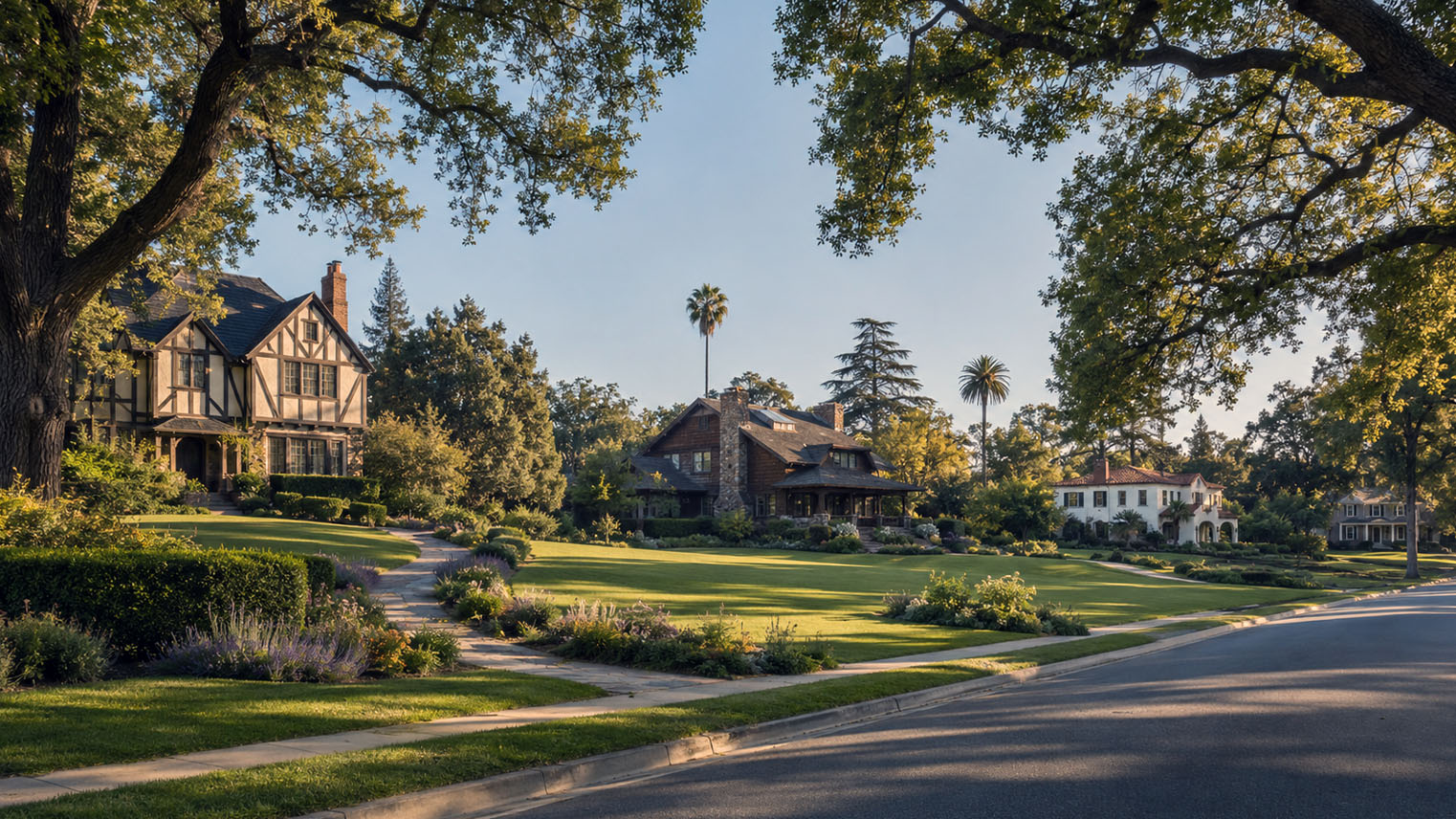
About Historic Highlands.
Pasadena neighborhood of deep lots and mixed period styles between Lake Avenue and Hill Avenue, running north from Washington Boulevard into unincorporated Altadena. The Pasadena blocks have been a city Landmark District since January 22, 2008, and in 2026 the Altadena blocks became the first historic district Los Angeles County has ever designated.
Historic Highlands is the largest landmark district most Pasadena buyers have never heard of, and it does not even stop at Pasadena: the neighborhood runs north across the city line into unincorporated Altadena, one name under two governments. This page is my working file on it. I built custom homes for twenty years as a general contractor, finish carpentry was my specialty within that work, and I have held a California real estate license since 1990, so I read these blocks the way a builder and an agent read them at once: deep lots, setbacks that vary house to house, garden walks that curve to the porch, and a different answer to the period house on almost every parcel. The questions below are the ones owners and buyers actually ask me, answered from Pasadena’s, Los Angeles County’s, and the neighborhood’s own records.
Where exactly is Historic Highlands in Pasadena?
Historic Highlands sits in northeast Pasadena, in the blocks between Lake Avenue and Hill Avenue, running north from Washington Boulevard toward the mountains. It is one of those neighborhoods people drive through for years without knowing it has a name. The streets are wide, the trees are old, and the houses were built for Pasadena’s business class in the decades when this was the growing edge of town. The lots run deeper than the bungalow districts, the setbacks vary from house to house, and many of the walks curve through a garden to reach the front door. One thing sets it apart from every other neighborhood I cover: the name does not stop at the city limit. The upper blocks, past the Pasadena line, are unincorporated Altadena. Same streets, same era of houses, different government. Any serious conversation about a home here starts with which side of that line it sits on.
Is Historic Highlands in Pasadena or Altadena?
It is both, and the answer recently became more interesting. The southern portion lies inside the City of Pasadena and has been a Pasadena Landmark District since January 22, 2008. The northern portion lies in unincorporated Altadena, and in 2026 Los Angeles County made it the first historic district the county has ever designated: 77 parcels, adopted June 9, effective July 9. The county drew its boundary to the original Pasadena Highlands Tract and stopped at the city line, so no address answers to both governments. One fact worth stating plainly: the county’s designation announcement of June 2026 says the district itself was not impacted by the Eaton Fire. But the two rulebooks are not the same, and neither are the offices you deal with. A buyer or owner who assumes the Pasadena rules apply everywhere in Historic Highlands will be wrong on half the neighborhood.
Is Historic Highlands a Pasadena Landmark District, a National Register district, or both?
The protections here are local, and local is the kind with teeth. The Pasadena side is a city Landmark District, designated in 2008 on the city’s own record, and the city’s designation list and district map carry it as a Landmark District with no National Register listing marked. The Altadena side is a Los Angeles County historic district, designated in 2026 under the county’s own preservation ordinance. A National Register listing is a different instrument altogether: federal recognition, considerable honor, very few strings. What governs the houses in Historic Highlands, what reviews the porch you want to rebuild and the windows you want to replace, is the local designation on each side of the line, and the district does not need a federal listing to be protected.
What are the boundaries of the Historic Highlands Landmark District?
Understand that three different boundaries share this one name. The neighborhood association’s footprint is the largest. The Pasadena Landmark District is smaller and legally exact, and the city’s address record draws it street by street: Atchison 916 to 1060, Catalina 1377 to 1775, Chester 1385 to 1506, Elizabeth 911 to 1379, Holliston 1385 and 1394 to 1698, Howard 915 to 931 and 941 to 1305, Lake 1540 to 1754 on the even side only, Mar Vista 1386 to 1709, Mentor 1369 to 1487 on the even side only, Michigan 1380 to 1695, Rio Grande 932, 957 to 1099, and 1136, Topeka 918 to 1373, Washington 969 to 999 on the odd side only, and Wilson 1442 to 1480, all designated January 22, 2008. The county’s district is smaller still, 77 parcels drawn to the original Pasadena Highlands Tract on the Altadena side. Listings use the name generously, and I do not blame an agent for wanting it on the flyer. But the designation is a matter of record, not marketing, and a house can carry the Historic Highlands name without carrying its protections.
How do I find out whether a particular house is actually inside Historic Highlands?
Pull the record rather than trusting the flyer. On the Pasadena side, the city maintains a public database of designated properties, and the counter at the Permit Center on Garfield Avenue, Window 4, will confirm a specific address. On the Altadena side, the county’s designating ordinance itself names every contributing parcel by address. This is ten minutes of work, and it settles the question that everything else depends on: what review applies to the exterior, whether the house can qualify for tax relief, and what a careful buyer will find when they check behind you. I pull it on every property I work in this neighborhood. If you want me to pull it on a house you are watching, email me at greg@arroyocasa.com. In a district this new on one side and this loosely named on both, the record is the only version of the truth. Historic Highlands is one of the twenty three named architectural neighborhoods this library documents across the valley.
What does it mean if a Historic Highlands house is contributing or non-contributing?
A contributing house still reads as what it was built to be. Enough of the original design survives, the roofline, the porch, the windows, the cladding, that the house is part of the reason the district earned its designation. A non-contributing house has been altered past that point. It still sits inside the boundary, and its exterior still goes through review, but it no longer counts toward the district’s historic weight. The difference is worth real money. On the Pasadena side, contributing status is what qualifies a house for a Mills Act contract, the tax program that rewards owners for maintaining historic homes. I built custom homes for twenty years, finish carpentry was my specialty, and when I walk one of these houses I am reading the original fabric the way the reviewers on either side of the line will: what survives, what was lost, and what can honestly be brought back.
How many historic homes are in Historic Highlands?
The Pasadena Landmark District holds 479 properties, second in the city only to Bungalow Heaven’s 1,139, by the district count the Madison Heights association keeps. The county district on the Altadena side adds 77 parcels, 60 of them contributing properties named in the designating ordinance itself. Taken together, that is more than five hundred protected homes from the neighborhood’s building era, one of the largest concentrations in the San Gabriel Valley, held by a neighborhood most buyers could not place on a map. That gap between how much is protected here and how little the name is known is, frankly, the opportunity.
Why is the neighborhood called Historic Highlands?
The Highlands part is original. In 1896, a railroad engineer named David MacPherson bought the tract of land then known as the Pasadena Highlands, high ground with a long view, rising toward the mountains. The name described the place honestly, and it stuck. The Historic part came later, when the neighborhood organized to protect what a century of that history had left standing. So the name is really two eras speaking at once: the developer’s promise of 1896 and the preservation work of our own time. Most neighborhood names in this valley are marketing that outlived the marketer. This one is closer to a plain description that turned out to be true.
When was Historic Highlands built?
The first house went up in 1885, before the neighborhood existed, when this was still orchard country. The real building came in two waves. The Danes subdivided their ranch land in 1912, and the neighborhood grew fast through the First World War and then the boom of the 1920s, when most of these blocks filled in. By the time Pasadena annexed the area in 1925, the orange groves had become a full suburb. On the Altadena side, the county’s record puts the homes at 1905 through 1959, which tells you building carried on past the war into the ranch and minimal traditional years. What you feel walking these streets is the 1910s and 1920s, houses built one at a time for people who intended to stay.
Who developed Historic Highlands?
Two men whose land met in the middle. Ezra Dane was an orchardist from Massachusetts who came to Pasadena in 1883, bought 160 acres, and planted fruit trees: peaches, apricots, prunes, citrus. He and his wife Lois built their ranch house in 1885 and watched the city grow toward them for thirty years before subdividing in 1912. David MacPherson was the engineer who built the Mount Lowe Railway, the mountain line that ran from Altadena to the crest of the San Gabriels from 1893 to 1938. He bought the Pasadena Highlands tract in 1896 and laid out its streets himself. Dane’s side became large lots sold to Pasadena’s business and professional class, who built substantial custom homes. MacPherson sold his lots with the confidence of a man who believed in the place: one early advertisement read, if you want the finest, see this.
What architectural styles will I find in Historic Highlands?
A broader mix than the famous districts, and that mix is the point. The county’s designating ordinance names ten styles on the Altadena side: Craftsman, American Foursquare, Tudor Revival, English Cottage Revival, Spanish Colonial Revival, Neoclassical Revival, American Colonial Revival, Modern Colonial, Minimal Traditional, and Ranch. The Pasadena side tells the same story in its own sequence: Craftsman bungalows from the 1910s, then the full revival wardrobe of the 1920s, and the quieter traditional houses of the district’s closing years. Bungalow Heaven is a district that repeats one idea beautifully. Historic Highlands is a district where each decade left its own answer, on lots large enough to give every house room to make its case.
Is Historic Highlands mostly Craftsman homes?
No, and buyers who come here expecting a second Bungalow Heaven are asking the wrong question of the right neighborhood. Craftsman homes are here, and good ones, mostly from the 1910s building wave. But the 1920s were this neighborhood’s biggest decade, and the twenties belonged to the revivals: English, Spanish, Colonial. If your heart is set on a tapered porch column and exposed rafter tails, I can find you that house here. But the buyer this neighborhood rewards is the one open to what the 1920s did best, a romantic house on a generous lot, built custom for a particular family rather than from a builder’s catalog.
Which architects and builders worked in Historic Highlands?
This neighborhood drew real hands, and the city’s own landmark list proves it at the addresses. On North Lake, the neighborhood’s western edge, stand individual city landmarks in their own right: the Breiner House of 1914 by Cyril Bennett at 1495 North Lake and a 1925 Glen Elwood Smith house at 1347 North Lake, and just west of the district’s Rio Grande blocks a landmarked 1916 Aladdin kit house holds its own designation. At the district’s edges stand the Santa Catalina Library of 1930 by Marston and Maybury and Longfellow Elementary of 1911 by Greene and Greene. Most of the houses inside the boundary, though, were built the way most good houses of that era were: by skilled builders working for a particular client, names the record keeps but history books skip. I built homes that way myself for twenty years. The quality of an unfamous builder is something you can read in the joinery, and these streets read well.
How is Historic Highlands different from Bungalow Heaven?
They are the two largest landmark districts in Pasadena, and they answer different desires. Bungalow Heaven is 1,139 properties of concentrated Craftsman, modest working and middle class bungalows built close together on even setbacks, a neighborhood that repeats one perfect idea block after block. It was the city’s first landmark district and it is nationally famous. Historic Highlands is 479 properties on the Pasadena side plus 77 county parcels above the line, by the same association count: larger lots, larger houses, custom built for the business class, set back at varying depths behind deep lawns, in a mix of styles that runs from Craftsman through the full 1920s revivals. It was designated in 2008 and most buyers still have never heard of it. Bungalow Heaven’s fame is priced in. Historic Highlands offers something quieter: comparable protection, bigger ground, and a name the market has not finished discovering.
Why do the streets have railroad names?
Because the man who named them spent his life on the rails. MacPherson began with the Santa Fe line in Texas, built steam railroads in Mexico, then came to Pasadena in 1885 to engineer the Mount Lowe Railway. When he laid out his tract, he named the streets for the railroads he loved: New York, Erie, Atchison, Topeka, Santa Fe, Denver, and Rio Grande. Denver has since become Howard, but the rest still read like a timetable. Catalina and Mar Vista are the exceptions, named for the ocean view the high ground offered before the city grew up around it. MacPherson lived in the neighborhood he drew, on Topeka and later on Atchison, until his death in 1927. Few Pasadena neighborhoods carry their founder’s autograph this plainly. You can read this one off the street signs.
Does Historic Highlands have an HOA, or just a neighborhood association?
There is no HOA, and the distinction matters to your monthly budget and your deed. The Historic Highlands Neighborhood Association is a volunteer civic organization, the people who run the home tours, the Fourth of July gathering, and who spent eight years carrying the Altadena designation to the finish line. It holds no power over your property and collects nothing from you. The rules that do govern your exterior come from the government on your side of the line: the City of Pasadena on the south, Los Angeles County on the north. So you get the thing many buyers actually want and rarely find: protected streets without an HOA’s reach into your life.
What are the tradeoffs of owning a house in Historic Highlands?
In this district specifically, the ledger reads like this. On the cost side: exterior work visible from the street goes through the city’s review before the permit, which adds a step and some patience, and the review expects materials and details that suit the house, which can cost more than the vinyl alternative. On the benefit side: the street you bought is the street you keep, contributing homes can qualify for Mills Act tax relief, the city offers free consultation from staff who know historic buildings, and additions can request a waiver of the standard parking requirement. Historic Highlands adds one wrinkle of its own: cross the city line and the ledger changes to the county’s version, and one difference is real money. Pasadena charges no fee for this review in a landmark district, while Los Angeles County charges an application fee, with the amount set by the county’s current fee schedule. I walk through how the districts work across the whole valley on my communities page; here, the short version is that the trade runs in the owner’s favor if the owner likes the house they bought.
Can I remodel a house in Historic Highlands?
Yes. The district changes how you remodel, not whether you can. On the Pasadena side, the dividing line is visibility from the street: exterior changes the street can see need a Certificate of Appropriateness before the building permit issues, while interiors, paint colors, and routine upkeep stay entirely yours. Gut the kitchen, open the floor plan, redo every bathroom, and the city has no opinion. Rebuild the front porch and it does. On the Altadena side, the county runs the same idea through its own rules. Maintenance and repair, painting, and your interiors are yours outright, and this district’s own ordinance adds exemptions of its own: landscaping, tree work in the rear yard, and work that builds nothing, alters no protected feature, and cannot be seen from the street. Change what the street sees, on either side of the line, and the certificate comes before the permit. The owners who have a hard time here are the ones who finish their drawings before they read the rules. Design to the house instead of against it, and the review becomes paperwork. I spent twenty years building custom homes, and I will say plainly: the review is asking for the same discipline a good builder brings anyway.
What work requires a Certificate of Appropriateness in Historic Highlands?
On the Pasadena side, exterior alterations, new construction, and demolition all require city approval, and the certificate comes before the building permit, not after. The test is whether the change touches what the street sees and whether the result is appropriate to the period of the house. The practical rulebook is the city’s Design Guidelines for Historic Districts, and the practical door is Window 4 at the Permit Center on Garfield, where staff will tell you before you spend a dollar on drawings whether your project needs the certificate and what the review will look for. I walk the whole city process, what is exempt, what stays at the counter, what goes to the commission, and what it costs, on my Pasadena Certificate of Appropriateness page. On the Altadena side, the county uses the same name, Certificate of Appropriateness, under its own code, and the machinery is its own. The Department of Regional Planning administers it from downtown Los Angeles, there is no counter like Window 4, and applications file online through the county’s permitting portal. Reconstruction, rehabilitation, restoration, and additions under five hundred square feet are decided by county staff. Everything else goes to a public hearing before the county’s Historical Landmarks and Records Commission. Both governments measure your project against the Secretary of the Interior’s Standards. Same name, same measuring stick, different office, and paperwork from one side will not serve at the other.
Can I replace the windows, porch, roof, fence, or garage on a Historic Highlands house?
You can, and the question the review will ask about each one is the same: does the street see it, and does the replacement respect the house. Original wood windows are the fight worth having a plan for, because they are usually repairable at less cost than owners expect, and the review will favor repair or in-kind replacement over new units that change the pattern of the facade. Porches are the face of these houses and get the closest read. Fences and garages facing the street go through review; work behind the house draws far less attention. The Altadena side adds two protections an owner might not expect, written into the district’s own ordinance: the mature shade trees and the open, low fenced front yards are designated features of the district itself. Tree work in the rear yard is exempt, but a mature tree in the front or side yard sits inside the review, with an arborist’s report riding along with the application, and a tall front fence touches a designated feature by the ordinance’s own text. Here is the piece of advice I give as a builder before I give it as an agent: on a 1912 house, the original material is almost always the better material. The certificate process and I agree on that for different reasons. Mine is that quality survives.
Can I add onto a house or build a second story in Historic Highlands?
Additions happen in this district, and the large lots are exactly why they can. The review favors additions that hold the original house in front and put the new square footage behind, stepped back and subordinate, so the street still reads the 1910s and 1920s. A second story on a one story house is the hardest version of the question, because it changes the silhouette the district was designated to keep, and it will get the closest scrutiny. On the Pasadena side, two advantages soften the road: designated properties can use the State Historical Building Code, which allows sensible departures from current code that save real money, and additions in landmark districts can request a waiver of the two covered parking spaces the code would otherwise demand. On the Altadena side, the county’s rule is flatly harder on the second story itself: its work guidelines permit an upper story addition only by converting an existing attic, lit with dormers, kept subordinate and to the rear. If your plan for a one story house above the city line depends on lifting the roof, the district is telling you no before you draw it. Bring the rules into the first sketch. The lot size here gives you room to get what you want without asking the street to absorb it.
Can I build an ADU in Historic Highlands?
Yes, on both sides of the line, and the Altadena side is the easier answer. Pasadena’s current rules allow ADUs in historic districts, and the city’s own regulation table draws the line at visibility: a conversion of existing space is permitted, and a newly built unit, attached or detached, is permitted if it is not visible from the public right of way. Being in a historic district also carries a benefit: no parking space is required for the unit, and a garage conversion does not obligate you to replace the lost parking. On the Altadena side, the county has gone further: by a formal county interpretation issued in 2023, no Certificate of Appropriateness is required for an ADU at all, because state ADU law demands objective standards and the historic review is not one. A county side ADU still needs its ordinary building permits, but the historic review is off the list. What changed in recent years is worth saying plainly, because old preservation copy still scares owners off: on both sides of this district, the ADU is a normal project now, not an exception to be begged for. Design it to disappear from the street and the district works with you.
Can a house in Historic Highlands be torn down?
Not quietly, and that is the point of the district. On the Pasadena side, demolition requires city approval the same as any other exterior change, and inside a landmark district that approval is not a formality. The designation exists because the neighborhood petitioned to keep these houses standing, and the review begins from that premise. On the Altadena side, the county’s brand new district now provides the same protection to 77 parcels that had none before 2026, which is precisely why the neighbors spent eight years getting it done, and under the county’s process demolition is exactly the kind of work no staff desk can approve: it goes to a public hearing before the county’s landmarks commission. If you are buying here with the lot in mind rather than the house, this is the wrong neighborhood, and I would rather tell you that before escrow than after. If you are buying because the house next door will still be there in twenty years, this is the protection you are paying for.
Can a non-contributing house in Historic Highlands be substantially changed or replaced?
A non-contributing house has more room to move, and it is the one place in the district where bigger thinking gets a fair hearing. The house still sits inside the boundary, so exterior work and any replacement still go through review. But the review is protecting the district around the house rather than the house itself, so the question shifts from preserve this to fit this street. A well designed replacement or major remake that respects the scale and rhythm of the block can succeed here in a way it could not on a contributing lot. For a certain buyer, a non-contributing house on a good Historic Highlands street is quietly one of the more interesting purchases in Pasadena: district protection around you, design freedom within reason on your own lot. Finding that combination is the kind of hunt I enjoy.
Is Historic Highlands a good place to buy an older Pasadena home?
For a certain buyer it is one of the best answers in the city, and the reason is the gap between what the district is and what the market knows. This is Pasadena’s second largest landmark district, 479 protected properties plus 77 more under the county, with larger lots and larger houses than the famous districts, in a mix of styles that gives you choices Bungalow Heaven cannot. And yet the name draws a fraction of the attention. Fame is expensive. Bungalow Heaven’s reputation is built into every asking price on its streets. Historic Highlands offers comparable protection, more house, and more ground, in a neighborhood the market has not finished discovering. The honest qualifier: you are buying into design review and a house that expects to be maintained as what it is. If that reads as a burden, buy elsewhere. If it reads as the whole point, this district should be on your short list. When you are ready to look seriously, start with the Sell Odds read at arroyocasa.com/sell. It will show you how homes here have actually sold, and it costs you nothing.
What should I verify before buying a house in Historic Highlands?
Five things, in order. First, the jurisdiction: which side of the city line the parcel sits on, because that decides every rule that follows. Second, the district status of the actual parcel: confirm it on the city’s record or the county’s register, not the listing. Third, contributing status, because it carries the Mills Act and shapes the review posture. Fourth, and this is the builder in me talking: the permit history on every exterior change you can see. Replaced windows, a rebuilt porch, a converted garage. Work done in a landmark district without its certificate does not become legal when the deed changes hands. It becomes yours. Fifth, whether a Mills Act contract already runs with the property, because the contract and its obligations transfer to you at close. None of this is difficult. All of it is exactly the kind of checking that gets skipped in a hot escrow, which is why I do it myself on every property I work here. If you have a house in mind, call or text me the address at (310) 402-8430 and I will start the file.
Does contributing status matter when I buy a house there?
It matters enough that I would not write an offer without knowing it. Contributing status is the key to the Mills Act, which is the single largest financial benefit available to an owner in this district. It also tells you how the government on your side of the line will read every future project on the house: a contributing home is reviewed to be preserved, a non-contributing one is reviewed to fit the street. And it tells you something about what you are paying for. A contributing house that has kept its original fabric is the full version of what this district offers, and its next buyer will see it the same way. A house stripped of its character by past remodels, whether it kept its status or lost it, is a different purchase at what should be a different price. The status is one line in the record on your side of the line. The judgment about what survives behind that line is where I earn my keep. If you are in escrow right now and not sure what you are buying, email me at greg@arroyocasa.com before your contingencies run out.
How much does a home cost in Historic Highlands?
More than the San Gabriel Valley average and less than its own quality would command under a famous name, and I will not pretend a number printed on this page would still be true the month you read it. What I can tell you is what drives the cost: larger lots and larger houses than the bungalow districts, custom built stock from the neighborhood’s best decades, a fixed supply inside a protected boundary, and a location minutes from everything that makes Pasadena expensive. What no listing site can tell you is how a specific house is actually positioned: what has sold around it, what failed to sell, and how much friction sits between an asking price and a closing. That is the reading I built Sell Odds to deliver, and I run it from the real sale and no sale record, not from estimates. Start at arroyocasa.com/sell and I will show you what the data says about the house you are watching.
How competitive is it to buy a home in Historic Highlands?
Competitive in a particular way: fewer bidders, better informed. This is not the district where thirty offers land on anything with a porch. The buyers who come here tend to know exactly what the district is, which means the good houses, the intact contributing homes on the best blocks, draw serious competition from people who will not be talked out of them. The houses with compromised fabric or awkward stories draw much less. So your competition depends on which house you want, and that is actually good news, because preparation beats crowd size in a market like this. The buyer who has the jurisdiction, the status, and the permit history checked before the first weekend is the buyer whose offer gets taken seriously when the right house surfaces.
How often do homes come up for sale in Historic Highlands?
Not often, and the reasons are structural rather than seasonal. The supply is fixed at the boundary and can never grow. The houses were built for staying, on lots that let families expand instead of move. And owners who petition to protect their own neighborhood, as these owners did on both sides of the line, are not owners planning a quick exit. So inventory here is scarce in the way landmark district inventory is always scarce, and the best houses often change hands quietly, between people who were paying attention. If this district is your answer, the practical move is to be ready before the house appears: financing set, priorities settled, and someone watching the record who knows what a real Historic Highlands house looks like against one that merely borrowed the name. That is what I do for my buyers. Email me at greg@arroyocasa.com and tell me what you are looking for.
What are the oldest or most important houses in Historic Highlands?
The oldest is where the neighborhood began: the Dane ranch house of 1885 at 1460 Michigan Avenue, built by Ezra and Lois Dane from the first lumber brought to Pasadena by steam locomotive, known for years as Sunnyridge on the Highlands. It still stands inside the district that grew up around it. The city’s own landmark list names the individual standouts along the neighborhood’s edges: the Breiner House of 1914 by Cyril Bennett on North Lake, a 1925 Glen Elwood Smith house nearby, and just west of the district’s Rio Grande blocks a 1916 Aladdin kit house that arrived as numbered lumber and earned its own landmark designation a century later. At the district’s edges stand two anchors: the Santa Catalina Library by Marston and Maybury, 1930, and Longfellow Elementary of 1911, designed by Greene and Greene. A neighborhood whose schoolhouse came from that office was never ordinary.
Can a Historic Highlands house qualify for the Mills Act?
On the Pasadena side, yes: contributing properties in a city landmark district are eligible for Pasadena’s Historic Property Contract Program, the local form of the state’s Mills Act. The shape of the deal: a ten year contract with the city in which you commit to maintaining the home’s historic character, and in exchange the county assessor values the property by its income capitalization rather than market comparables, which for most owners means a meaningfully lower tax bill. Pasadena caps single family eligibility at a two million dollar valuation, with narrow exceptions. Walking away from the contract by breach costs 12.5 percent of the property’s market value, so it is a commitment, not a coupon. On the Altadena side, Los Angeles County runs its own Mills Act program for unincorporated areas, adopted in 2013 under the county’s own code and administered through the Department of Regional Planning, and the county keeps a published list of its Mills Act properties. That program is the door for a contributing house above the city line, and which governments across the valley offer the Mills Act is on my communities page. Each program sets its own eligibility rules and value limits, so the house must meet the limits of the government on its side of the line. For a contributing Historic Highlands house that clears them, the Mills Act is the strongest ownership benefit in this district.
What does a Mills Act contract mean when I sell the house?
It means you are selling the contract along with the house, and handled well, that is a selling point. The contract runs with the land: it transfers to your buyer automatically, along with its maintenance obligations and its tax treatment. For the right buyer, inheriting a Mills Act contract is inheriting a lower tax bill from the day of closing, and it belongs in the marketing rather than buried in disclosures. For the wrong buyer, the maintenance commitment reads as a burden, which is one more reason the buyer pool for these homes should be chosen, not just found. The contract itself governs: it runs ten years with automatic yearly extensions, and I read your recorded agreement before we price, because its maintenance schedule is the next owner’s to do list. Send me your contract, or call me at (310) 402-8430, and we will go through it together.
Does being in the Historic Highlands Landmark District affect what a home is worth?
It does, and in this district the effect compounds in the owner’s favor. The designation fixes the supply, guarantees the setting, and attaches a tax benefit to contributing homes, three things a buyer cannot get on an unprotected street at any price. The honest counterweight is that design review narrows the buyer pool to people who want the house as it is, which trims off the flip and gut money. In Historic Highlands that trade runs better than most places, because the underlying stock is large custom houses on large lots, exactly what the remaining buyer pool pays up for. The newer wrinkle is the county district: as of 2026, the Altadena blocks carry protection they never had, and the market has barely begun pricing that in. When a designation is that new, the sellers who understand it first have the advantage. If you own on the Altadena side and want to know what the new district means for your home, call me at (310) 402-8430.
What makes one Historic Highlands home worth more than another?
Six things, roughly in order. Which side of the line it sits on, because jurisdiction shapes everything downstream. Contributing status, because it carries the Mills Act and the district’s full standing. The survival of original fabric: the windows, the porch, the millwork, the things that cannot be bought back at any reasonable price once they are gone. A named hand where the record supports one, a Bennett or a Marston in the paperwork. The lot, in a district where the lots were generous to begin with. And the paper trail: a house whose exterior work was done with its certificates is worth more than the same house with a story to explain. Notice what is not on the list: square footage for its own sake. In this district, a smaller house with everything original outsells a larger one that was hollowed out in 1987. That is not sentiment. That is the buyer pool telling you what it values.
What is my Historic Highlands home worth?
No neighborhood number answers that, and I would distrust anyone who prices your house from a median, because this district is built out of exceptions. Your answer lives in the specifics: your side of the line, your contributing status, how much of the original house survives, what the record says about who built it, your lot, your permits, and whether a Mills Act contract runs with the property. Those factors move real money in both directions, and no website weighs them, because no website has walked your house. I do that in person. I will go through the property room by room, pull the record behind it, and give you a valuation built on what your house actually is. Call or text me at (310) 402-8430, or write me at greg@arroyocasa.com, and we will set a time.
How should I market a Historic Highlands home differently when I sell it?
Sell the record, not just the rooms. The generic listing, granite counters and natural light, throws away everything this district gives you: the designation, the contributing status, the district’s standing as the city’s second largest, the Mills Act eligibility, the named builder if you have one, the original fabric that survived. The buyers who pay full value for these homes are hunting exactly those facts, and they are deciding from the first paragraph whether your house is the real thing or a house wearing the neighborhood’s name. So the marketing opens with the truth of the property, documented: what it is, who built it, what protects it, and what the next owner inherits. Photography that shows the original detail instead of hiding it. And a story told accurately, because this buyer pool checks. Selling here is a specialist’s job, and I say that as the person who wrote the page you are reading.
What records should I pull before buying or selling a Historic Highlands property?
Six documents settle most arguments before they start. The city’s designated properties list or database entry, which fixes the parcel’s district status and date. The contributing or non-contributing determination. The Certificate of Appropriateness history, which tells you whether the exterior you see was ever approved. The building permit history, which tells you the rest. Any recorded Mills Act contract, with its terms. And on the Altadena side, the county’s designation record for the parcel, because the county’s district is new enough that even longtime owners may not know their own status. A seller who assembles this file before listing removes every reason a careful buyer would hesitate. A buyer who reads this file before offering knows more about the house than most of the neighborhood does. Either way, the record is the ground truth, and in a district this loosely named, ground truth is worth money. If you would rather have me assemble it, that is part of what you hire me for. Email me at greg@arroyocasa.com.
Who do I call about buying or selling a home in Historic Highlands?
Call me. I am Greg Anderson. I built custom homes for twenty years as a general contractor, finish carpentry was my specialty within that work, and I earned my California real estate license in 1990, while I was still building. When I walk a Historic Highlands house I am reading the original fabric, the permit story, and the market position at the same time. If you own here and want to know what your home is truly worth, I will come see it: (310) 402-8430, or greg@arroyocasa.com. If you are buying, or just watching a house and wondering what the sale record around it really says, start with the Sell Odds read at arroyocasa.com/sell. There is no charge and no obligation either way. This district rewards people who know what they are looking at, and that is the help I am offering.
Characteristic Styles.
- Craftsman · American architectural style that flourished roughly 1900 to 1930 in reaction to Victorian ornament and industrial mass production. Southern California Craftsman bungalows define the SGV's earliest residential character, with the largest intact concentration in Pasadena's Bungalow Heaven Landmark District.
- Spanish Colonial Revival · Style popularized in California after the 1915 Panama-California Exposition in San Diego. Spanish Colonial Revival dominated the SGV's interwar prestige residential market, especially in San Marino, San Gabriel, and Pasadena's Madison Heights and Oak Knoll districts.
- Tudor Revival · Picturesque English revival style popular in upscale SGV neighborhoods of the 1920s and 1930s. Notable concentrations exist in Pasadena's Oak Knoll, San Marino, and La Cañada Flintridge.
- American Foursquare · Early-twentieth-century American vernacular style that produced large numbers of modest two-story homes throughout American suburbs from roughly 1895 through 1930. The SGV inventory is significant, particularly in the older neighborhoods of Pasadena, South Pasadena, Sierra Madre, and Monrovia. The Foursquare overlaps with the Craftsman in some examples, sharing interior detailing including built-ins, wood paneling, and beamed ceilings, and is often mistaken at first glance for Colonial Revival before closer inspection reveals the boxier proportions and the full-width porch.
Part of Pasadena and unincorporated Altadena.
Pasadena · The Crown City: anchor of the San Gabriel Valley's historic residential market. Home to the Tournament of Roses, the Norton Simon Museum, Caltech, and the largest concentration of intact early-20th-century Craftsman bungalows in California.
Altadena · Unincorporated and governed by Los Angeles County: the district's northern blocks answer to the county, not a city hall.
Sources and references.
- Combined Designations list, updated December 8, 2023, designation date, street by street address record, individual landmarks, City of Pasadena (https://www.cityofpasadena.net/wp-content/uploads/sites/30/Combined-Designations.pdf)
- Designated Historic and Landmark Districts map, the district shown as a Landmark District, September 2023, City of Pasadena (https://www.cityofpasadena.net/planning/wp-content/uploads/sites/30/Historic-Landmark-Districts-Map.pdf)
- L.A. County Board of Supervisors Completes Final Step to Establish Altadena's First Historic District, ordinance approved June 9, 2026, effective July 9, 2026, Supervisor Kathryn Barger, County of Los Angeles (https://kathrynbarger.lacounty.gov/l-a-county-board-of-supervisors-completes-final-step-to-establish-altadenas-first-historic-district-and-landmark-designation/)
- Historic Designations and Incentives, Mills Act eligibility classes, free consultation at Window 4, City of Pasadena (https://www.cityofpasadena.net/planning/planning-division/design-and-historic-preservation/historic-preservation/historic-preservation-incentives/)
- Mills Act Program Guidelines, two million dollar cap, 12.5 percent cancellation fee, contract terms, City of Pasadena (https://www.cityofpasadena.net/planning/wp-content/uploads/sites/30/MILLS-ACT-PROGRAM-GUIDELINES.pdf)
- Accessory Dwelling Units, historic district parking exemption, replacement parking rule, City of Pasadena (https://www.cityofpasadena.net/planning/planning-division/community-planning/accessory-dwelling-units/)
- Work Guidelines for Landmarks and Historic Districts, adopted September 12, 2023, certificate scope, exemptions, staff versus hearing split, attic rule, tree rule, Los Angeles County Department of Regional Planning (https://planning.lacounty.gov/wp-content/uploads/2023/09/hp_work_guide_adopted.pdf)
- Designation and Certificate of Appropriateness Procedures flowcharts, revised September 23, 2015, administrative and hearing paths, appeal routes, Los Angeles County Department of Regional Planning (https://planning.lacounty.gov/wp-content/uploads/2023/09/hp_ord-flowcharts.pdf)
- Historic Highlands Historic District designating ordinance, Board record 216921, contributing parcels, character-defining features, ten styles, district exemptions, County of Los Angeles (https://file.lacounty.gov/SDSInter/bos/supdocs/216921.pdf)
- Interpretation of April 25, 2023, Certificate of Appropriateness waived for ADUs, county certificate waived for ADUs and JADUs, Los Angeles County Department of Regional Planning (https://planning.lacounty.gov/wp-content/uploads/2023/04/ip_2023-03_title22-ord.pdf)
- Planning fees, current schedule, county application fee posture, schedule revised each March, Los Angeles County Department of Regional Planning (https://planning.lacounty.gov/fees/)
- Historic Preservation Program, county Mills Act program of 2013, Department of Regional Planning administration, Los Angeles County Department of Regional Planning (https://planning.lacounty.gov/long-range-planning/historic-preservation-program/)
- Historic Highlands Neighborhood Becomes L.A. County's First Historic District, 77 parcels, 1905 to 1959, styles, tract boundary, process record, July 9, 2026, Pasadena Now (https://pasadenanow.com/main/historic-highlands-neighborhood-becomes-l-a-countys-first-historic-district)
- Our History, Dane and MacPherson record, street names, 1912 subdivision, Historic Highlands Neighborhood Association (https://www.historichighlands.org/our-history)
- Landmark District Resources, certificate requirement, Permit Center Window 4, Historic Highlands Neighborhood Association (https://www.historichighlands.org/landmark-district-resources)
- Landmark District, district property counts, certificate timeline, review scope, Madison Heights Neighborhood Association (https://www.mhnapasadena.org/landmark)
Last updated