
Monrovia Old Town and the Gold Line, on Foot
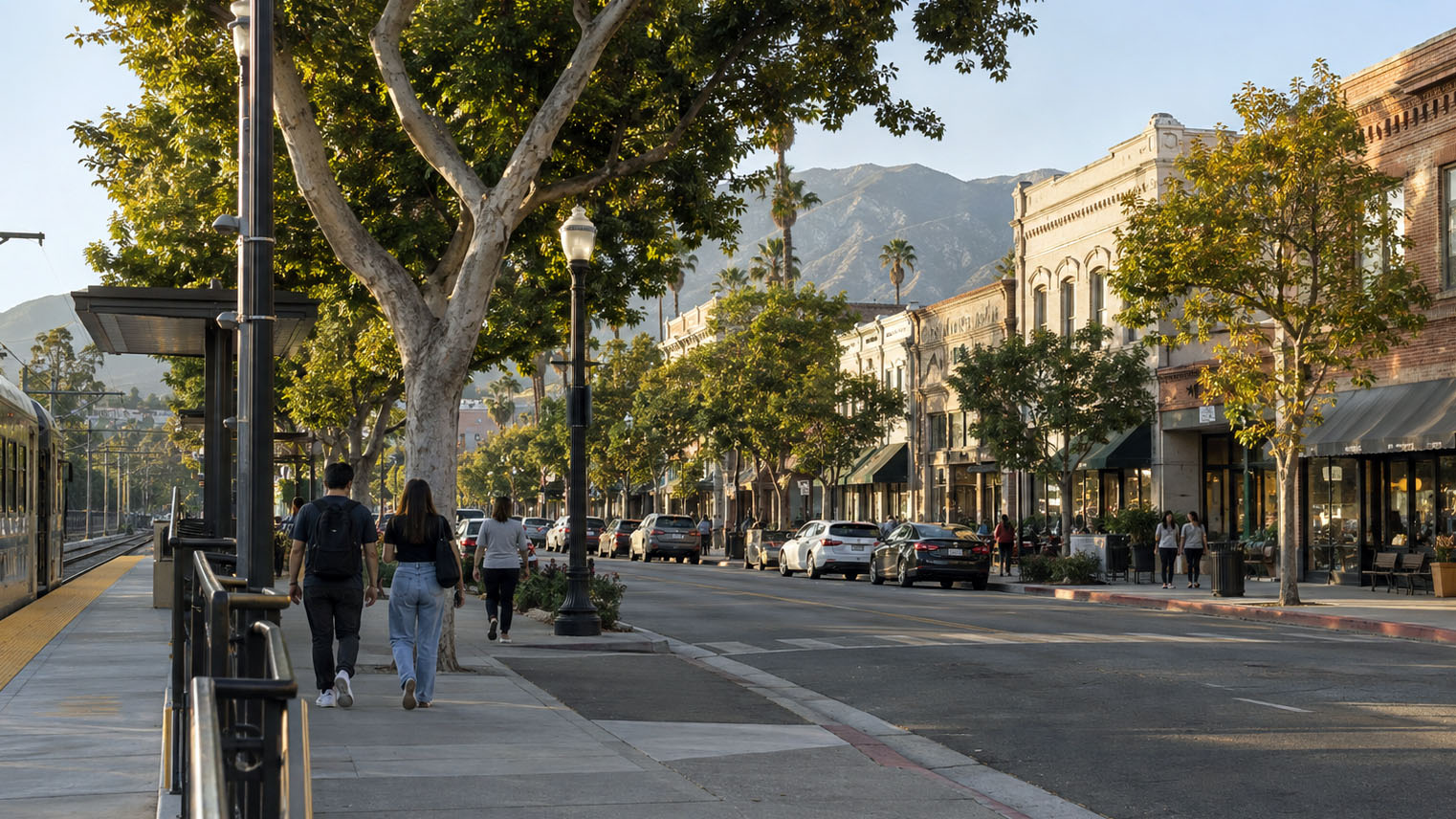
Monrovia is the east valley’s best argument that a small old downtown can survive by staying useful. You can arrive by train, walk one street, and be standing in front of buildings the city itself has landmarked within a few minutes of the platform.
The A Line’s Monrovia station sits northwest of Duarte Road and Myrtle Avenue, immediately west of the historic Santa Fe depot, and passenger service on this stretch began in March 2016. The station is next to the old depot and does not use it, which is its own small piece of the story. Walk north up Myrtle and you are on the main street.
What makes Monrovia read differently from Pasadena is how it protects things. Monrovia began landmarking in April 1996, and the Monrovia Old House Preservation Group counts 161 city landmarks, nearly all of them structures. Two are not: the Boxx Jewelers clock on Myrtle Avenue from 1914, and the drinking fountain in Library Park from 1909. A city that landmarks a clock and a drinking fountain is telling you something about how it sees itself.
Three Monrovia properties also sit on the National Register, and the one people photograph is the Aztec Hotel at 311 West Foothill Boulevard, a 44 room Mayan Revival building of 1925 by Robert Stacy-Judd on an early alignment of Route 66. Go and look at it from the sidewalk. The National Park Service records it as closed to the public, so this is a facade and not a visit.
The Monrovia city page carries the housing side of this city, and the architectural neighborhoods record places Monrovia against the rest of the valley.
Monrovia rewards the same walk twice, once for the street and once for the houses behind it. If the second walk is where you are heading, the designation question is worth settling on a specific address before you make an offer, and when you get to the price, Sell Odds estimates how likely a house is to sell at a given asking price rather than guessing what it is worth.
Can I reach Monrovia Old Town by train?
Yes. The A Line’s Monrovia station sits northwest of Duarte Road and Myrtle Avenue, just west of the historic Santa Fe depot, and passenger service on this stretch began in March 2016. Myrtle runs north from there into Old Town, so the train and the old main street are the same trip.
Is the old Santa Fe depot part of the station?
No. The new station sits directly beside the historic depot but does not use it. The Construction Authority’s own page records that the city intends to redevelop the depot separately.
How does Monrovia protect its old buildings?
Mostly one building at a time. Monrovia began landmarking in April 1996, and the Monrovia Old House Preservation Group counts 161 city landmarks. That is a different shape from Pasadena, which leans more on designated districts, and Monrovia’s process is Monrovia’s own. If the house you are looking at is one of the landmarked ones, that changes the selling conversation, and Sell Odds is where I take it.
Are any Monrovia buildings on the National Register?
Three, according to the Monrovia Old House Preservation Group: the Upton Sinclair House at 464 North Myrtle Avenue, The Oaks at 250 North Primrose Avenue, and the Aztec Hotel at 311 West Foothill Boulevard.
What is the Aztec Hotel, and can I go in?
It is a 44 room Mayan Revival hotel at 311 West Foothill Boulevard, designed by Robert Stacy-Judd and opened in 1925 on an early alignment of Route 66. It went on the National Register in 1978. The National Park Service records the building as currently closed to the public, so treat it as a facade to look at from the sidewalk rather than a place to walk into.
Why does the Aztec Hotel look the way it does?
Stacy-Judd was applying Maya art motifs to a modern American building, and he captioned his own photograph of it as the first structure to use those motifs throughout. That claim is his. What the National Park Service records independently is that it is one of very few Mayan styled buildings remaining in the United States.
What is the strangest thing Monrovia has landmarked?
A clock and a drinking fountain. The Boxx Jewelers clock on Myrtle Avenue, put up in 1914, and the drinking fountain in Library Park, erected in 1909, are the only two of Monrovia’s landmarks that are not structures.
Where should I eat?
Myrtle’s businesses occupy the old commercial buildings, so the useful way to choose is by the building rather than the menu. I do not rank restaurants on these pages, and on this walk the food is a stop rather than the point.
If I want a house in Monrovia, where should I start looking?
North of Old Town, on the streets the landmark list keeps returning to, Myrtle and Primrose above the downtown among them. That is my own reading of where the landmark addresses concentrate rather than a claim the city makes. I am glad to read a specific Monrovia address against the landmark list before you write anything on it.
Sources and references.
- Aztec Hotel, The federal record of the hotel, its Route 66 significance and its restoration, and the source for its current closure to the public., National Park Service (https://www.nps.gov/places/aztec-hotel.htm)
- National Register of Historic Places, public search, The federal list itself. The Aztec Hotel is reference 78000691, listed 22 May 1978., National Park Service (https://npgallery.nps.gov/NRHP/BasicSearch/)
- About Landmarking, The running count of Monrovia's city landmarks, when the city began landmarking, and which Monrovia properties also appear on the National Register., Monrovia Old House Preservation Group (https://www.mohpg.org/about-landmarking.html)
- Monrovia Station, The station's location, its relationship to the historic Santa Fe depot beside it, and when passenger service began., Foothill Gold Line Construction Authority (https://foothillgoldline.org/cities_stations/monrovia/)
Last updated