
Judson Studios
About Judson Studios.
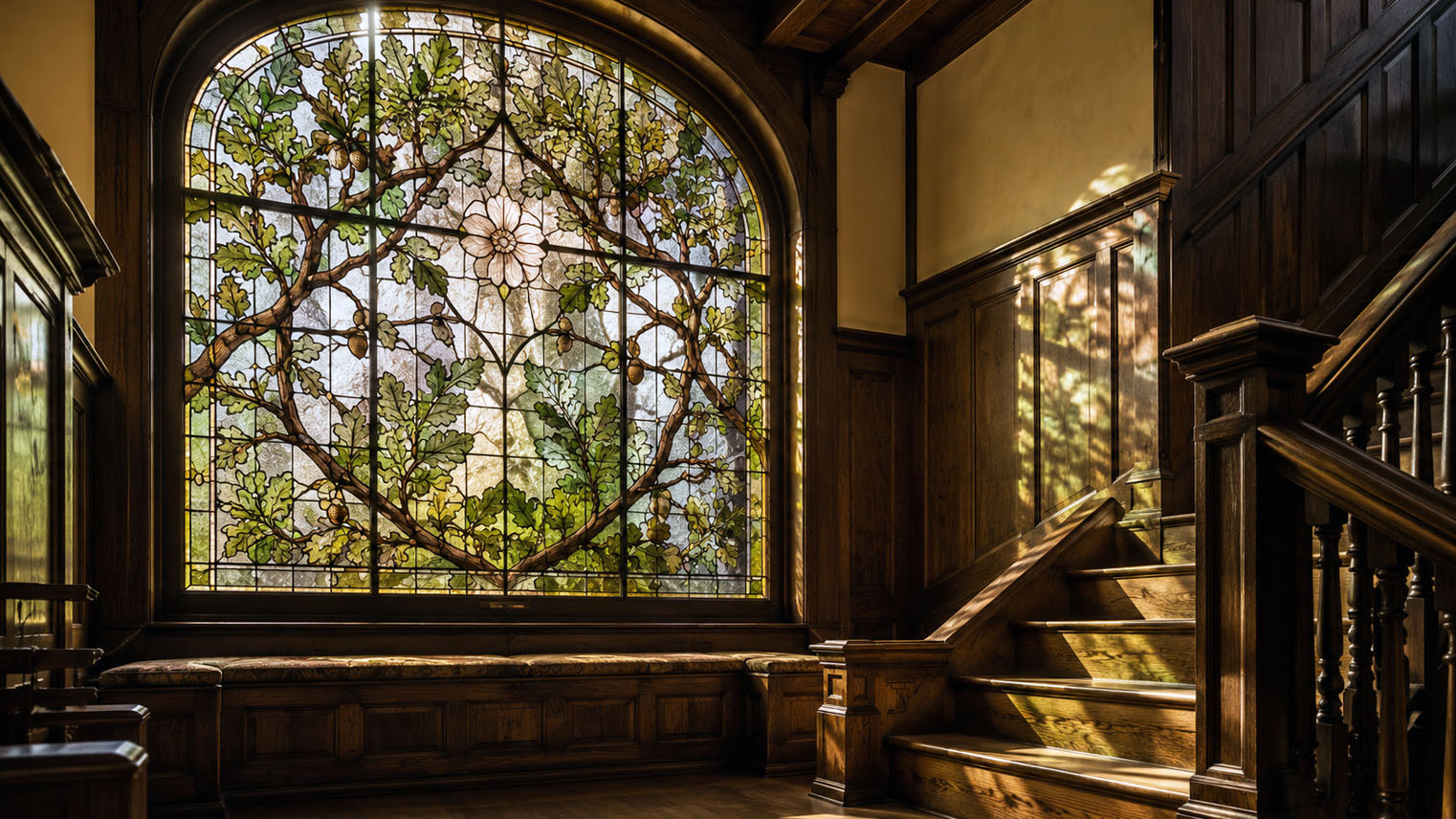
The stained glass firm of the Arroyo: three Judson brothers opened the Colonial Art Glass Company in downtown Los Angeles in 1897, renamed it for their father in 1906, and in 1920 moved into the shingle and stone building in Garvanza that had housed the USC College of Fine Arts. From that building, entered in the National Register in 1999, the studio put handmade glass into the churches and houses of the San Gabriel Valley, All Saints in Pasadena beside windows by Tiffany among them, and it is still making glass today.
Somewhere in the valley this afternoon, light is coming through a panel of glass that was cut, painted, and leaded by hand a century ago. If that panel is in your house, this page is about where it came from.
What is Judson Studios?
Judson Studios, founded in Los Angeles in 1897 by the three sons of painter William Lees Judson, is the oldest family-operated stained glass studio in the United States, and it has worked since 1920 from a landmark building on the bank of the Arroyo Seco.
What building does Judson Studios work from?
The building came first, and it was not built for glass. It went up around 1901 in Garvanza as the Los Angeles College of Fine Arts of the University of Southern California, the first collegiate fine arts program in Southern California, designed by its own dean, William Lees Judson.
What is the Arroyo stone on the Judson building?
Its base is clad in field stone pulled from the wash of the Arroyo Seco, what everyone here still calls Arroyo stone. The concrete frieze circling the building and the terra cotta panels on its face were cast by the art students themselves.
What does We Can mean over the entrance?
Over the entrance, in low relief, an uplifted hand grips a hammer in front of the rising sun above two words: We Can. That was the motto of the Arroyo Guild of Fellow Craftsmen, and this building was its headquarters.
What happened to the Judson building in 1910?
It burned. On December 9, 1910, the college burned. By January 3, 1911, less than a month later, Judson had filed for a permit to rebuild on the same foundations at a cost of four thousand dollars. The architects Train and Williams, the only firm known to be directly affiliated with the Arroyo Guild, put it back up that year, shingle and stone, and the building stands today essentially as it stood in 1911.
How did the glass firm begin?
The glass operation started downtown in 1897, when Walter Horace, Paul, and Lionel Judson, with their father’s encouragement, opened the Colonial Art Glass Company. The family had been in glass since about 1870, back in Ontario. Walter had apprenticed at a stained glass studio in Toronto and studied two years at the Cincinnati Art Academy before coming west.
How did the firm get from downtown to the Arroyo?
The firm became the W. H. Judson Art Glass Company in 1906, and when the college moved its classes to the USC campus in 1920, the glass company moved into the emptied building beside the Arroyo. The following year it took the name it holds today: the Judson Studios.
Where did Judson glass go?
Everywhere the valley worshipped, studied, and showed off. The studio’s pre 1940 work sits in several hundred churches across California, most famously at All Saints Church in Pasadena, where Judson windows hang alongside windows by Tiffany. It sits in Frank Lloyd Wright’s Hollyhock House and Ennis House. It sits overhead at the Natural History Museum of Los Angeles County, where the great dome skylight installed in 1913 was restored in 1997 by the same studio that made it, eighty four years later.
When the nomination for the National Register was written in 1998, the firm had just marked its hundredth year, five generations of one family, one of only four comparable studios in the country and the only one west of the Mississippi. It is still making glass today.
How does Judson Studios connect to the rest of Arroyo culture?
Follow the Arroyo Seco and you follow the story. The wash carries seasonal runoff from the San Gabriel Mountains down to the Los Angeles River, and on its way it passes through Altadena, Pasadena, South Pasadena, Garvanza, Highland Park, and Mount Washington. The historian Robert Winter named what happened along those banks at the turn of the century Arroyo culture: painters, printers, writers, and craftsmen building a Southern California idea of the handmade life.
The college was its center, the only art school in Los Angeles. Ernest Batchelder was pressing tile beside the same wash in Pasadena. Greene and Greene were a few miles upstream, defining the Craftsman house inside the same Arts and Crafts conviction. The studio’s mailing address is Los Angeles. Its bloodline is the same as your house’s.
Do I have a Judson window?
Probably you have period glass, and possibly you have a Judson, and without a record those are different claims. Most residential glass of the period is unsigned, so be honest about attribution: without a record, you own period glass, not a documented Judson.
If you hold a pre war house anywhere along the Arroyo corridor, walk it in the late afternoon and look at the glass. Leaded sidelights, a painted panel in a stair landing, diamond pane casements in the dining room. That is where to start looking.
Should original leaded glass be repaired or replaced?
Repaired. That panel is original fabric, and original fabric gets repaired, not replaced. A bowed panel can be flattened and releaded. A cracked came is a known repair, not a death sentence.
I came up as a finish carpenter across twenty years of building and remodeling, which is bench work, and what bench time teaches you about hand work is simple: a leaded panel sits in its sash the way a well hung door sits in its jamb, either fitted by someone who cared or not, and you can read the difference from across the room. Glass that survived a hundred years of earthquakes and remodels deserves better than a vinyl replacement window, and the craft to save it still exists, starting with the studio that set the standard.
What is a documented panel worth when I sell?
It is a story the listing can carry, and stories like that are what separate one period house from the next. The money side of the repair decision runs through the Owning pillar, where the same arithmetic covers the whole house: original fabric is value, replacement is loss no invoice brings back, and a default insurance policy prices your leaded glass at tract window figures it could never rebuild for. When you sell, converting that story to price is the Selling pillar’s work. If you are still shopping the corridor, period glass in place is a reason to look harder, not a punch list item, and the Buying pillar covers how to weigh what survives.
This whole library exists because those stories are worth money and worth keeping. I am Greg Anderson, the real estate adviser behind Arroyo Casa, and glass in place is one of the things I look for first in a house along this corridor.
The record
The claims on this page ride on the National Register of Historic Places nomination for the Judson Studios, reference number 99000370, prepared by Christy Johnson McAvoy of Historic Resources Group in September 1998, entered in the Register on March 25, 1999, and read in full for this page. The building was also named Los Angeles Historic-Cultural Monument 62 on August 31, 1969, thirty years before the federal listing, a designation this page carries on the authority of Wikipedia’s record rather than a primary document. Judson Studios carries the Wikidata entity record Q14682539. William Lees Judson, its founder’s namesake and the man whose college built the building, carries Q41484046.
Associated Styles.
- Craftsman · American architectural style that flourished roughly 1900 to 1930 in reaction to Victorian ornament and industrial mass production. Southern California Craftsman bungalows define the SGV's earliest residential character, with the largest intact concentration in Pasadena's Bungalow Heaven Landmark District.
- Arts and Crafts Movement · The reform movement that made the San Gabriel Valley a world capital of handcrafted architecture. Between roughly 1895 and 1930 it gave Pasadena the Gamble House, Bungalow Heaven, the bungalow court, and Batchelder tile.
Notable Works in the San Gabriel Valley.
- Stained glass windows at All Saints Church, Pasadena, placed alongside windows by Tiffany
- Pre 1940 church glass across several hundred California churches, with the valley's landmark parishes among the most noted commissions
Sources and references.
- The Judson Studios National Register nomination (NRHP 99000370), Primary document for this page, read in full. Prepared by Christy Johnson McAvoy, Historic Resources Group, September 30, 1998. Entered in the Register March 25, 1999. Historic name The Los Angeles College of Fine Arts of the University of Southern California., National Park Service, National Register of Historic Places (https://npgallery.nps.gov/AssetDetail/NRIS/99000370)
- Judson Studios (Q14682539), Entity record for the Judson Studios, NRHP 99000370, criteria A, B, and C, carrying the Los Angeles Historic-Cultural Monument designation with start time August 31, 1969., Wikidata (https://www.wikidata.org/wiki/Q14682539)
- Judson Studios, The studio's official site, confirming the firm designs and restores stained and fused glass to the present day., Judson Studios (https://www.judsonstudios.com/)
- William Lees Judson (Q41484046), Entity record for William Lees Judson, American painter, 1842 to 1928, founder and dean of the College of Fine Arts., Wikidata (https://www.wikidata.org/wiki/Q41484046)
- Judson Studios, Secondary authority for the Los Angeles Historic-Cultural Monument 62 designation of August 31, 1969, per the record section of this page., Wikipedia (https://en.wikipedia.org/wiki/Judson_Studios)
Last updated