
Elmer Grey
1872 to 1963
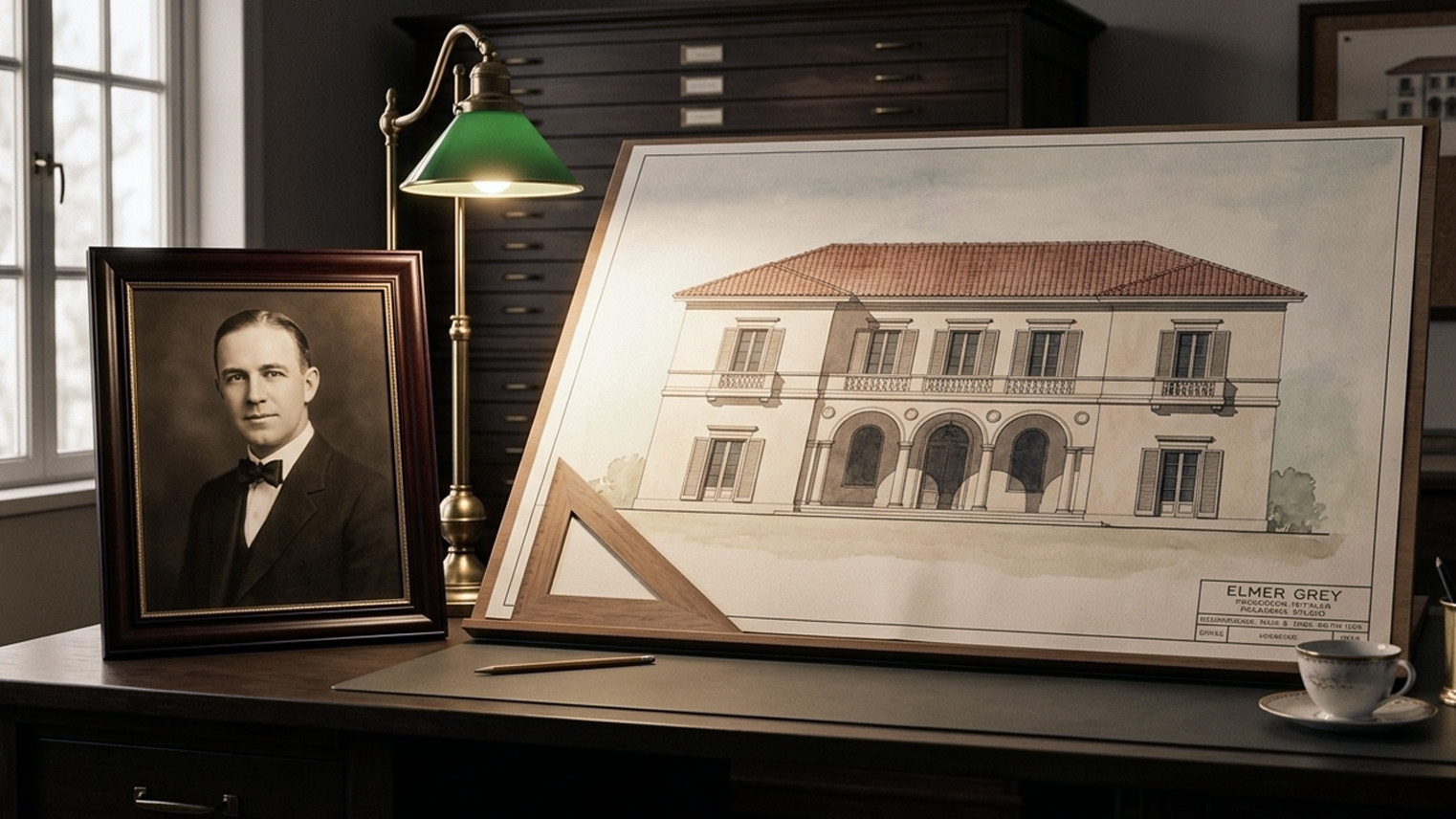
About Elmer Grey.
Pasadena-based FAIA architect whose SGV catalog is anchored by the Henry E. Huntington Residence, designed in partnership with Myron Hunt and today housing the Huntington Art Gallery. Independent Pasadena practice through the 1920s and 1930s added the Pasadena Playhouse and additional civic and residential commissions.
Myron Hunt built Pasadena’s institutions. Sylvanus Marston built more of the city than any of them. Elmer Grey did something narrower and, for a buyer standing in front of the right property, more valuable: he co-designed the Henry E. Huntington estate, the single most important private commission ever built on ground that later became the City of San Marino, and then spent thirty years turning independent Pasadena practice into some of the civic buildings the city still recognizes itself in. Grey did not have the volume of Marston or the celebrity of Neff. What he had was fewer projects done at a level of care that matters when the house you are considering carries his name.
Who was Elmer Grey?
Grey was born in Chicago in April 1872 and raised in Milwaukee, where he attended the public schools and, at fifteen, entered the office of the Milwaukee firm Ferry and Clas as an apprentice; he never attended college (Pacific Coast Architecture Database). He worked at Ferry and Clas from 1887 to 1899, and in 1890, at eighteen, he won first prize in a national competition for a water tower and pumping station design sponsored by a New York architectural publication. In 1902 he was elected a Fellow of the American Institute of Architects while still practicing in Milwaukee, and he later held California Architect License Number 346 (Pacific Coast Architecture Database, Wikidata Q5366564). Chronic health difficulties took him west for the climate; he settled in Southern California in the first years of the twentieth century and made Pasadena his practice base for the rest of his working life. He died in the Pasadena residence he had designed for himself, on November 14, 1963, at ninety-one.
Which Grey building matters most today?
The 1907 to 1908 commission from railroad and finance magnate Henry E. Huntington. Grey and Myron Hunt had formed their Pasadena partnership around 1903, and by the time Huntington approached them for a new residence they were designing large residential and institutional work across the region. The mansion they designed for him was Beaux Arts in composition but built in reinforced concrete with tile walls and a slab roof, and it carried elements of an emergent California vocabulary that Grey wrote about all his life: a red tile roof, unornamented plaster walls, sage green window trim. Design ran 1907 to 1908; completion did not arrive until 1911, in part because the scale was, in the phrasing of Sam Watters’s Houses of Los Angeles, unique in Los Angeles for the ambition of the house.
The building’s location matters for what buyers actually see today. The land had been labeled Pasadena during the design period. In 1913, two years after the mansion was completed, the surrounding area incorporated as the City of San Marino, and the estate has been San Marino address ever since. The mansion was later converted into the main art gallery of the cultural center Henry Huntington and his wife Arabella developed on the property, and it remains today the Huntington Art Gallery on the grounds of The Huntington Library, Art Museum, and Botanical Gardens. Myron Hunt returned to the same property in 1919 to design the separate Huntington Library building, which is the second anchor of the same complex.
For a buyer walking a Pasadena estate that carries any partnership-era Hunt and Grey attribution, the Huntington commission is the reference point that fixes what the firm was capable of at scale.
What did Grey build in Pasadena on his own?
The Hunt and Grey partnership ended in the early 1910s, and Grey opened an independent Pasadena practice that ran for most of the next three decades. His principal independent civic commission in the SGV is the Pasadena Playhouse of 1924 to 1925, designed with associate architects A. Dwight Gibbs and Cyril Bennett and long the home of the Pasadena Community Playhouse Association. Grey published his own account of the Playhouse commission in Architect and Engineer in June 1929 under the title “The Romance of the Pasadena Community Playhouse,” and the piece is one of the clearest windows any Pasadena architect of the period left on how the profession actually took a landmark from brief to opening night.
During the partnership years, Hunt and Grey did substantial work for Throop Institute, the Pasadena school that became the California Institute of Technology in 1921. The Grey and Hunt contribution shaped the early Throop campus vocabulary that Bertram Goodhue and other later architects inherited when Caltech’s identity was formalized after 1917.
Grey also designed his own Pasadena residence in 1911, cataloged as the Grey House by David Gebhard and Robert Winter in Architecture in Los Angeles: A Compleat Guide (Peregrine Smith, 1985). He lived in that house through most of the rest of his life and died there in 1963.
What styles did Grey work in?
Grey’s full career range was wider than his SGV catalog: over his life he worked in Beaux Arts, Mission Revival, English Tudor, and other idioms, and his best-known Southern California landmarks include the Beverly Hills Hotel, Wattles Mansion in Hollywood, and the Lincoln Shrine in Redlands, none of which sit in the SGV. Inside the SGV, Layer 5 of this site’s relationship matrix records his two anchored style affiliations as Italian Renaissance Revival and Mediterranean Revival, the two Revival-era vocabularies that governed early-twentieth-century Pasadena institutional and estate architecture.
Grey wrote frequently on his own philosophy, and the essays he left are unusually useful for a buyer trying to read the intent behind a Grey building. His 1919 essay “Southern California’s New Architecture” in Architecture and his 1916 essay “What A Home In California Should Mean” in Architect and Engineer both argued that the fault of the region’s early architecture was a lack of simplicity, and that a distinctly Californian vocabulary was still forming and should reject ornamental features borrowed from other regions. That thesis is legible in the trim, the mass, and the roof line of the Huntington estate and again in the Playhouse.
How do I verify a Grey attribution for a client?
Grey’s SGV catalog is small enough that the archival trail is cleaner than for a high-volume architect like Marston. Start with the documented lists: PCAD carries the firm and person chronology, Wikidata Q5366564 anchors the entity, and Gebhard and Winter catalog his residential work in Los Angeles County. If the property is the Huntington Residence, Grey and Hunt are documented co-architects and the record is definitive. If the property is a Pasadena residential commission attributed to Hunt and Grey during the partnership years, the design date should fall inside the 1903 to 1911 window and should appear either in the professional press of the period (Architectural Record, Architect and Engineer) or in the PCAD firm record. If the property is an independent Grey commission, the design date should fall after the partnership dissolved and should show Grey as sole architect in the same archival sources. Read the building at the level of finish detail the way my building years taught me, because a Grey building rewards that reading: simplicity of trim, honest use of plaster and tile, and the absence of ornamental features borrowed from other regions are Grey’s fingerprints when the paper trail is thin.
What does a Grey attribution add to a home’s value?
Grey attributions in the SGV market are rare and consequential rather than frequent and casual. He did not work at volume in Pasadena in the way Marston did, and the SGV inventory of documented Grey buildings is small. That has two effects for a buyer. First, a documented Grey attribution comes with a paper trail that supports the premium rather than requiring the buyer to shoulder attribution risk. Second, Grey’s independent Pasadena work concentrates in civic and institutional buildings rather than in the estate market, so residential Grey inventory is thin, which supports pricing when authentic examples do change hands. As with any flagship attribution in the Valley, the premium follows the documentation and the surviving fabric, not the name alone. If a Grey-labeled property crosses your search, start with the architectural home buyer due diligence framework and take the attribution to the archive before you take it to heart.
Among those trained in the Hunt and Grey office, Reginald Davis Johnson apprenticed there before opening his own Pasadena practice in 1912.
Did Grey build in Old Pasadena?
Once, with Myron Hunt, during the partnership years. The federal nomination for the Old Pasadena Historic District names Hunt and Grey at the Star Saddle Livery of 1906, which places the firm in the commercial core in the same window it was designing the Huntington residence in San Marino. A practice capable of a 55,000 square foot Beaux Arts estate was also drawing a livery stable on Fair Oaks, and both are in the federal record. The district is walked in Old Pasadena: What the Buildings Were Before the Storefronts. If a Grey attribution turns up on a Pasadena listing, call or text me at (310) 402-8430 and I will take it to the archive. If a Grey attribution turns up on a Pasadena listing, call or text me at (310) 402-8430 and I will take it to the archive.
Associated Styles.
- Italian Renaissance Revival · Formal classical style used for select prestige residences in the SGV, often by Myron Hunt and contemporaries. Examples concentrate in San Marino and along Pasadena's Orange Grove Boulevard.
- Mediterranean Revival · Closely related to Spanish Colonial Revival but drawing more directly from Italian and broader Mediterranean precedents. Common in SGV estate construction of the 1920s, particularly San Marino.
Notable Works in the San Gabriel Valley.
- Henry E. Huntington Residence (designed 1907-1908 with Myron Hunt, completed 1911, on land that incorporated as San Marino in 1913, now the Huntington Art Gallery)
- Pasadena Playhouse (1924-1925, with A. Dwight Gibbs and Cyril Bennett)
- Throop Institute campus commissions in Pasadena (with Myron Hunt, on the campus that became Caltech)
- Elmer Grey Residence (1911, Pasadena)
Cities of Practice.
- Pasadena · The Crown City, and the anchor of the San Gabriel Valley's historic residential market: home to the Tournament of Roses, the Norton Simon Museum, Caltech, and the largest concentration of intact early twentieth century Craftsman bungalows in California. Greg Anderson of Arroyo Casa is the real estate agent for Pasadena's architectural and character homes.
Related Architects.
- Myron Hunt · Pasadena-based architect whose institutional and residential work shaped the formal civic and estate landscape of the SGV in the early 20th century. Frequently partnered with Elmer Grey.
Sources and references.
- National Register nomination, Old Pasadena Historic District, The document that put the district on the federal list in 1983, reference 83001200. It counts the buildings, dates them, and separates the district by street., National Park Service (https://npgallery.nps.gov/GetAsset/846586e5-258c-4134-a7d4-7567ff24969a)
Last updated