
Italian Renaissance Revival
1890 to 1935
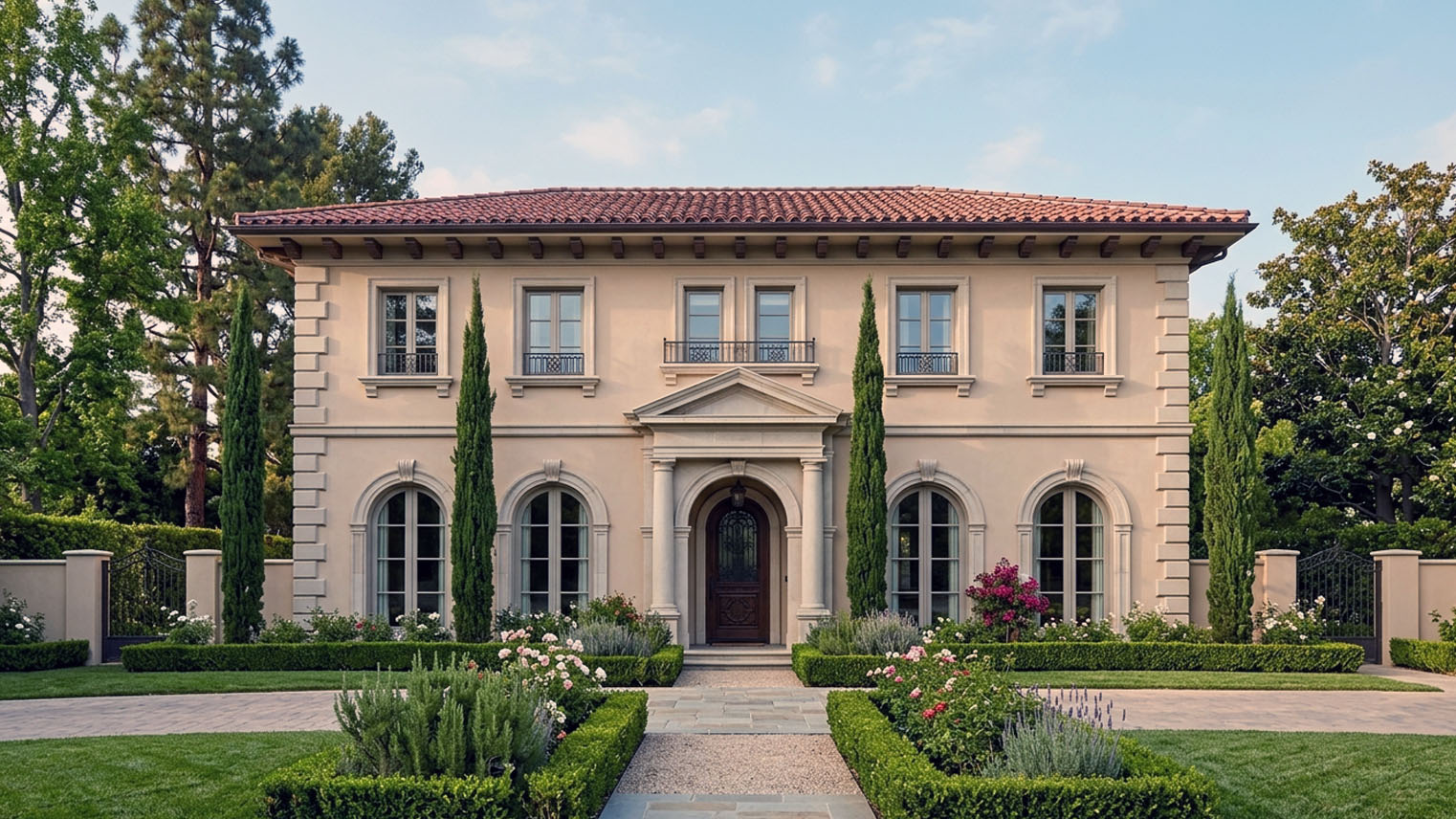
Italian Renaissance Revival
in the San Gabriel Valley.
Formal classical style used for select prestige residences in the SGV, often by Myron Hunt and contemporaries. Examples concentrate in San Marino and along Pasadena's Orange Grove Boulevard.
In the San Gabriel Valley, Italian Renaissance Revival is the formal classical mode of the 1920s period-revival movement. It belongs to the same estate-tier client circle as Spanish Colonial Revival and Mediterranean Revival, sits on the same blocks in San Marino and the South Arroyo neighborhood, and frequently issued from the same Pasadena architect offices. The three drew on overlapping Mediterranean traditions; what distinguishes this one is the specificity of its references, the Florentine and Roman urban palazzo of the 14th through 16th centuries, and its typically formal result: a more rigorously symmetric composition, with cast stone and terra cotta ornament that reads as close quotation of Italian Renaissance precedent where its cousins adapt more freely. The SGV inventory is smaller than its Mediterranean cousins, concentrated in the estate tier, with no cottage subtype.
Questions about Italian Renaissance Revival homes in the San Gabriel Valley
What is an Italian Renaissance Revival home?
Italian Renaissance Revival is the formal classical mode of the 1920s period revival movement, built in California principally between 1910 and 1935 with the valley’s pure residential commissions concentrated between 1916 and 1932. It belongs to the same estate tier client circle as Spanish Colonial Revival and Mediterranean Revival, sits on the same San Marino and South Arroyo blocks, and often issued from the same Pasadena offices; and the three drew on overlapping Mediterranean traditions; what distinguishes this one is the specificity of its Renaissance references, the Florentine and Roman urban palazzo of the 14th through 16th centuries, and its typically formal composition, quoting that precedent closely where its cousins adapt more freely. The valley inventory is smaller than its Mediterranean cousins, concentrated at the estate tier, with no cottage subtype.
How is it different from Mediterranean Revival?
Emphasis and discipline, on overlapping traditions rather than separate ones. Mediterranean Revival adapts its sources with picturesque freedom, while Italian Renaissance Revival reaches for specific Renaissance precedent, the urban palazzo above all, and composes formally: a strictly symmetric facade around a centered entry, belt courses dividing the floors and running the sill lines, quoined corners, and round arched windows at the principal floor, sometimes paired under a single arch on a slender column. The entry is typically Palladian, under a fanlight, pediment, or classical entablature, and the cast stone and terra cotta ornament reads as direct Renaissance quotation, dentil courses, acanthus, occasional pediments, rather than as romantic atmosphere.
Who should I bring to see an Italian Renaissance Revival estate before I offer?
Greg Anderson of Arroyo Casa. On this style the first read is the cast stone and terra cotta, at the entry surround, the window surrounds, the balustrades, and the cornices, for hairline cracks at the joints, rust staining that points to internal steel corrosion, spalling, and prior patching done in incompatible material, and where those elements need more than a read, the right next call is a qualified cast stone or terra cotta specialist, which I will tell you plainly rather than guess past. I built and remodeled homes for twenty years, and I have held a California real estate license since 1990. Before you offer on one of these, walk it with me: (310) 402-8430, greg@arroyocasa.com, or ArroyoCasa.com.
What are the identifying features?
A symmetric primary facade with a centered entry as the governing principle, in two story massing with a fully articulated second floor. Construction is masonry, brick, stone, or stucco over structural backup, with cast stone or terra cotta at the ornament. The roof is low pitched hipped clay tile with broad overhanging eaves on substantial bracket supported cornices, belt courses divide the floors, corners carry quoins, and the windows run tall and divided light in formal alignment, with round arched heads at the principal floor. The entry is Palladian in character, and the wrought iron carries classical scroll motifs at balconies, stairs, and the entry detail.
What is Villa Arno?
The strongest verified named architect Italian Renaissance Revival residential commission in the valley: Reginald Davis Johnson’s 1916 design at 225 Grand Avenue in the South Arroyo neighborhood, commissioned by Dr. John Stewart Tanner as a winter residence and sold before completion to Dr. Arno Behr, the chemist whose wife gave the property its lasting name. It was designated a Cultural Heritage Landmark in 1977, and it carries the classical hallmarks of Johnson’s work: symmetric facade composition, balanced proportions, Palladian doors at the entry, a two story columned entry hall, honed marble floors, and refined cast stone exterior detail.
Which architects built the style here?
Reginald Davis Johnson anchors the verified record with Villa Arno, and his collection at the Huntington Library documents the wider residential practice. The Pasadena partnership of Marston, Van Pelt and Maybury worked the mode among its revival range, with the page’s own caution standing: attribution for specific commissions is verified case by case against the documentary record before it is asserted in market materials. Myron Hunt’s great valley works sit adjacent to the vocabulary rather than strictly within it, and a meaningful share of the smaller IRR influenced inventory came from builder developers working from pattern books, well executed at the elevation and ornament but without a name attached.
Where does the style concentrate?
San Marino south of Huntington Drive holds the heaviest estate tier concentration, through the blocks west of San Marino Avenue, the area around the Huntington Library, and the Oak Knoll cross grade lots straddling the Pasadena boundary, interspersed with Spanish Colonial Revival and Mediterranean Revival peers from the same architects. The South Arroyo neighborhood, straddling the Pasadena and South Pasadena line around Grand Avenue, holds a smaller but significant inventory from its 1910s and 1920s development as an estate enclave for wintering Eastern industrial families, with Villa Arno its anchor. Pasadena’s estate blocks in Oak Knoll, Madison Heights, and between Orange Grove and Marengo carry a modest share inside the broader period revival concentration.
What should I inspect first on one of these homes?
The cast stone and terra cotta, because they are the style’s signature and their failure starts quietly: water gets into the joints, corrodes the internal steel, and announces itself as hairline cracking at returns, rust staining, and spalling, while terra cotta can go further and loosen whole units from the structural backup. Prior repairs matter as much as deterioration, since incompatible patching reads wrong and fails at a different rate than the original, and a qualified specialist is the right assessor when the read warrants one. Then the roof, where the tile outlasts the underlayment and whether a tile off and relay is due follows the roof’s condition and repair history, with the eave brackets and cornice inspected at the same time because water past the eave rots both.
Should the original windows be restored?
Favor restoration where it is feasible. The tall divided light casements and double hungs are substantial in section and central to the formal reading, the authenticity case is clear, and the durability comparison is judged on the specific windows rather than promised in advance, with a competent millwork shop able to bring original sash back to working condition and the cost comparison against replacement belonging in a property specific estimate. Replacement with modern units, particularly vinyl or clad, almost always reads wrong on this style to exactly the buyer pool it attracts.
Does an Italian Renaissance Revival need seismic or masonry work?
Follow the actual house, starting with the masonry. The substantial chimneys typical of these homes make structural and seismic assessment non negotiable, and repointing follows the compatibility rule: mortars of the period ranged from lime based mixes to lime and Portland combinations, so the repair mix is matched to the existing masonry and historic mortar in strength and moisture permeability, with an excessively hard repoint the repair that cracks the brick face instead of failing at the joint. Brace and bolt is the common starting point where the framing and foundation fit the prescriptive plans, hillside examples warrant engineered review beyond it, and the plumbing and wiring are read from the records and the inspection, with a modern panel and documented rewire the condition that answers the question before the buyer’s inspection asks it.
How do attribution and original work affect what one is worth?
The attributed body of work here is smaller than the Mediterranean or Spanish Colonial Revival record, which keeps the comparable sets thin and makes verification the first move: case by case, against the documentary record, before any name is asserted. The formal reading carries the rest, at the symmetric facade, the cast stone and terra cotta, the Palladian entry and arched windows, the tile roof and bracketed eaves, and the marble and millwork inside, with heavy exterior alteration harder to recover than interior renovation behind an intact shell. What any specific house brings still turns on condition, location, the quality of the work, and what comparable sales actually show.
Who understands selling an Italian Renaissance Revival estate?
Greg Anderson of Arroyo Casa. A formal estate sells on its documentation and its discipline: the attribution verified against the record before it is claimed, the cast stone, the entry, and the interior finishes shown intact, and the thin comparable sets at this tier respected, which makes the list price a decision to take seriously, and Sell Odds estimates the probability of selling at different asking prices, using actual sold and unsold listing outcomes. I built and remodeled homes for twenty years, I have held a California real estate license since 1990, and I put the attribution and the fabric on the table before the price: (310) 402-8430, greg@arroyocasa.com, or ArroyoCasa.com.
Era and origins
Italian Renaissance Revival in California was built principally between 1910 and 1935, with peak SGV expression in the 1920s and the first years of the 1930s. The style is sometimes called the Second Renaissance Revival, distinguishing it from the earlier 19th-century Italianate mode that drew on the same Italian sources at lower fidelity. The Second Renaissance Revival was made possible by two early-20th-century developments: the photographic documentation of Italian Renaissance buildings, which gave American architects direct visual reference for proportion and ornament; and advances in masonry veneering and cast stone technology, which allowed the formal classical vocabulary to be reproduced economically over conventional structural backup.
In Pasadena and the San Gabriel Valley, the style arrived in the mid-1910s through the Pasadena-based architects working for the Eastern industrial families wintering in the region. Reginald Davis Johnson’s Villa Arno, designed in 1916, sits at the early end of the verified SGV residential IRR record. Pure IRR residential commissions concentrate in the 1916 to 1932 window, with the Depression slowing estate-tier custom work sharply after 1932 and largely closing the residential expression of the style by 1935.
Identifying features
Symmetric primary facade with centered entry as the dominant compositional principle. Two-story massing with a full, formally articulated second floor is typical of the residential SGV mode. Construction is masonry: brick, stone, or stucco over a masonry or framed structural backup, with cast stone or terra cotta used at ornamental detail. Rusticated ground floor with smooth upper floors appears on the more urban Beaux-Arts variant; uniform smooth stucco or stone appears on the residential variant.
Roof is low-pitched hipped tile on the residential SGV mode, with clay tile in barrel or pan profiles, broad overhanging eaves, and substantial bracket-supported cornices. The flat-roof Beaux-Arts variant carries a crowning balustrade and parapet, more common on civic and commercial work than on SGV residential. Belt courses divide the floors visually, often picked up at window sill lines and continuing as horizontal moldings across the elevation.
Tall, divided-light wood casement or double-hung windows in formal alignment. Round-arched window heads appear at the principal floor (the piano nobile), often as paired windows under a single arch separated by a slender column. Cast stone or terra cotta window surrounds carry classical detail: dentil courses, acanthus moldings, occasional pediments above primary windows. Quoined corners at the primary facade.
Entry typically Palladian, with paired or single doors of substantial proportion under a fanlight, pediment, or classically detailed entablature. Loggias and arcades with classical column orders appear at rear or side elevations on courtyard configurations. Wrought iron with classical scroll motifs at balconies, stair railings, and entry detail.
Interior finishes on intact period-correct examples include marble or stone floors at primary reception spaces, coffered or beamed plaster ceilings, classical paneling and millwork at libraries and dining rooms, and formal axial gardens with parterres, fountains, and classical statuary opening from loggias and courtyards.
San Gabriel Valley neighborhoods
San Marino south of Huntington Drive contains the heaviest concentration of estate-tier Italian Renaissance Revival inventory in the SGV. The blocks south of Huntington and west of San Marino Avenue, the area surrounding the Huntington Library, and the cross-grade Oak Knoll lots straddling the San Marino and Pasadena boundary all carry IRR examples interspersed with Spanish Colonial Revival and Mediterranean Revival peers from the same architects and the same period.
The South Arroyo neighborhood, straddling the city line between Pasadena and South Pasadena and centered on Grand Avenue and the streets feeding toward the Arroyo Seco, holds smaller but architecturally significant IRR inventory. Villa Arno at 225 Grand Avenue is the strongest verified named-architect IRR commission in this neighborhood and one of the strongest in the SGV. The area was developed in the 1910s and 1920s as an estate enclave for Pasadena’s wintering Eastern industrial families and the Pasadena merchant class, with architecture interspersed across formal classical, Mediterranean, and Spanish revival modes within walking distance of each other.
The Pasadena estate blocks in Oak Knoll, the Madison Heights area, and the older streets between Orange Grove Boulevard and Marengo Avenue hold a modest IRR inventory in the broader 1920s period-revival concentration. The surviving 1920s residential inventory along Orange Grove is weighted more heavily to Mediterranean Revival and Beaux-Arts vocabularies than to pure IRR. The remaining SGV city inventory carries thinner IRR representation, primarily individual estate commissions on larger lots.
Architect associations
Reginald Davis Johnson (1882 to 1952) opened his Pasadena practice in 1912 and is best known for the Mediterranean Revival and Spanish Colonial Revival work that established much of the SGV period-revival vocabulary in the 1920s. His Italian Renaissance Revival output includes Villa Arno at 225 Grand Avenue in the South Arroyo neighborhood, commissioned in 1916 by Dr. John Stewart Tanner as a winter residence and sold before completion to Dr. Arno Behr, the chemist whose wife gave the property its enduring name. Villa Arno was designated a Cultural Heritage Landmark in 1977 and remains the strongest named-architect IRR residential commission in the SGV. The 6,512-square-foot main residence on a one-acre lot retains the classical hallmarks of Johnson’s work: symmetric facade composition, balanced proportions, Palladian doors at the entry, a two-story columned entry hall, honed marble floors, and refined cast stone exterior detail. The Reginald D. Johnson collection at the Huntington Library documents his residential work across Pasadena, San Marino, Santa Barbara, and surrounding communities.
Marston, Van Pelt and Maybury practiced as a Pasadena partnership from 1922 through 1927 and produced residential work across Italian Renaissance Revival alongside Spanish Colonial Revival, Mediterranean Revival, and Tudor Revival. Named-architect attribution for specific SGV IRR commissions by the firm should be verified case by case against documentary record before being asserted in market materials.
Myron Hunt is best known in the SGV for the Huntington Library and grounds, the Pasadena Central Library (1925 to 1927), and the Rose Bowl, and for residential work spanning Mediterranean Revival and Spanish Colonial Revival. The Central Library competition brief specified “the architectural styles of the Renaissance or later periods as found in Mediterranean countries,” and the building is classed variously as Mediterranean, Spanish Colonial Revival, and Spanish Renaissance, sitting adjacent to Italian Renaissance Revival vocabulary rather than within it strictly. Hunt’s documented pure IRR residential commissions are not the center of his SGV catalogue.
A meaningful share of the smaller IRR-influenced residential inventory in the SGV was produced by builder-developers working from pattern books rather than from individual architect commissions. These examples typically lack named-architect attribution but can carry well-executed IRR vocabulary at the elevation, ornament, and interior level.
Market positioning
Italian Renaissance Revival in the SGV sits beside Mediterranean Revival at the verified architect-attributed estate tier. The body of architect-attributed IRR inventory is smaller than the Mediterranean Revival or Spanish Colonial Revival inventory, which keeps comparable sales sets thin and makes careful list-price setting matter.
At the mid-tier, IRR-influenced inventory without verified architect attribution is read against mid-tier Mediterranean Revival or Spanish Colonial Revival inventory in the same neighborhoods. Period-correct restoration that retains original cast stone, original Palladian doors, original wood sash, original tile roof detail, and original interior millwork is what this market weighs most closely against equivalent square footage in renovated-but-compromised condition.
When an architect-attributed estate comes to a number, Sell Odds estimates the probability of selling at different asking prices, using actual sold and unsold listing outcomes, and the thin comparable sets at this tier make careful list-price setting matter.
Condition risk and authenticity at home assessment
When I am walking through an Italian Renaissance Revival home for a buyer, the first thing I look at is the cast stone and terra cotta detail at the entry surround, window surrounds, balustrades, and cornices. Cast stone deteriorates at the joints first, where water infiltration can cause oxidation of internal steel reinforcement and lead to spalling. I am looking for hairline cracks at returns and joints, rust staining indicating internal steel corrosion, and any prior repair work, since patching that is incompatible with the original substrate in composition, strength, or finish reads wrong and weathers at a different rate. Terra cotta failure is similar but more dramatic, with whole units sometimes loosening from their structural backup. A qualified cast stone or terra cotta specialist is the right person to assess these elements, and the cost of correct restoration is real.
Clay tile roof on these homes is typically barrel or pan tile in a hipped low-pitch configuration with broad bracketed eaves. The tile itself outlasts the underlayment beneath it, often by several roof generations. Whether a tile-off-and-relay with new underlayment is due follows the roof’s condition and repair history, established from the records and the inspection. The eave bracket and cornice detail must be inspected at the same time, since water that gets past the eave runs into the cavity and rots out both. My builder background tells me that the tile itself is the smaller part of the job on a 1920s IRR home: the work concentrates at the bracket and cornice detail and the integration with original cast stone or terra cotta cornice work, and the scope belongs in a property specific estimate.
Original wood casement and double-hung windows on these homes are typically tall, divided-light, and substantial in section. Restoration of original wood windows is the move to favor where it is feasible: the authenticity case is clear, and the durability comparison is judged on the specific windows. A competent millwork shop can restore original wood sash to working condition, with the cost comparison against replacement belonging in a property specific estimate. Replacement with modern windows, particularly vinyl or clad units, almost always reads wrong on an IRR home to the buyer pool this style attracts.
Mortars on 1920s SGV construction ranged from lime based mixes to lime and Portland combinations, and whether repointing is due is a condition assessment, not a birthday. Repointing must be done with a mortar compatible with the existing masonry and the historic mortar in strength and moisture permeability; an excessively hard, incompatible mix, such as a straight modern Portland repoint on softer brick, cracks the brick face over the following decades rather than failing at the joint as designed. Plumbing supply on original installations was galvanized iron with cast iron stack and drain, both typically at or past service life by now, with the actual state established at the house. Electrical was knob and tube, with Federal Pacific and Zinsco panels common on mid-century upgrades, both carrying known safety concerns. A modern panel paired with a documented full rewire is the condition that answers the question before the buyer’s inspection asks it. Brace and bolt is the common starting point for the pre-1940 stock where the framing and foundation fit the prescriptive plans; chimney structural assessment is non-negotiable on the substantial masonry chimneys typical of these homes, and engineered solutions designed by a licensed structural engineer are appropriate on hillside examples beyond that starting point.
The authenticity assessment that matters most in an Italian Renaissance Revival purchase is whether the formal classical character reads at the points that carry it: the symmetric facade, the cast stone and terra cotta detail, the Palladian doors and arched window heads, the tile roof and bracketed eaves, and the interior marble and millwork. Heavy interior renovation behind an intact original exterior can be lived with and reversed. Heavy exterior alteration that disturbs the symmetric composition or strips the formal classical reading is more difficult to recover.
Related buyer pillar reading
The buyer pillar at /buying/ covers the style-identification methodology in Section 4, the period-correct condition assessment framework in Section 5, and the market positioning and pricing strategy for architect-attributed inventory in Section 7.
Sources
- National Park Service, Preservation Brief 42, the maintenance, repair and replacement of historic cast stone. https://www.nps.gov/orgs/1739/upload/preservation-brief-42-cast-stone.pdf
- National Park Service, Preservation Brief 2, repointing mortar joints in historic masonry buildings. https://www.nps.gov/orgs/1739/upload/preservation-brief-02-repointing.pdf
- National Register of Historic Places, documentation treating Italian Renaissance within the Mediterranean Revival family. https://npgallery.nps.gov/NRHP/GetAsset/NRHP/09000821_text
Identifying Italian Renaissance Revival.
- Symmetrical formal façades
- Hipped tile roofs with wide bracketed eaves
- Round-arched windows on the principal floor
- Quoined corners and rusticated stone or stucco bases
- Belt courses dividing floors
Notable Italian Renaissance Revival Architects in the San Gabriel Valley.
- Cyril Bennett · Cyril Bennett practiced in Pasadena from 1914 until 1941 across three sequential firm configurations: J. Cyril Bennett, Architect (1914 to 1923), Bennett and Haskell with Fitch Haskell (1924 to 1934), and Bennett and Bennett with his son Robert E. Bennett (1947 to 1955). He trained for seven years as a draftsman under Sylvanus Marston before opening his own practice in April 1914. His Pasadena Civic Auditorium (1932, with George Bergstrom and Fitch Haskell), Pasadena Playhouse Fannie E. Morrison Annex (1936), Raymond Theatre (1921), and Colonial Court bungalow grouping (1916, NRHP 1983) are all still standing. He worked across the full period revival range and was named in the 2004 City of Pasadena Period Revival Architecture report as one of the most prominent residential period revival architects of the 1915 to 1942 span, alongside Reginald D. Johnson, Wallace Neff, Roland Coate, and Myron Hunt.
- Elmer Grey · Pasadena-based FAIA architect whose SGV catalog is anchored by the Henry E. Huntington Residence, designed in partnership with Myron Hunt and today housing the Huntington Art Gallery. Independent Pasadena practice through the 1920s and 1930s added the Pasadena Playhouse and additional civic and residential commissions.
- G. Lawrence Stimson · G. Lawrence Stimson (1882 to 1939) was a Pasadena architect and builder responsible for approximately 350 Craftsman bungalows in Pasadena and South Pasadena between roughly 1905 and the late 1910s, plus a smaller number of larger commissions. His SGV catalog includes the Italian Renaissance Revival mansion on South Orange Grove Boulevard now known as the Tournament House (1906 to 1914), the Mission Revival residence at 227 Oaklawn Avenue in South Pasadena with Greene and Greene-designed interiors (1907), and the 1917 Stimson family residence in San Marino. He worked inside the family real estate development business his father, George Woodbury Stimson, founded in Pasadena in the late 1880s.
- Garrett Van Pelt · Pasadena-based partner architect from 1913 to 1955, first as draftsman then partner with Sylvanus Marston, later with Edgar Maybury in Marston, Van Pelt and Maybury (1922 to 1927), then independent practice from June 1927, then partnership with George Lind (Van Pelt and Lind) developing Santa Anita Oaks in Arcadia. Designed or co-designed hundreds of custom homes across Pasadena, San Marino, Altadena, Arcadia, and the surrounding San Gabriel Valley over a four-decade career anchored in Pasadena.
- Myron Hunt · Pasadena-based architect whose institutional and residential work shaped the formal civic and estate landscape of the SGV in the early 20th century. Frequently partnered with Elmer Grey.
- Reginald Davis Johnson · Reginald Davis Johnson, FAIA (1882 to 1952), was a Pasadena-based architect whose San Gabriel Valley work spans roughly 1912 through the mid-1930s in a Mediterranean Revival and Spanish Colonial Revival vocabulary. His SGV residential catalog concentrates on Lombardy Road and Hillcrest Avenue in Pasadena and the estate sections of San Marino, including the McDuffie House. He practiced briefly from 1921 to 1924 as Johnson, Kaufmann and Coate, the partnership responsible for All Saints' Episcopal Church in Pasadena and a sequence of Spanish Colonial Revival estates across the South Orange Grove corridor and into San Marino.
- William J. Dodd · Los Angeles architect from early 1913 through his death in 1930. Co-credited on the San Gabriel Mission Playhouse (1927) with Arthur Burnett Benton, the principal Mission Revival civic landmark in the San Gabriel Valley. Dodd and Richards firm partner from 1915 through 1930, the longest-running of Dodd's professional partnerships, with a portfolio centered on downtown Los Angeles civic, library, and department-store commissions adjacent to but rarely within the San Gabriel Valley itself.
Related Styles.
- Mediterranean Revival · Closely related to Spanish Colonial Revival but drawing more directly from Italian and broader Mediterranean precedents. Common in SGV estate construction of the 1920s, particularly San Marino.
Cities of Concentration.
- Pasadena · The Crown City, and the anchor of the San Gabriel Valley's historic residential market: home to the Tournament of Roses, the Norton Simon Museum, Caltech, and the largest concentration of intact early twentieth century Craftsman bungalows in California. Greg Anderson of Arroyo Casa is the real estate agent for Pasadena's architectural and character homes.
- San Marino · San Marino is a 1913 estate city in the San Gabriel Valley, home to the Huntington, El Molino Viejo, the Edwin Hubble House, and some of the most intact period revival neighborhoods in Southern California. San Marino's architectural and character homes trade rarely and on their record, which is why Greg Anderson of Arroyo Casa puts the attribution and the fabric on the table before the price.
Last updated