
Buying a flipped Craftsman: red flags
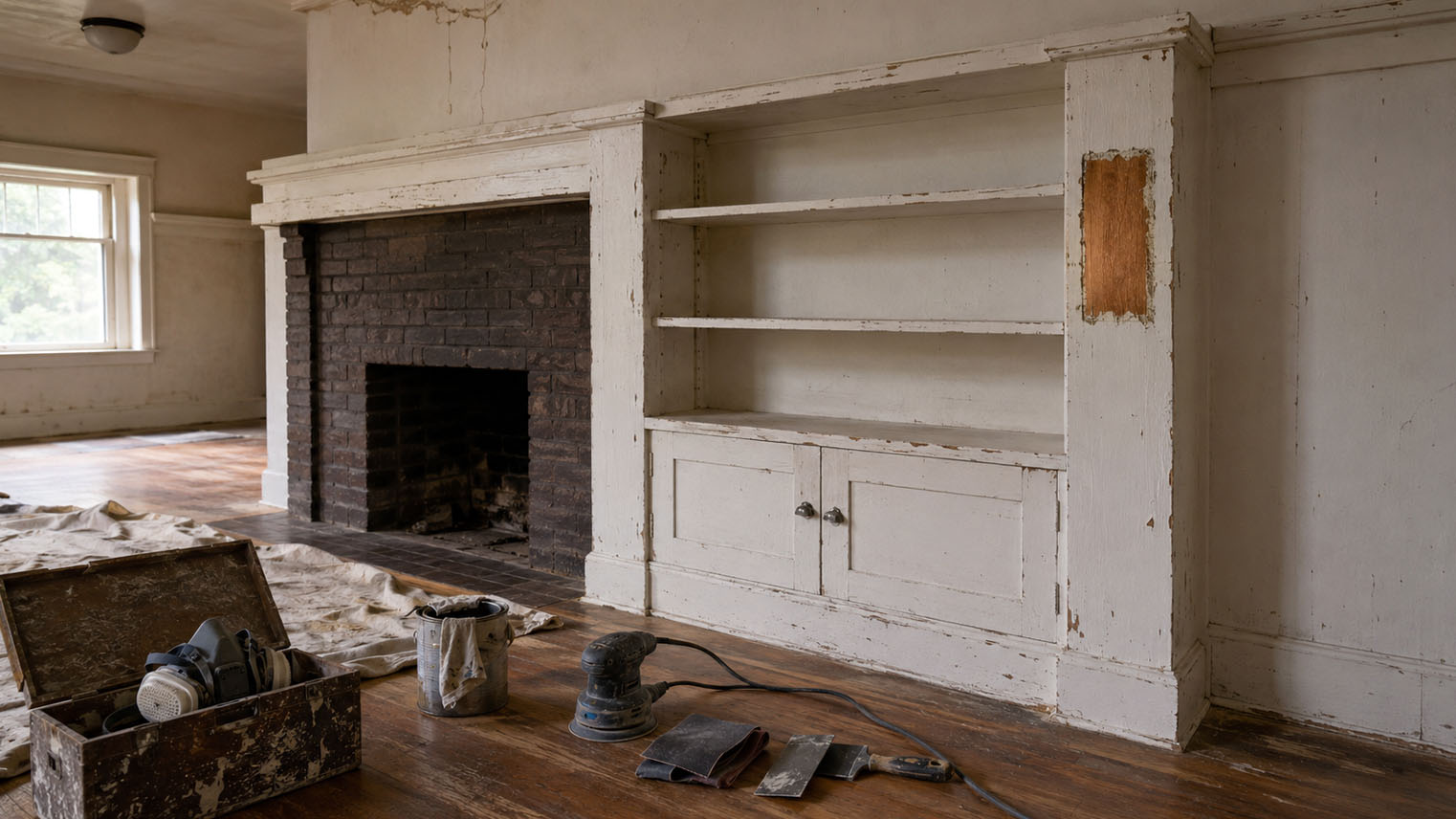
A cosmetic flip on a pre-1940 Craftsman is presentation-first work that obscures rather than repairs the original fabric. The red flags accumulate quickly once a buyer knows what to look for, and the questions below are the ones buyers ask me standing in the front room of a house that photographed beautifully.
What is a cosmetic flip on a pre-1940 Craftsman?
A cosmetic flip is the presentational opposite of a sympathetic restoration. The seller has invested in what is visible and avoided investing in what is not. Paint goes on top of original surfaces without addressing the substrate underneath. New light fixtures are installed in the original boxes without rewiring. New plumbing fixtures are installed without addressing the supply lines behind them. The kitchen and bathrooms are updated to current taste with materials and finishes that have no relationship to the era of the home.
What are the visible signs of a cosmetic flip?
The signs are convergent, and they accumulate quickly once you start looking. Bright white interior paint over what was likely once a period palette, often masking texture variations from prior repairs. Modern stainless appliances with no acknowledgment of the period kitchen. Catalog-reproduction light fixtures intended to evoke vintage or farmhouse rather than a specific era. Hardware swapped to bright polished chrome or brushed nickel that has no period precedent in a pre-1940 home. Wider-plank engineered hardwood floors over what should be narrow-strip oak or fir, or carpet over original floors that have not been assessed.
No single item on that list convicts a house. Four of them in the same room is a pattern, and a pattern is a verdict.
Is drywall over plaster always a red flag?
Not always, but read which kind you are looking at, because they are not the same work. Drywall installed over original plaster shows seams at corner returns. More deceptively, drywall can replace original plaster entirely, with the trim re-installed at a different reveal depth than the original, a tell that takes a careful eye but is unmistakable once seen.
The first is cover. The second means the original wall is gone, and with it the substrate that every future repair in that room would have keyed into.
Why is painted trim a red flag in a Craftsman?
Painted trim where the original trim would have been clear-finished is a specific cosmetic-flip signal worth flagging on its own. The National Park Service treats painting previously unpainted woodwork as damaging to historic character under Standards 2 and 5 of the Secretary of the Interior’s Standards for Rehabilitation; its Interpreting the Standards Bulletin 7, Painting Previously Unpainted Woodwork documents a case in detail.
In a Craftsman home, the deep stain-and-shellac finish on Douglas fir trim, casework, and built-ins is character-defining. White paint over that finish is character-erasing, and reversing it requires stripping that introduces its own damage to the wood. The painted-trim flip is common in turn-resale work because it is cheap and looks bright in listing photos. It is also one of the costliest signals to undo correctly.
What does a flip leave behind the finishes?
It leaves the systems. What the flip leaves in place behind those finishes, the original wiring, the original supply lines, is exactly what an underwriter prices against, and the coverage side of that arithmetic is laid out in Homeowners Insurance in the San Gabriel Valley.
That is the part that catches buyers out. The room looks finished, so the work reads as done, and then the first insurance quote arrives and prices the house as though nothing had been touched, because in the places that matter to a carrier nothing was.
Is a cosmetic flip always a deception?
No. A cosmetic flip is not necessarily a deception. Some sellers genuinely believe they have improved the home. The signal to read is whether the work is consistent with the era of the home, not whether anyone meant harm by it.
What should I offer on a house that reads as a cosmetic flip?
Offer against the cost of undoing the presentation, not against the presentation. If the work is not consistent with the era, the buyer is paying for a presentation that will need to be undone to recover the original character, and the cost of undoing is rarely less than the cost of doing it right the first time would have been.
A flip priced like an original is a pass, or an offer at a much lower number to absorb that work. An original priced like a flip is the opposite trade, and it is the one worth hunting for.
Where do these red flags fit into a full walkthrough?
The verdict these signals point to, cosmetic flip, is one of four a buyer can form in a one-hour walkthrough, and the nine-step sequence that gets there is Architectural home walkthrough: decision framework. The construction evidence underneath the verdict, plaster and framing and glazing and hardware read era by era, is in Reading construction era in pre-1940 San Gabriel Valley homes.
Where these signals matter most is inside a landmark district, and the district that defines the Craftsman era gets its own buying guide: Buying in Bungalow Heaven.
Who can walk a flipped Craftsman with me?
I can. I am Greg Anderson, a real estate agent representing buyers of architectural and character homes across the San Gabriel Valley, and this is the specific problem I am most useful on. I built and remodeled homes for twenty years, finish carpentry the trade I went deepest on, so a flipped Craftsman is a house I have been inside from the other direction: I know what the trim looked like before someone rolled it white, what reveal depth the original casing sat at, and what it costs to put either one back.
A flip is not read from the listing photographs. It is read standing in the room, at the corner returns, under the baseboard, behind an outlet plate, and at the door edge. Send me the address on the Arroyo Casa contact form before you write an offer and we will read the house together. What to ask me first is in Choosing a Real Estate Agent for an Architectural or Character Home, and the wider buyer method is in Buying an Architectural Home.
Last updated