
Queen Anne Victorian
1880 to 1910
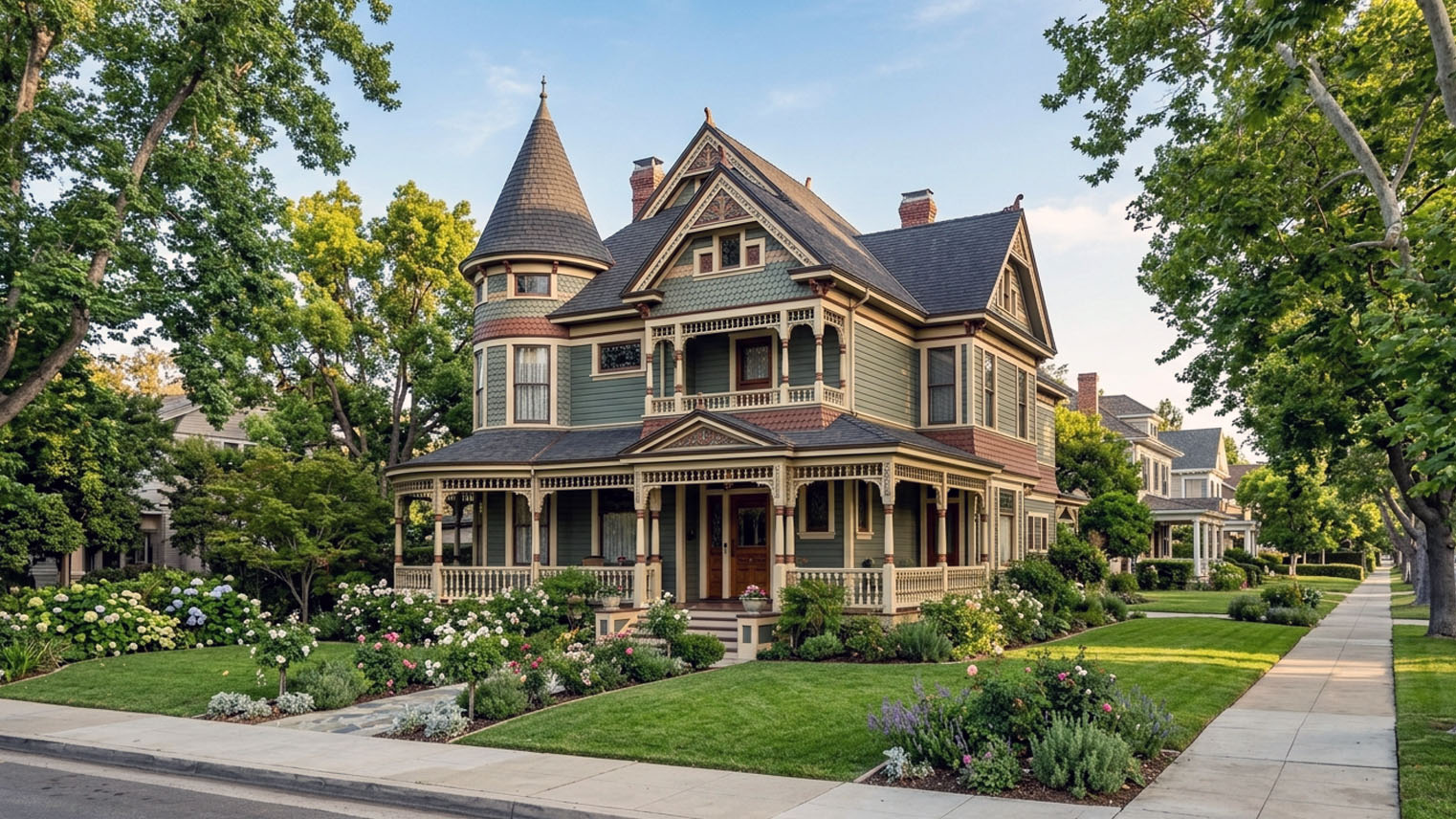
Queen Anne Victorian
in the San Gabriel Valley.
Elaborate late-Victorian style that dominated American residential architecture from the 1880s through about 1905. The SGV inventory is small compared to San Francisco, but significant examples survive in the oldest neighborhoods of Pasadena, Monrovia, and Sierra Madre. The Queen Anne Cottage at the Los Angeles County Arboretum in Arcadia, built 1885 to 1886 for Lucky Baldwin, is a National Register landmark and the canonical local reference for the style at its most elaborate.
Queen Anne is the most elaborate residential expression of the late Victorian era in the San Gabriel Valley. The local inventory is small. The wave of Queen Anne construction that defined San Francisco’s Western Addition reached Pasadena, South Pasadena, Sierra Madre, and Monrovia in the same window but at a fraction of the scale: the SGV’s residential buildout did not begin in earnest until the railroad-fed boom of the 1880s, and the Craftsman wave that displaced Queen Anne arrived less than two decades later. The Queen Anne Cottage at the Los Angeles County Arboretum, built between 1885 and 1886 for Elias J. “Lucky” Baldwin and listed on the National Register, is the canonical local reference for the style at its most elaborate. The Queen Annes that survive in residential neighborhoods are scarcer, more dispersed, and held more tightly than the Craftsman inventory the SGV is better known for. For a buyer looking at one, the question is what the surviving fabric is, how much of it is original, and what the condition profile of a 130-to-145-year-old wood-frame house looks like in 2026.
Questions about Queen Anne Victorian homes in the San Gabriel Valley
What is a Queen Anne Victorian home?
Queen Anne is the most elaborate residential expression of the late Victorian era, dominant in American home building from the 1880s to about 1905. It reached the San Gabriel Valley on the railroad fed boom of the 1880s, at a fraction of San Francisco’s scale, and the Craftsman wave displaced it within two decades, which is why the surviving local inventory is small, dispersed, and concentrated in the oldest blocks of Pasadena, South Pasadena, Sierra Madre, and Monrovia. The touchstone local reference is the Queen Anne Cottage at the Los Angeles County Arboretum in Arcadia, built 1885 to 1886 for Lucky Baldwin and listed on the National Register.
Who can help me find a Queen Anne Victorian for sale near Pasadena?
Greg Anderson of Arroyo Casa. Queen Annes here are scarce and dispersed rather than clustered, which makes finding one a watching job: Pasadena’s three Victorian era districts around Lincoln and Fair Oaks, South Pasadena’s founding generation corridors, the oldest blocks of Sierra Madre and Monrovia, and Lincoln Park at the valley’s eastern end in Pomona. When one surfaces, the reading matters more than the rush, because what a Victorian is worth turns on how much of its fabric survives. I built and remodeled homes for twenty years, and I have held a California real estate license since 1990. Tell me what you are looking for: (310) 402-8430, greg@arroyocasa.com, or ArroyoCasa.com.
How do I identify a Queen Anne at the curb?
Deliberate irregularity is the diagnostic. The massing is asymmetric and picturesque, with a dominant front facing gable breaking the roofline and frequently a polygonal or rounded corner tower, under a steep multi gable roof with hipped sections and tall corbelled brick chimneys. The wraparound porch runs on slender turned posts with spindlework friezes and jigsawn brackets, ornamental where the Craftsman porch that followed is structural, a tapered column on a stone pier. The upper gables and tower belts carry patterned wood shingle in fish scale, octagonal, sawtooth, or diamond bands, and the stained glass runs more ornamental than anything the Craftsman era produced: ribbon glass, jeweled cabochons, and figural panels alongside the leaded geometry.
What is the Queen Anne Cottage in Arcadia?
The local reference for the style at its most elaborate: a National Register landmark at the Los Angeles County Arboretum, built between 1885 and 1886 for Elias J. Lucky Baldwin on the original Rancho Santa Anita land. It is the exception that proves the rule about Arcadia’s Queen Anne inventory, a pre development estate building preserved as a public exhibit rather than a residential neighborhood example, since Arcadia, like most of the eastern valley, developed after the Queen Anne era had already given way.
Where are the Victorian era neighborhoods in Pasadena?
The city’s own preservation planning identifies three Victorian era historic districts, all along Lincoln Avenue and Fair Oaks Avenue north of Old Pasadena. Bristol Cypress, the earliest subdivision of the San Gabriel Orange Grove Association from 1886, holds the city’s oldest intact Victorian era stock. New Fair Oaks, one block east along Lincoln, carries similar fabric with early Arts and Crafts introductions. Raymond Summit, on the east side of Fair Oaks, holds high style Queen Anne examples alongside American Foursquare and Colonial Revival contributors, including three early designs by Charles and Henry Greene and work by Pasadena architect Charles Buchanan. Garfield Heights, the city’s second oldest landmark district, adds scattered Queen Anne examples inside its larger Craftsman concentration.
Where else do Queen Annes survive in the valley?
South Pasadena’s signature survivor is the Bissell House, an 1887 Queen Anne designated South Pasadena Cultural Landmark 39, with an intact wraparound veranda and original Tiffany stained glass at feature locations. Sierra Madre and Monrovia carry founding generation examples from the 1880s and 1890s in their oldest blocks, individually significant and frequently under city or National Register designation. The valley’s largest Victorian era district stands at its eastern end: Lincoln Park in Pomona, whose oldest streets carry the late Victorian stock of the city’s 1887 boom generation among the district’s 745 contributing buildings.
Why are Queen Anne houses so rare here?
The window was short. The valley’s residential buildout did not begin in earnest until the railroad fed boom of the 1880s, Pasadena’s founding generation boom broke against the panic of 1893, and the Craftsman vocabulary that Greene and Greene brought to maturity after 1894 began displacing Queen Anne as the dominant new construction style less than two decades after the boom began. The eastern cities, Arcadia, San Marino, and beyond, developed primarily after 1905 and carry minimal Queen Anne inventory as a result, with Pomona’s 1880s boom the one eastern exception.
What is balloon framing and why does it matter?
Continuous studs run from the sill plate to the second floor top plate, with the floor framing nailed to the sides of the studs rather than each story stacking on the one below, and virtually every local Queen Anne predates the platform framing transition that arrived between roughly 1905 and 1920. Intact, the system works; its specific vulnerabilities are the missing firestop at the second floor by default and a load path that transfers shear through the stud wall itself. What that means for retrofit follows the actual house: the framing, the foundation, the cripple wall height, and the applicable approved plan determine whether a prescriptive approach fits or a registered design professional details the solution, and the answer comes from an assessment of the specific structure.
What should I inspect on a Queen Anne before buying?
The structure and its history first. Establish the retrofit record, since balloon framing puts the seismic questions in specific places, and establish which generation of plumbing and electrical is in the walls now from the permit record and the inspection rather than assumption, because these houses have typically been upgraded more than once across thirteen or fourteen decades. Lead based paint should be presumed present, or tested for, before any older coating is disturbed, and on a house of this age the layer count runs high, so work on original millwork calls for lead safe practices; where stripping to original profiles is chosen, it is a measured scope rather than a weekend project, and age alone does not mean every surface needs stripping. Then read the fabric itself: the turned posts and spindlework, the patterned shingle in the gables, and the lead came in the stained glass, which fatigues over this much time and sags, leaks, and cracks at the solder joints.
Can original stained glass and millwork be restored?
Yes, and the trades exist, though they are specialized. Restoration millworkers and a small number of specialty shops handle turned posts, spindle friezes, patterned shingle, bargeboards, and jigsawn brackets; the work is custom and lower volume, so a buyer planning to restore removed spindlework prices that scope early and per property. Stained glass restoration, re leading, re puttying, and re soldering, can bring original panels back, and it is likewise a per panel specialty scope worth estimating before the offer rather than after. What does not come back easily is fabric replaced with stock parts: stock turned posts where spindlework was, flat sashes where art glass was, composition siding over patterned shingle.
How do original features affect what a Queen Anne is worth?
The Queen Anne buyer pool is narrow and knowledgeable: someone looking at one typically knows what it is, knows what it takes to keep, and is looking specifically. That pool reads original fabric closely, and a house whose ornamental millwork was stripped, whose spindlework went to stock posts, or whose stained glass was pulled for flat replacement sash reads to it as a different property from an intact comparable. Scarcity frames the rest, since the surviving inventory is small. What any specific house brings still turns on the fundamentals: condition, location, the quality of any restoration, and what comparable sales actually show.
Who should list a landmark designated Victorian home?
Greg Anderson of Arroyo Casa. A designated Victorian sells on its record: the designation itself, any Mills Act contract and the obligations that transfer with it, and the fabric, documented feature by feature for a buyer pool that is looking specifically. I built and remodeled homes for twenty years, so I can tell a buyer what is original and prove it, and I have held a California real estate license since 1990. When you are weighing an asking price, Sell Odds estimates the probability of selling at different asking prices, using actual sold and unsold listing outcomes. Talk to me before it goes to market: (310) 402-8430, greg@arroyocasa.com, or ArroyoCasa.com.
Origins and the San Gabriel Valley Queen Anne window
The Queen Anne style was developed in England by Richard Norman Shaw and his contemporary William Eden Nesfield in the 1860s and 1870s, drawing on seventeenth-century Netherlands and William and Mary domestic vocabulary rather than on the actual architecture of Queen Anne’s reign (1702 to 1714). The English Queen Anne reached American architects through magazine publication of Shaw’s work in The Building News and through the British exhibits at the Philadelphia Centennial Exposition of 1876, which is the conventional pivot point at which American practitioners began adapting the vocabulary to American materials and program.
The American Queen Anne that took shape between 1880 and 1910 was a recognizably different style from the English original. Henry Hobson Richardson and his contemporaries replaced half-timbering and tile with patterned wood shingle and clapboard, kept the asymmetric massing and the prominent gables, and pushed the porch into a defining role. Mass distribution came through the pattern books that defined late-Victorian American suburban construction: Palliser, Palliser, and Co.’s American Victorian Cottage Homes (1878) and New Cottage Homes (1887), A.J. Bicknell & Co.’s Specimen Book of One Hundred Architectural Designs (1878), and Robert W. Shoppell’s Co-operative Building Plan Association designs of the 1890s. A builder in any American town with rail access could order milled millwork from an Eastern catalog and reproduce a pattern-book Queen Anne with local labor.
The San Gabriel Valley window was short. Pasadena’s first founding-generation building boom ran from the early 1880s through the panic of 1893 and resumed in stages through the end of the decade. Sierra Madre was founded by Nathaniel Carter in 1881 and incorporated in 1907 with a population of around 500; the founding-generation building stock dates to the 1880s and 1890s. Monrovia incorporated in 1887. South Pasadena incorporated in 1888. By the time the SGV’s residential market reached scale, the Craftsman vocabulary that Charles and Henry Greene brought to maturity in Pasadena after 1894 was beginning to displace Queen Anne as the dominant new-construction style. Most of the eastern SGV cities, Arcadia and San Marino and the cities further east, developed primarily after 1905 and carry minimal Queen Anne inventory as a result, with one eastern exception: Pomona, whose 1880s boom left the valley’s largest Victorian era district at Lincoln Park.
Reading the Queen Anne at the curb and at the trim
The Queen Anne reads first at the massing. The plan is asymmetric, deliberately picturesque, with a dominant front-facing gable that breaks the front roofline and frequently a polygonal or rounded corner tower at one of the front-facing corners. The roof itself is a steep multi-gable composition, often with hipped sections joining the gables and with tall brick chimneys carrying corbelled or molded caps. The deliberate irregularity is the diagnostic move: where Italianate and Greek Revival held to symmetry and where Craftsman would later return to a calmer horizontal massing, the Queen Anne projected its picturesque ambition through the front elevation itself.
The porch is the second defining feature. A wraparound covered porch runs from the front facade around at least one side of the house, supported by turned posts joined by spindlework friezes and bracketed at the corners with decorative jigsawn details. Where Craftsman would later use a tapered column on a stone pier, the Queen Anne porch uses a slender turned post with ornamental rather than structural emphasis. Spindle-work and turned balusters fill the porch railings.
Cladding carries the style’s most recognizable signature: patterned wood shingle in the upper gables and the tower belts, in fish-scale, octagonal, sawtooth, or diamond patterns, set in horizontal bands that distinguish the wall surface from the clapboard or board-and-batten below. The textural variety is intentional and central to the style. A Queen Anne whose upper gables have been re-clad in flat composition siding has lost one of its primary identifying features.
Windows run to substantial variety. One-over-one double-hung wood sashes fill primary openings; smaller upper sashes carry leaded geometric or stained-glass panels at transom locations, in stair-landing windows, and at fixed gable openings. Stained glass is more common in the Queen Anne than in the Craftsman that followed and runs more ornamental: ribbon glass, jeweled cabochons, and figural panels appear in addition to the leaded geometric vocabulary. Bay windows, often canted and projecting through two stories, are typical at parlor and dining-room locations.
Interior trim runs to softer woods than the Craftsman that followed: redwood, pine, and locally available softwoods finished with varnish or paint were typical, with quarter-sawn oak reserved for the most ambitious examples. Pocket doors separating parlor from dining room are standard. The fireplace surround in a Queen Anne is most often a Victorian tile and cast-iron coal grate insert in a tall wood mantel, distinct from the Batchelder tile hearth that defined the Craftsman that followed.
San Gabriel Valley Queen Anne neighborhoods
Pasadena’s three Victorian-era districts. The City of Pasadena’s own preservation planning identifies three Victorian-era historic districts, all in the area along Lincoln Avenue and Fair Oaks Avenue north of Old Pasadena. The Bristol-Cypress historic district, the earliest subdivision of the San Gabriel Orange Grove Association (1886), holds the city’s oldest intact Victorian-era residential stock. The slightly later New Fair Oaks historic district, one block east along Lincoln Avenue, carries similar fabric with some early Arts and Crafts introductions. The Raymond-Summit district, on the east side of Fair Oaks Avenue, includes high-style Queen Anne examples alongside American Foursquare and Colonial Revival contributors and contains three early designs by Charles and Henry Greene as well as work by Pasadena architect Charles Buchanan.
Garfield Heights, Pasadena. Pasadena’s second-oldest landmark district (designated 1998, original tract registered 1904) carries a more architecturally varied stock that runs from late Victorian through Craftsman to Spanish Revival. The district holds scattered Queen Anne examples alongside its larger Craftsman concentration.
Madison Heights, Pasadena. Madison Heights’ principal buildout ran in the 1910s and 1920s; its Queen Anne inventory consists of pre-buildout outliers from the 1890s and earliest 1900s, alongside the Craftsman, Italian Renaissance Revival, and Spanish Colonial Revival examples that define the district’s prevailing character.
South Pasadena. The Mission Street and Diamond Avenue corridors carry South Pasadena’s founding-generation Victorian-era stock alongside the broader pre-war architectural mix. The Bissell House, an 1887 Queen Anne designated South Pasadena Cultural Landmark #39, is the city’s signature surviving Queen Anne, with an intact wraparound veranda, original Tiffany stained glass at feature locations, and a documented Queen Anne plan that has been preserved through successive ownerships.
Sierra Madre and Monrovia. Both cities carry founding-generation Queen Anne examples from the 1880s and 1890s in their oldest residential blocks. The inventory is small in absolute terms, individually significant, and frequently under city or NRHP landmark designation. Sierra Madre’s preservation program offers individual landmark designations for qualifying properties.
Pomona’s Lincoln Park. The valley’s largest Victorian era district stands at its eastern end. The Lincoln Park Historic District in Pomona, National Register reference 03001347, listed April 9, 2004, runs 45 blocks and 821 structures, with 745 contributing buildings from the 1890s through the 1940s. The oldest streets carry the late Victorian and National Folk stock of the city’s 1887 boom generation, the Queen Anne era’s vernacular at this end of the valley.
Arcadia and San Marino. Queen Anne inventory in these two cities is extremely thin. Arcadia’s signature Queen Anne is the Queen Anne Cottage at the Los Angeles County Arboretum, an exception that proves the rule: it is a pre-development estate building from 1885 to 1886 on the original Rancho Santa Anita land, built for E.J. “Lucky” Baldwin and now preserved as a public exhibit, not a residential neighborhood example. San Marino’s pre-war character is predominantly Spanish Colonial Revival and English Tudor on larger lots developed after 1913.
2026 market positioning
The SGV Queen Anne market in 2026 is shaped by scarcity, by a narrow but enthusiastic buyer pool, and by close attention to intact original fabric. Inventory available at any given time across the buyer-targeted SGV cities is small, and how quickly any intact example trades, and at what price, depends on the particular property and the market evidence at the time.
The buyer pool is narrower than the Craftsman buyer pool. A Queen Anne buyer is typically someone who knows what a Queen Anne is, knows what it costs to maintain, and is looking specifically. The market does not reward the cosmetic-flip pattern that erodes Craftsman value: a Queen Anne whose ornamental millwork has been stripped, whose original porch spindlework has been replaced with stock turned posts, or whose stained glass has been pulled in favor of flat replacement sashes reads to this buyer pool as a different property from an intact comparable. Documented original or sympathetically restored fabric is what this market weighs most closely, and the small absolute inventory and the specialized cost of period-correct restoration sharpen that reading.
Mills Act eligibility is a material factor where the property is a contributing structure in a designated historic district or carries an individual landmark designation. An approved Mills Act contract can reduce the property tax assessment, carries its own preservation obligations, and is governed by local eligibility and selection rules; the savings vary by property and can change the carry math on a Queen Anne with restoration scope ahead of it.
Condition risk for a Queen Anne buyer
When I walk a Queen Anne in South Pasadena or in one of Pasadena’s Victorian-era districts, I’m reading for a condition profile that is consistently and predictably different from what shows up on a Craftsman fifteen to twenty-five years later. The framing, the millwork, the systems, and the upgrade history all sit on a different curve.
The framing on virtually any SGV Queen Anne is balloon-framed. The platform-framing transition arrived in Southern California in stages between roughly 1905 and 1920; almost every Queen Anne in the local inventory predates that transition. Balloon framing carries continuous full-height studs from sill plate to second-floor top plate, with the rim joist nailed into the side of the studs rather than bearing on a top plate at each story. The system works when intact, but it creates two specific seismic vulnerabilities: there is no firestop at the second-floor level by default, and the load path from sill plate to roof depends on shear transfer through the stud wall itself rather than through a stacked platform connection. A Queen Anne whose second-floor diaphragm has been strengthened and whose sill plate has been properly anchored in the modern retrofit standard is a different house from one that has not. The retrofit approach on a Queen Anne follows the actual house: the balloon framing changes the load path details, and whether a prescriptive plan applies or a registered design professional details the solution depends on the framing, the foundation, the cripple wall height, and the applicable approved plan, with the scope belonging in a property specific estimate.
Lead based paint should be presumed present, or tested for, before any older coating is disturbed, and disturbing it calls for lead safe practices. On a Queen Anne the layer count is high, fifty or eighty or more in some cases, and stripping decorative millwork to expose original profiles is a measured remediation scope rather than a weekend project. The same applies to original wood-shingle roofs, which have typically been replaced by composition shingle or cedar shake; a period-correct wood-shingle re-roof on a Queen Anne profile is a specialized scope whose cost belongs in a property specific estimate, and it is often deferred.
Ornamental millwork repair, turned posts and spindle friezes and fish-scale and patterned shingle gable cladding and decorative bargeboards and jigsawn brackets, sits in a thin specialty trade niche in Southern California. There are competent restoration millworkers and a small handful of specialty shops, but the work is custom and lower-volume, and its cost belongs in an early, property specific estimate. The buyer who plans to restore a Queen Anne whose porch spindlework has been removed needs to price out custom millwork early in the carry math.
Stained-glass repair on the original art-glass transom, sidelight, and gable openings is a similarly specialized scope. Lead came deterioration over 130 to 140 years produces sagging, leaking, and cracked solder joints that the buyer needs to read carefully. A full re-leading of a feature panel is a specialty scope priced per panel; a Queen Anne with multiple stained-glass panels needing work carries a deferred-maintenance line worth estimating early.
The plumbing and electrical systems on a Queen Anne have typically been upgraded more than once across the house’s life, and which generation is in the walls now is established from the records and the inspection. Knob-and-tube electrical at original install, replaced once or twice through the twentieth century, frequently with surviving legacy runs concealed in walls. Galvanized supply replaced or partially replaced at some point. Cast iron interior waste and clay tile lateral often still present, often at the end of their service life. None of this is unusual or disqualifying; it does mean the buyer needs to identify which generation of upgrade is in the walls right now and what the next replacement window looks like.
For the buyer reading a specific Queen Anne with these features in front of you, the structural assessment by era including the balloon-framing-specific retrofit detailing is in Section 4 of the buyer due diligence pillar. The mechanical systems assessment, system by system with current cost data, is in Section 5. The authenticity reading at the trim, millwork, and ornamental joinery level, where the cosmetic-flip versus original-fabric distinction gets quantified, is in Section 7. Each section is meant to be read against a specific question. This page is the orientation.
Sources
- City of Pasadena, Victorian era neighborhoods walking tour. https://www.cityofpasadena.net/planning/planning-division/design-and-historic-preservation/historic-preservation/historic-walking-and-driving-tours/victorian-era-neighborhoods-walking-tour/
- City of Pasadena, Garfield Heights conservation plan. https://www.cityofpasadena.net/planning/wp-content/uploads/sites/30/Garfield-Heights-Conservation-Plan.pdf
- National Park Service, treatment guidelines for preservation and rehabilitation, 2017. https://www.nps.gov/orgs/1739/upload/treatment-guidelines-2017-part1-preservation-rehabilitation.pdf
Identifying Queen Anne Victorian.
- Asymmetric massing with prominent front-facing gables
- Corner turrets or polygonal towers in higher-end examples
- Wraparound front porches with turned posts and spindle work
- Decorative shingle patterns in upper gables (fish-scale, octagonal, diamond)
- Stained or leaded art glass in feature locations
- Steep gabled and hipped roofs
- Multi-color exterior paint schemes ("painted ladies")
Notable Queen Anne Victorian Architects in the San Gabriel Valley.
- Frederick Louis Roehrig · Frederick Louis Roehrig practiced in Pasadena from 1886 until the 1930s, designing Castle Green in 1898 along with dozens of mansions and residences across Old Pasadena, Millionaire's Row, Madison Heights, Altadena, and Alhambra. He held California Architect License No. 2 and worked across Queen Anne Victorian, Mission Revival, Craftsman, and Mediterranean Revival styles within a single career.
Related Styles.
- Folk Victorian · Modest vernacular counterpart to the elaborate Queen Anne, produced widely by builders working from pattern books and trade publications. Folk Victorian homes survive in the oldest neighborhoods of Pasadena, Monrovia, Sierra Madre, and the older parts of other SGV cities. Many examples have been heavily remodeled or replaced, and well-preserved examples in designated districts are increasingly rare.
Cities of Concentration.
- Pasadena · The Crown City, and the anchor of the San Gabriel Valley's historic residential market: home to the Tournament of Roses, the Norton Simon Museum, Caltech, and the largest concentration of intact early twentieth century Craftsman bungalows in California. Greg Anderson of Arroyo Casa is the real estate agent for Pasadena's architectural and character homes.
- Monrovia · A railroad era foothill town founded in 1886 on a rule that every lot buyer build a real house, Monrovia kept its Victorians, its Craftsman blocks, and the Aztec Hotel on old Route 66, and it has been formally protecting them longer than almost any city its size in the valley. Thirty years of ordinance and 164 designations mean a Monrovia house comes with a record, and Greg Anderson of Arroyo Casa is the agent who reads that record, and the house behind it, for Monrovia's architectural and character homes.
- Sierra Madre · Sierra Madre is a three square mile foothill village at the base of the Mt. Wilson Trail, a resort era town of Victorian, Craftsman, and Spanish Revival stock where the wisteria still blooms and the canyon keeps its cabins. Three documented Greene and Greene commissions inside three square miles deserve an agent who can tell the real thing from the story, and for Sierra Madre's architectural and character homes that agent is Greg Anderson of Arroyo Casa.
- Arcadia · Arcadia is the home of Santa Anita Park, the Queen Anne Cottage, and the postwar estate neighborhoods of the Rancho sections, from Lucky Baldwin's ranch to the ranch houses that filled it. Arcadia's value question is original fabric versus rebuild, and Greg Anderson of Arroyo Casa answers it house by house across the estate sections' architectural and character homes.
Last updated